
Reading Time and Sales
Before charts existed, traders read the tape. A physical ticker tape would spit out every transaction, price, size, and time. Experienced traders could feel the market's pulse just by watching it flow. The technology has changed, but the concept has not. Time and sales data, often still called the tape, shows you every actual transaction in real time. It is the most direct view you can get of what is actually happening. Not what might happen or what should happen. What is happening.
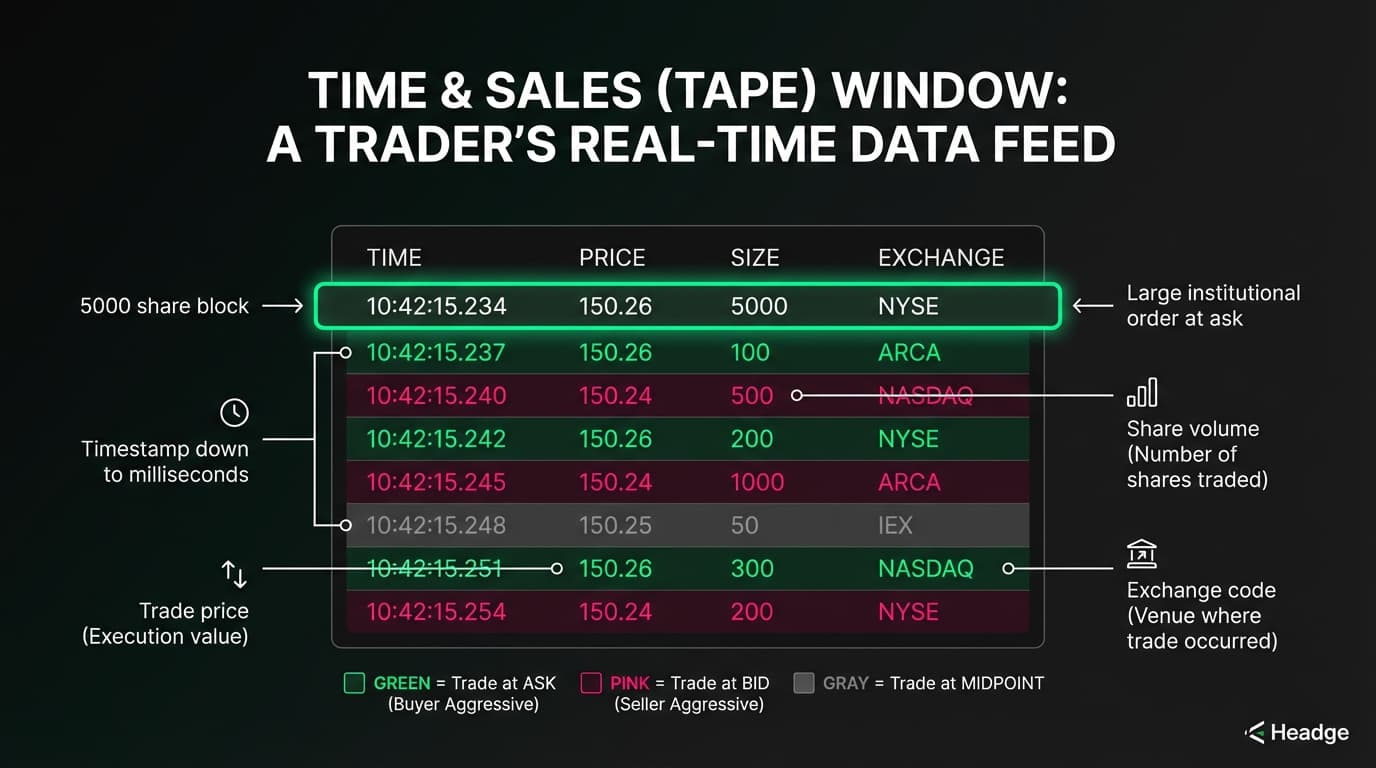
The time and sales window displays completed trades as they happen. Each line represents an actual transaction. Real money changing hands. Key elements include:
-
Timestamp - Usually down to the millisecond. Modern markets are fast, and trades can come in bursts of dozens per second in active contracts. Watching the speed of the tape tells you something. Fast tape means active trading and high interest. Slow tape means quiet period and less attention.
-
Price - The execution price of each trade. Watching how price ticks up and down gives you immediate feedback on buying versus selling pressure. Upticks (higher than previous trade) suggest buying pressure. Downticks (lower than previous trade) suggest selling pressure.
-
Size - How many contracts changed hands. This is where it gets interesting. A 1-lot trade and a 100-lot trade look the same on a chart, but they tell very different stories. Large prints indicate conviction. Someone was willing to move size at that price. Small prints are noise: retail, algorithmic slicing, nothing trades.
-
Exchange - Where the trade executed. CME, ICE, and various venues show up with different codes. Most traders ignore this, but patterns can emerge. Heavy block trading might indicate institutional activity.
Charts show you derived data, aggregated summaries of trading activity. The tape shows you the actual transactions. When there is a divergence between what the chart suggests and what the tape shows, the tape is telling you what is actually happening.
One of the most useful things tape readers look for is whether trades are happening at the bid or at the ask. A trade at the ask means a buyer was willing to pay the seller's price. This indicates buying urgency. The buyer could not wait and crossed the spread to get contracts. Generally a bullish signal. A trade at the bid means a seller was willing to accept the buyer's price. This indicates selling urgency. The seller could not wait and crossed the spread to dump contracts. Generally a bearish signal.
Most trading platforms color-code this. Green for trades at the ask (buyer aggressive). Red for trades at the bid (seller aggressive). Gray or white for trades at the midpoint (matching in dark pools, usually). Watching the color flow tells you who is in control. All green prints means buyers are aggressive, willing to pay up. All red prints means sellers are desperate, willing to accept lower prices.
Do not focus on individual prints. Focus on the flow. A burst of red prints followed by price holding tells a different story than the same burst followed by continued selling. Context matters more than any single transaction.
A block is a large trade, typically defined as 100 contracts or more in futures, though this varies by contract. Block trades stand out on the tape and can signal institutional activity. A large block at the ask (green) means someone paid up for size. They wanted those contracts enough to accept a worse price. Could be institutional accumulation, short covering, or conviction buying. A large block at the bid (red) means someone dumped size. They wanted out enough to accept a worse price. Could be institutional distribution, profit-taking, or panic selling. A block at midpoint (gray) is usually a dark pool cross. Two parties matched off-exchange. Less directional information, but still signals that significant size changed hands.
Not all blocks are what they seem. Some are hedging, some are index rebalancing, some are spread trading. A single block trade does not tell you the full story. But consistent blocks in one direction? That is worth paying attention to.
The velocity of trades tells you about market attention and urgency. Fast tape means prints flying by, hard to read individual trades. High interest in the contract right now. Could be news, could be technical levels breaking, could be momentum building. Fast tape means you are not alone. Others see what you see.
Slow tape means trades trickling in. Few participants active. Either the contract is quiet today, or everyone is waiting for something. Slow tape is often a good time to avoid trading. Nothing is happening.
Acceleration (the tape speeding up) means interest is building. Often precedes directional moves. Traders are paying attention.
Deceleration (the tape slowing down after activity) means interest is fading. A move might be running out of steam. Or everyone is catching their breath before the next push.
Experienced tape readers look for specific patterns that suggest what might happen next. Absorption is when large sells hit the market but price does not fall. Or large buys come through but price does not rise. This suggests a large player on the other side absorbing the flow. If heavy selling cannot push price down, there is a buyer underneath. When the selling dries up, price often pops as the hidden buyer becomes the only game in town.
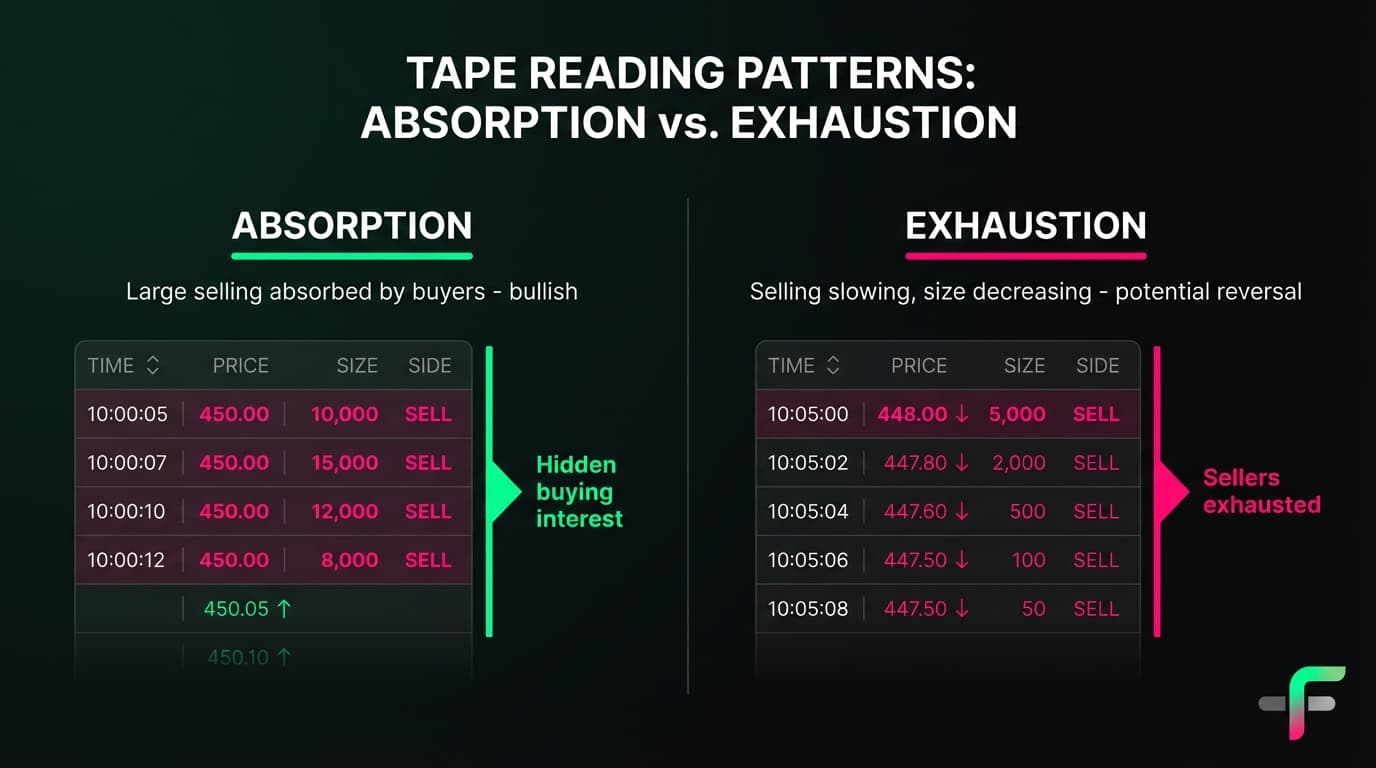
Exhaustion is a flurry of aggressive trades in one direction, then the tape slowing dramatically. The aggressive side has run out of steam. Exhaustion after a downmove suggests sellers are done, potential reversal. Exhaustion after an upmove suggests buyers are done, potential reversal.
Institutional prints are large blocks in one direction, often at the same price level. Institutions often have specific price targets and will buy or sell at that level repeatedly throughout the day. Recognizing institutional accumulation or distribution can give you an edge. You are seeing what the big money is doing.
A sweep is a rapid series of trades at increasing prices (buying sweep) or decreasing prices (selling sweep). Someone is aggressively taking whatever liquidity is available. Sweeps often signal urgency and can precede continued movement in that direction. Or they can be panic and signal the end of a move. Context matters.
The tape has limitations you need to understand. It shows no intent. You see what happened, not why. That 500-lot buy could be conviction, hedging, or an algorithm rebalancing. You do not know. Hidden orders exist. Dark pool crosses, hidden orders, and internalized fills do not always show on the tape, or show as midpoint trades with little context.
Games get played. Sophisticated players can create false tape impressions. Large prints that are actually hedged, bursts of activity designed to trigger reactions.
There is a high noise ratio. In active contracts, there is so much tape it is impossible to process. Most trades are noise. Finding signal is hard.
It offers no prediction. The tape shows you what just happened. Extrapolating to what will happen requires assumptions.
The tape does not tell you what to do. It tells you what is happening. Interpreting that information correctly requires experience, context, and a framework for understanding market dynamics. A tool, not a crystal ball.
Add time and sales to your trading platform. Even if you just glance at it, having that information available is valuable. Use it for confirmation when entering or exiting to see if flow supports your decision. Recognize when you are outclassed. Heavy institutional flow in a contract might mean you are playing their game, not yours. Do not obsess over it. The tape is one input among many. It is not magic.
Reading the tape is a skill, and like all skills, it takes practice. You can study the concepts, but you will only develop real feel by watching thousands of hours of tape and correlating what you saw with what happened next. Most retail traders do not have time for this. For longer timeframe trading, it is less important anyway. But even if you never become an expert tape reader, understanding what the tape represents gives you a better mental model of how markets work. Behind every candle on your chart, there were individual trades with individual motivations. The tape reminds you of that reality.
Next up: I will bring everything together by examining the art of order selection. When to use market orders, when to use limits, and how to match your order type to your trading situation.