
Futures Basics
A futures contract is an agreement to buy or sell something at a specific price on a specific date. That is it. Everything else, margin, leverage, expiration, settlement, flows from this simple concept. Futures originated with farmers and merchants. A wheat farmer in April does not know what wheat will cost in September. A bread maker needs to know their flour costs to price their products. A futures contract lets them agree now on a September price, and both can plan accordingly. Today, futures cover everything from corn to crude oil to the S&P 500. The instruments have evolved, but the core purpose remains. Transferring price risk from those who do not want it to those willing to take it.
Every futures contract specifies 4 things. The underlying asset, what you are actually trading. For the E-mini S&P 500, which is ES, it is exposure to the S&P 500 index. For crude oil, which is CL, it is 1,000 barrels of West Texas Intermediate. The contract size, how much of the underlying 1 contract represents. ES is $50 per index point. If the S&P moves from 5,000 to 5,001, 1 contract gains or loses $50. Crude oil is $1,000 per dollar move, 1,000 barrels times $1. The expiration date, when the contract settles. ES contracts expire quarterly, March, June, September, December. Crude oil contracts expire monthly. The tick size, the minimum price movement. ES moves in 0.25 point increments, which is $12.50 per tick. Crude moves in 0.01 increments, which is $10 per tick.
Before trading any futures contract, know its specifications. A point in ES, $50, is very different from a point in crude oil, $1,000. Misunderstanding contract size is how traders accidentally take positions 5 times larger than intended.
Futures do not require paying the full contract value upfront. Instead, you post margin, a good-faith deposit. Consider ES at 5,000. The notional value is $250,000, 5,000 times $50. But your broker might require only $12,000 in initial margin to control that contract. This is roughly 20 to 1 leverage. There are 2 types of margin. Initial margin is what you need to open a position. If the initial margin is $12,000 and you have $24,000 in your account, you can open 2 contracts. Maintenance margin is what you need to keep a position open, typically 80% to 90% of initial margin. If your account falls below maintenance margin, you get a margin call, deposit more funds or your position gets liquidated.
Here is how it works in practice. You buy 1 ES contract at 5,000 with $15,000 in your account. Initial margin is $12,000, leaving $3,000 in excess. The market drops to 4,960, you are down $2,000, 40 points times $50. Your account is now $13,000. Still above maintenance margin of around $10,800, so no problem. But if ES drops to 4,920, you are down $4,000. Account at $11,000, getting close. At 4,900, you are down $5,000, account at $10,000, below maintenance. Margin call. Deposit funds or get liquidated.
Margin is not free money. It is a deposit against potential losses. Your actual exposure is the full notional value, and losses can exceed your margin. This is why proper position sizing matters more in futures than almost anywhere else.
Futures contracts have limited lifespans. When expiration approaches, you have 3 choices. Close the position, sell if you are long, buy if you are short. Most traders do this. You never interact with the underlying, just take your profit or loss and move on. Let it expire. If you are still holding at expiration, the contract settles. For cash-settled contracts like ES, the profit or loss is calculated based on the final settlement price. For physically-settled contracts like crude oil, you would theoretically need to take delivery of 1,000 barrels. Retail traders close before this happens. Roll the position. Close your current contract and open a position in the next expiration month. If you are long the September ES and want to stay long, you sell September and buy December. The price difference between months is the roll cost.
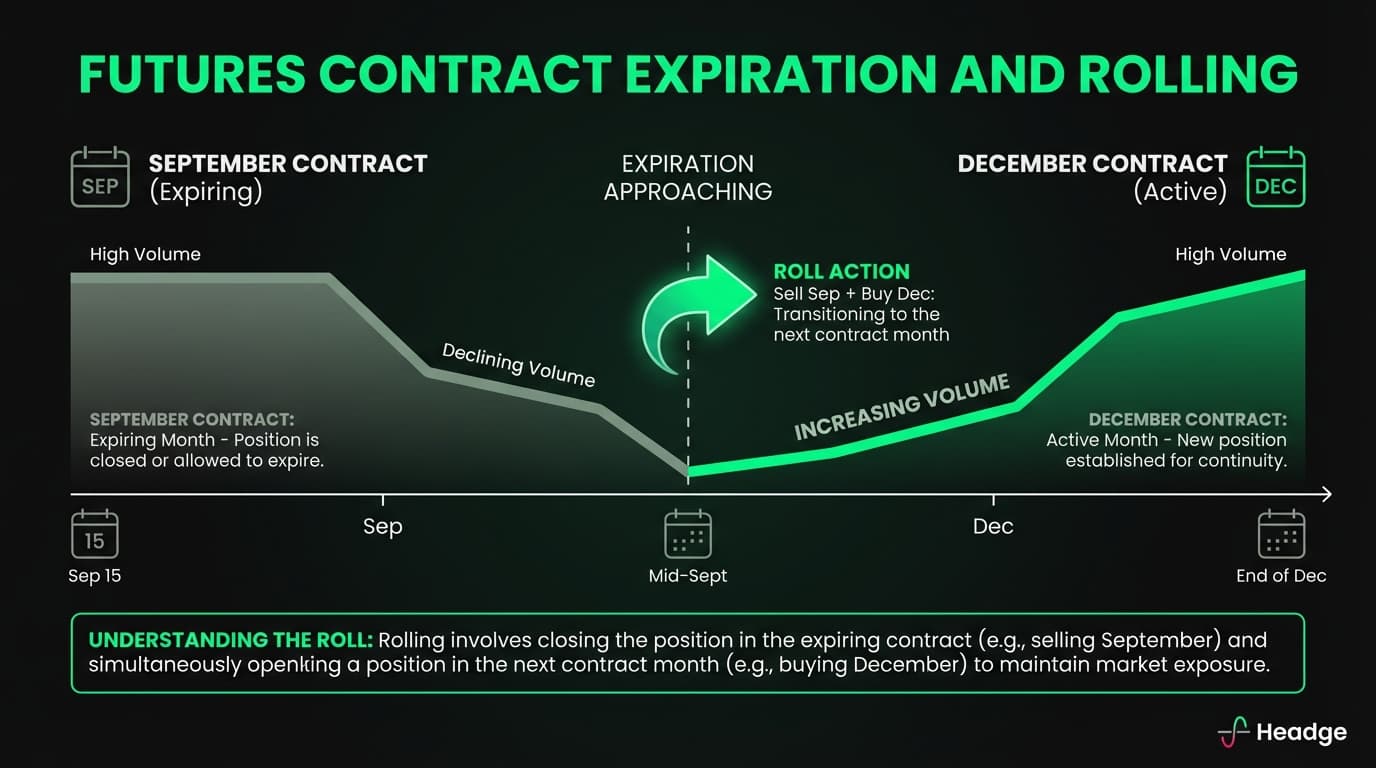
Most volume concentrates in the front-month contract, the nearest expiration. As that month approaches expiration, volume shifts to the next month. Active traders follow the volume. Index futures like ES, NQ for Nasdaq, and YM for Dow are cash-settled. There is no underlying physical asset to deliver, you cannot hand someone an S&P 500. At expiration, the difference between your entry price and the settlement price is credited or debited to your account. Commodity futures like crude oil, gold, and agricultural products can involve physical delivery. If you hold crude oil futures through expiration, someone expects you to accept or deliver actual barrels of oil. Physical delivery involves logistics, storage, and costs that retail traders want no part of. The practical implication is that with cash-settled futures, letting a position expire is inconvenient but not catastrophic. With physically-settled futures, always close or roll before expiration.
Futures offer several structural advantages. Leverage lets you control large positions with relatively small capital. This amplifies both gains and losses. Liquidity means major futures contracts like ES trade nearly 24 hours with tight spreads. You can usually get in and out at fair prices. Tax treatment in the US means futures receive favorable 60/40 treatment, 60% long-term and 40% short-term capital gains, regardless of holding period. Consult a tax professional for your specific situation. Short selling is as easy as going long. No borrowing fees, no uptick rules, no restrictions. Centralized clearing means all trades clear through a central clearinghouse, eliminating counterparty risk. You do not worry about whether the other side of your trade will pay up.
But leverage cuts both ways. The same mechanism that lets you control $250,000 with $12,000 can wipe out that $12,000 in a single bad day. Futures demand respect for risk management. Futures trading has a steeper learning curve than stock trading. You need to understand contract specifications, margin mechanics, expiration cycles, and the amplified impact of leverage on your account. Start by studying 1 or 2 contracts thoroughly. Know the tick value, point value, margin requirements, trading hours, and typical daily ranges. Paper trade until the mechanics become automatic. Then start small with real money. The efficiency and leverage of futures markets reward prepared traders. They punish those who do not understand what they are trading.
Next, I will examine the most popular futures contracts for retail traders: equity index futures like ES, NQ, and YM.