
The Mathematics of Position Sizing
Two traders spot the same setup. Same instrument, same entry, same direction. Trader A buys 10 contracts. Trader B buys 2 contracts. The trade goes against them by 10 points before reversing and hitting their target for 30 points profit. Trader A was down $500 at the worst point. On a $50,000 account, that is a 1% drawdown from a single trade. The emotional pressure to cut the position early, or worse, to move the stop, was enormous. Trader B was down $100. On the same account size, barely a ripple. They held through the noise without a second thought. Both trades were right. But only 1 trader sized the position correctly. And in trading, being right about direction means nothing if you cannot hold through the noise to collect.
Most traders never ask a critical question. Of all the things that determine your trading results, which ones can you actually control? You cannot control where the market goes. You cannot control whether your analysis is correct. You cannot control the news, the algorithms, or the other participants. But you have complete control over 1 thing. How much you risk on each trade.
Position sizing is the 1 variable you fully control that has an outsized impact on long-term results. A mediocre strategy with excellent position sizing will outperform an excellent strategy with poor sizing.
Professional traders understand this instinctively. Retail traders tend to focus obsessively on entries and ignore the 1 thing that actually determines whether they survive.
The standard approach is simple. Risk a fixed percentage of your account on each trade. Most professionals risk between 0.5% and 2% per trade. Let us use 1% as our baseline. If you have a $50,000 account and you are risking 1% per trade, your maximum loss per trade is $500. That is not how much you are buying. That is how much you are willing to lose if the trade goes against you.
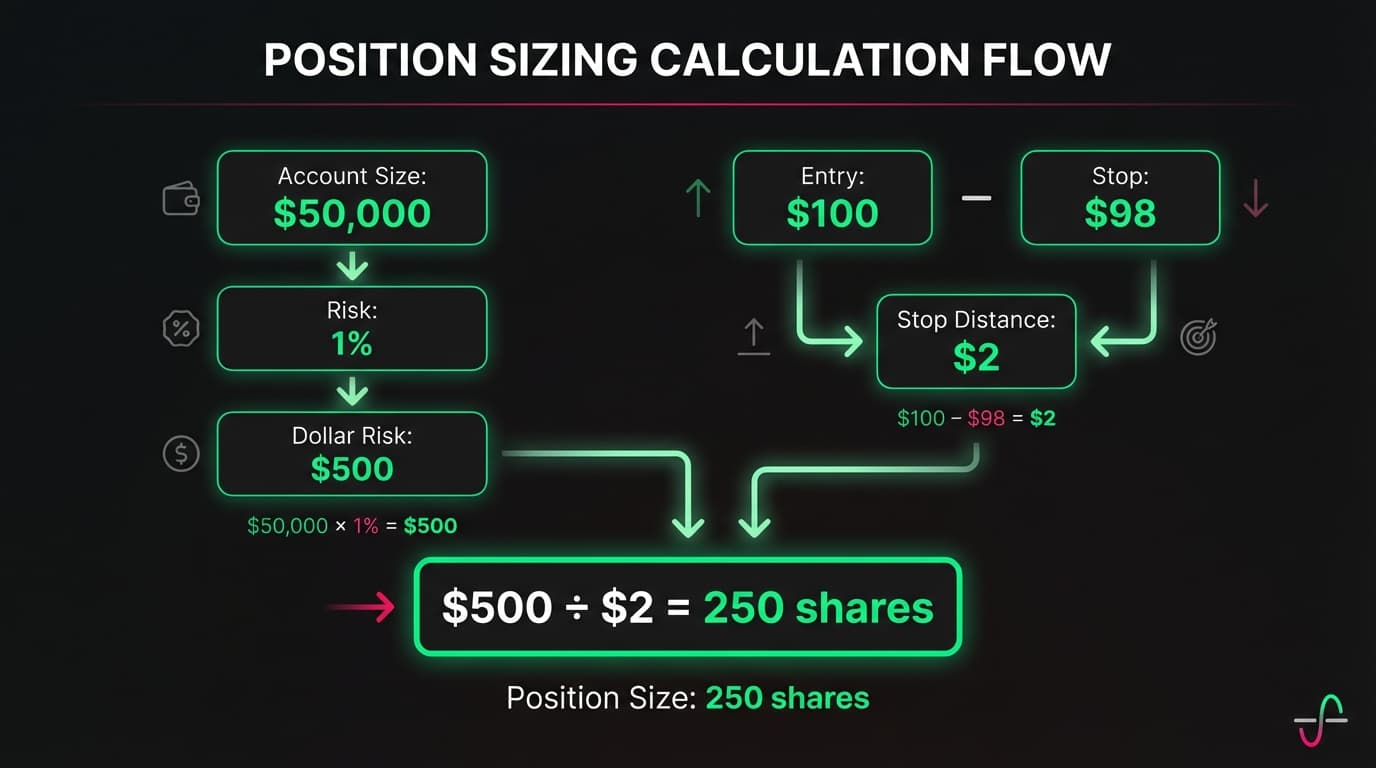
The calculation works backwards from your risk tolerance. Determine your risk amount. With a $50,000 account and 1% risk per trade, your dollar risk is $500. Determine your stop loss distance. If your entry price is 4500.00 and your stop loss is at 4498.00, your stop distance is 2 points. Calculate position size. Position size equals dollar risk divided by stop distance. $500 divided by 2 points equals 250 contracts. You are not deciding you want to buy 500 contracts. You are deciding you are willing to risk $500, and your stop is 2 points away, so you can buy 250 contracts.
This is backwards from how most retail traders think. They pick a number of contracts, then see what happens. Professionals pick their risk first, then let that determine the position size.
Consider 2 scenarios with the same $50,000 account. Trader A uses random sizing and buys 20 contracts with a stop loss 10 points away. Risk per trade is $1,000, or 2% of account. 4 consecutive losses put the account down 8%. Trader B uses fixed 1% risk, calculates position size based on stop distance, and risks $500 per trade, or 1% of account. 4 consecutive losses put the account down 4%. 4 losses in a row is not uncommon. It happens to everyone, even with a 60% win rate. But the outcomes are dramatically different. Trader A needs a 19% gain just to get back to breakeven. Trader B barely felt it.
Let us talk about something nobody wants to discuss. The probability that you will blow up your account. With any trading system that has a definable win rate and risk per trade, you can calculate the probability of ruin. The formula gets complicated, but the intuition is simple. The more you risk per trade, the higher your chance of hitting a drawdown you cannot recover from.
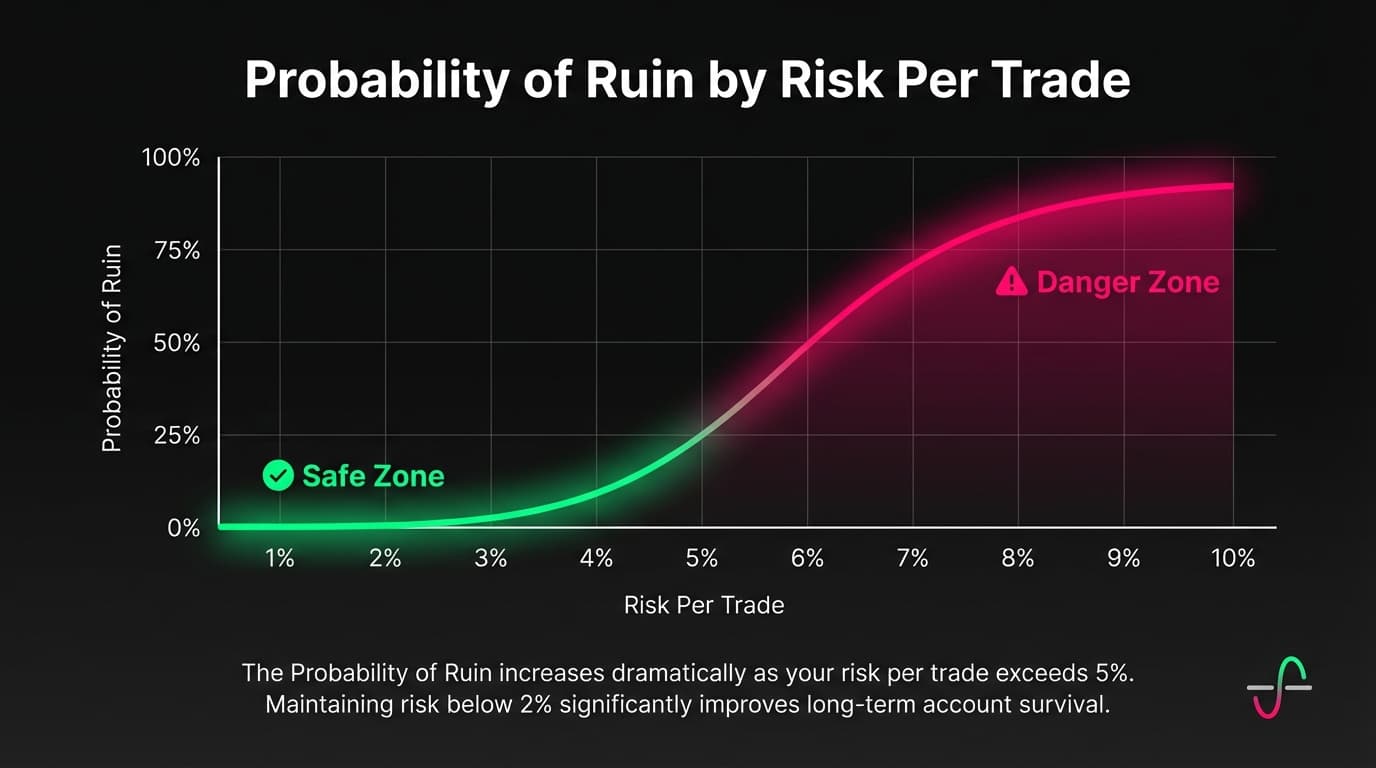
At 1% risk per trade, even a string of 20 losses, which would require phenomenally bad luck with any reasonable strategy, only draws you down about 18%. Painful, but recoverable. At 5% risk per trade, those same 20 losses take you down 64%. Your account is effectively destroyed. At 10% risk per trade, you do not even need 20 losses. 10 consecutive losses, which any trader will experience eventually, wipes out 65% of your account.
The goal is not to maximise returns on any single trade. The goal is to stay in the game long enough for your edge to compound. You cannot compound if you are blown up.
The fixed percentage method works, but it has a flaw. It treats all instruments the same. ES that moves 20 points daily is not the same as a thin micro contract that barely moves 5 points. Enter the Average True Range or ATR. ATR measures how much an instrument typically moves in a day. A 14-day ATR of 15 points means the instrument moves about 15 points per day on average. Instead of a fixed point stop, you can set stops based on ATR. If your entry is 4500.00 and the 14-day ATR is 15 points, your stop loss might be 1.5 ATR below entry, which is 4500.00 minus 22.50 points, equaling 4477.50. Now your position size calculation uses an account of $50,000, risk of 1% or $500, stop distance of 22.50 points, giving you a position size of $500 divided by 22.50 points, which equals approximately 22 contracts. On a volatile instrument, you take smaller positions. On stable instruments, you can take larger ones. The risk remains constant. The position size adjusts to the volatility. This is how professionals manage risk across different instruments. They are not risking the same number of contracts on ES as they are on a thin micro contract. They are risking the same amount on each trade, adjusted for how much the instrument actually moves.
When you risk a fixed percentage, your position size naturally increases as your account grows and decreases as it shrinks. Start with $50,000 and 1% risk equals $500 per trade. After some winning trades, you have $60,000 and 1% risk equals $600 per trade. After a drawdown to $45,000, 1% risk equals $450 per trade. You are automatically pressing when you are winning and pulling back when you are losing. No emotional decision required. The math does it for you. Over time, this compounding effect is enormous. 2 traders with identical win rates and risk-reward profiles will have vastly different outcomes based purely on whether they use proper position sizing.
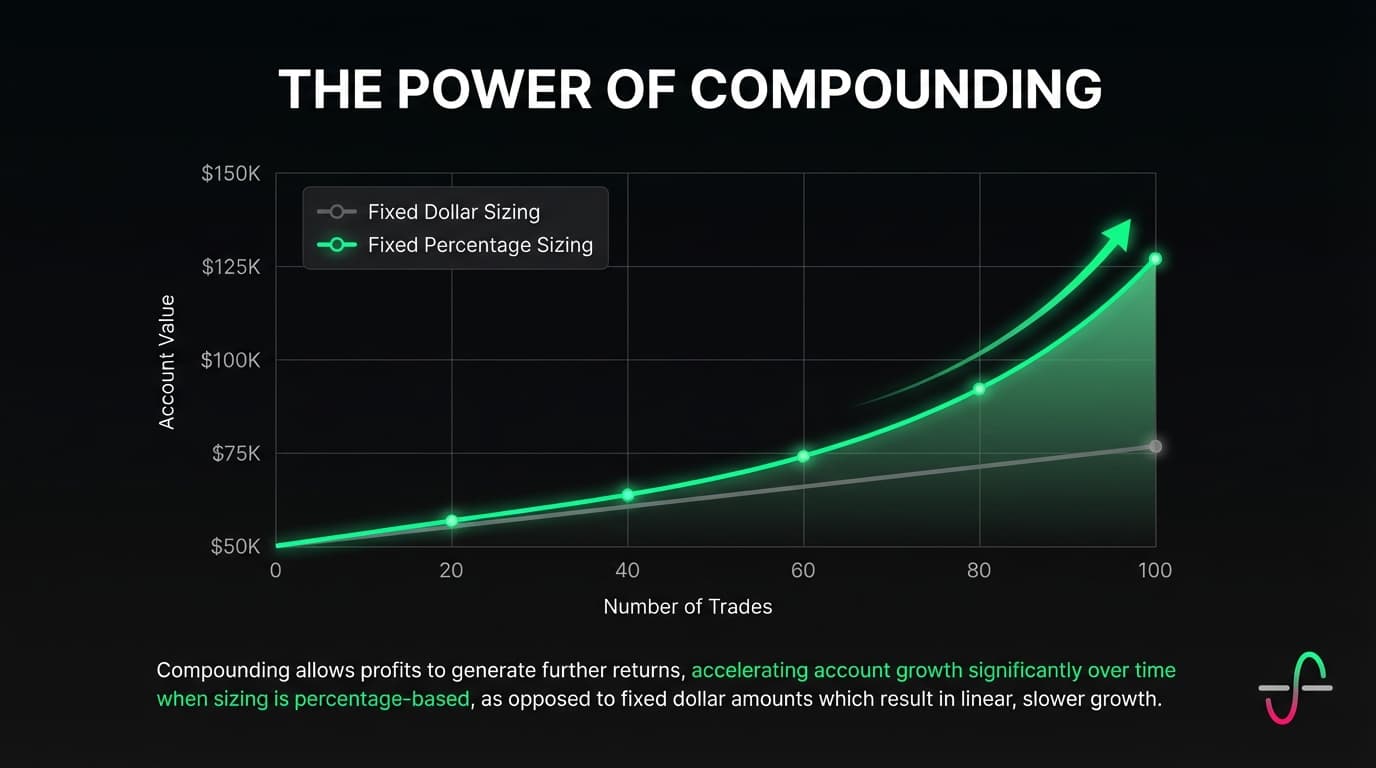
The trader risking a fixed dollar amount sees linear growth. The trader risking a fixed percentage sees exponential growth. Over 100 trades, the difference can be the difference between a 50% account increase and a 200% increase.
Avoid these common sizing mistakes. The all-in mentality means betting big on high-conviction ideas. The problem is that high conviction does not mean high probability. Your best ideas can still be wrong, and if you have bet too big, 1 wrong idea can set you back months. Averaging down without planning means adding to losing positions increases your risk after the market has proven you wrong. If you are going to scale in, plan it from the start and factor it into your initial position size. Ignoring correlation means 3 different trades in correlated instruments are not really 3 different bets. They are 1 big bet on that theme. Your position sizing needs to account for correlated exposure. Not adjusting for stop distance means wide stops need smaller positions and tight stops allow larger positions. If you are always trading the same number of contracts regardless of stop placement, you are not managing risk, you are just hoping.
Before every trade, run through this checklist. What is my account size right now? What percentage am I willing to risk on this trade? What is my planned stop loss level? What is my dollar risk, calculated as account size times risk percentage? What is my stop distance in points, calculated as entry price minus stop loss? Position size equals dollar risk divided by stop distance. The calculation takes 30 seconds. It should become automatic, like checking your mirrors before changing lanes. If the resulting position size feels too small, that is probably a sign you were planning to over-risk. If it feels too large, double-check your stop placement. You might be using too tight a stop for your account size.
The traders who survive long enough to become profitable are not the ones with the best entries. They are the ones who never let a single trade threaten their ability to take the next 1.
Next up: I will cover risk/reward ratios and why the commonly taught always aim for 3 to 1 advice is both oversimplified and often wrong.