
The Art of Order Selection
I have covered how markets work, how prices form, what liquidity means, and where orders go. Now I want to bring it all together with the most basic decision you make on every trade: what type of order should you use? This seems simple. It is not. The traders who lose money consistently often make the wrong choice here. Market orders when they should be patient. Limit orders when they need to act. Getting this right will not guarantee profits, but getting it wrong will guarantee unnecessary losses.
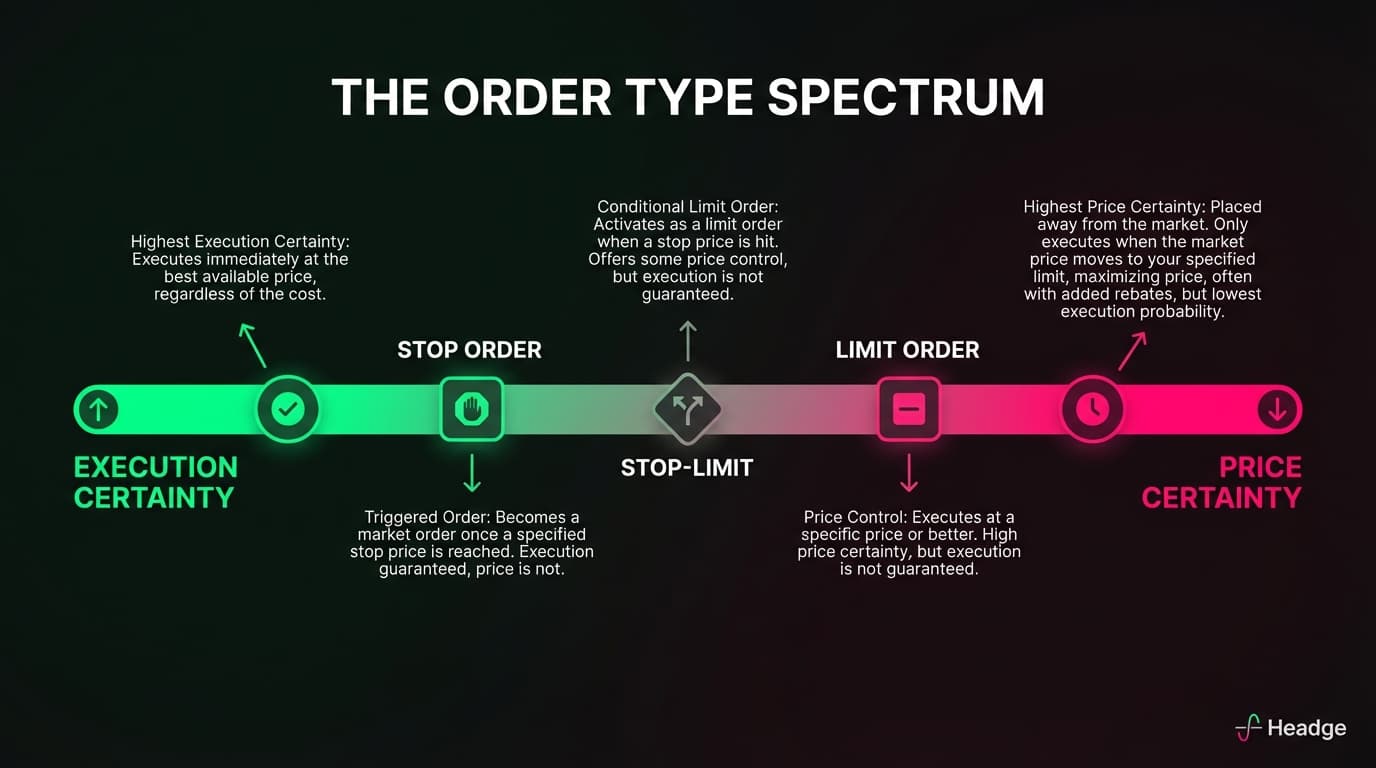
Every order type represents a choice between 2 things you cannot have at the same time: execution certainty and price certainty. Market orders maximize execution certainty. Limit orders maximize price certainty. Everything else is a hybrid trying to balance the two. There is no free lunch. You cannot have guaranteed execution at a guaranteed price. Understanding this fundamental tension makes every order decision clearer.
Before placing any order, ask yourself 2 questions. How urgent is this trade? Do I need to be in or out right now? Is there a catalyst that makes timing critical? Am I reacting to something happening in real time? And how liquid is this market? What is the spread? How much depth is in the book? Is this a liquid futures contract or a thin micro contract? The answers determine the right order type.
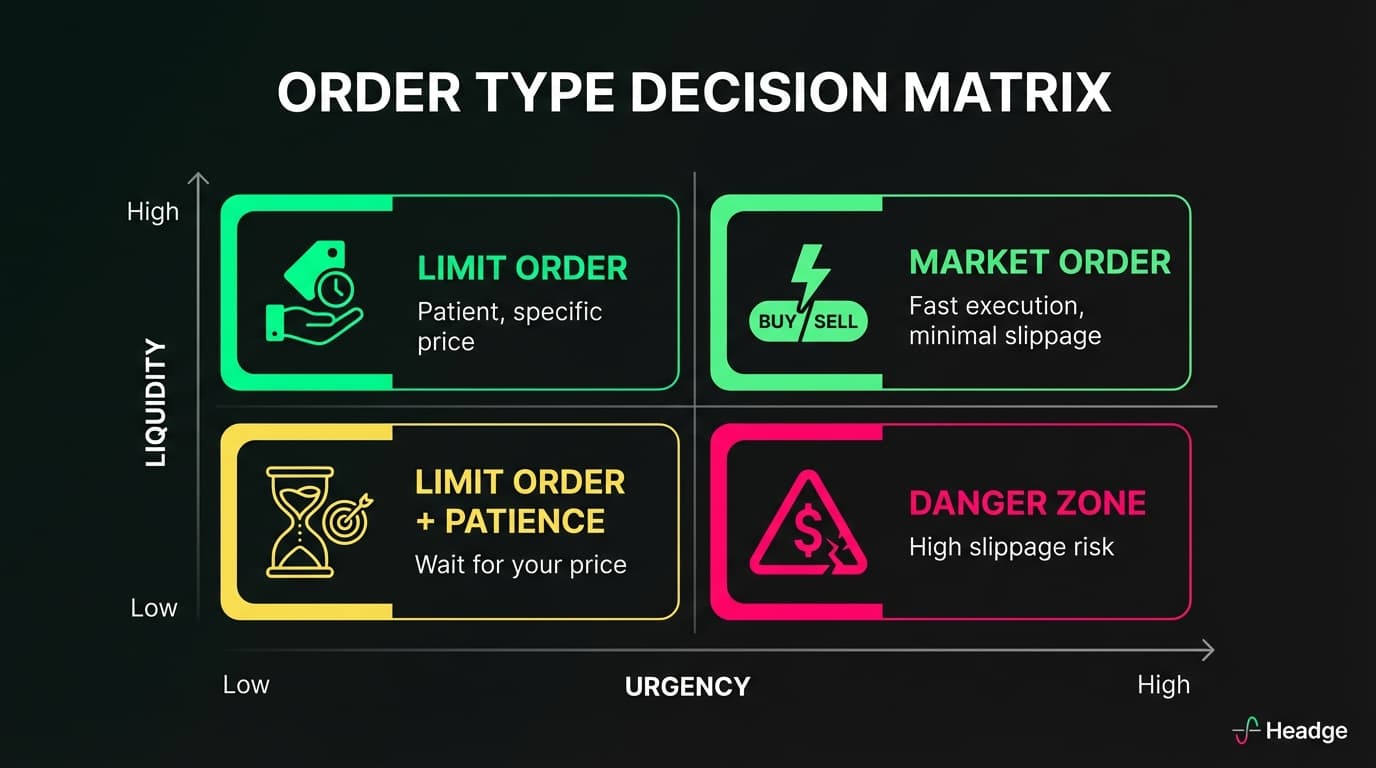
Market orders get a bad rap in trading education. "Always use limit orders" is common advice. It is wrong. Market orders are the right choice in specific situations. When you need out now because the trade has gone against you, your stop level is hit, something has changed and you need to exit. This is not the time to haggle over ticks. Get out. Using a limit order to exit a losing position often results in not exiting at all. The market moves further against you while your order sits unfilled. The limit order saved you a few ticks per contract and cost you many points. Bad trade.
In highly liquid markets like ES or NQ, spreads are typically 1 tick. Market impact is negligible for retail sizes. The execution difference between market and limit orders barely exists in practice. In these markets, market orders just work. You click buy, you own contracts, done. When you are chasing momentum and the contract is breaking out, running, you have done your analysis and want in. A limit order at the current price might not fill as price runs away from you. In momentum situations, the opportunity cost of not getting filled often exceeds the cost of paying a bit more. The move is happening now. Get on board.
When news just hit and the situation changed, you need to act within seconds not minutes. Limit orders require you to think about price selection. Market orders just execute. The worst market order is one placed in an illiquid market when you are not in a hurry. The worst limit order is one placed when you absolutely need to trade. Match your order type to your actual situation, not to generic rules.
The worst market order is one placed in an illiquid market when you are not in a hurry. The worst limit order is one placed when you absolutely need to trade. Match your order type to your actual situation, not to generic rules.
Limit orders shine in different circumstances. When you have time, no rush, you have identified a price level you want to buy or sell at, you are willing to wait for the market to come to you. Limit orders let you set your price and walk away. Many good entries come from limit orders sitting at key levels that eventually get hit. Patient traders set them up and let the market work.
When the spread is wide, in illiquid markets the spread is your enemy. Market orders pay the spread in full. Limit orders can get you filled at the midpoint or better. If the spread is 4 ticks and you are trading 10 contracts, a limit order that saves you 2 ticks per contract just made you $100. That adds up. When you are scaling in and building a position over time, limit orders let you accumulate at your target prices. Set orders at multiple levels and let them fill as the market fluctuates. Institutions do this constantly. Retail traders can too.
Every time someone uses a market order, they are taking liquidity. Every time someone uses a limit order that gets filled, they are providing liquidity. Liquidity providers often get better prices. Many exchanges even pay rebates for providing liquidity. You are on the right side of the spread.
Every time you place an order, you are choosing a position on the spectrum from execution certainty to price certainty. Choose wrong, and you either miss opportunities or pay too much.
These are the errors I see traders make constantly. Limit orders on exits when you are losing money. You set a limit order to exit at a specific price, the market keeps moving against you, you do not get filled. What was a small loss becomes a catastrophe. Use market orders to exit losing positions. Market orders in illiquid markets. You want to buy 20 contracts of a thin micro contract, you submit a market order, it sweeps through multiple price levels and your average price is 3% above where the contract was trading. Check liquidity before using market orders.
Chasing with limit orders. The contract is running, you set a limit order at the current price, it keeps running, you move your limit up, it keeps running, you chase all the way up, finally submit a market order at the high of the day. If you are going to chase, just chase. Use a market order and accept the cost.
Stale GTC orders. You set a limit order to buy at 4500.00 two months ago, forgot about it, the market dropped to 4450.00, your thesis is completely invalid, but your order is sitting at 4500.00, it finally fills on a bounce. Review outstanding orders regularly. I do this every Friday now.
Stop-limits too tight. Your stop is 4495.00, your limit is 4494.50, price gaps from 4496.00 to 4494.00, neither level was touched, your stop triggered but your limit could not fill, you are still in the position as it drops further. If you are using stop-limits, give the limit enough room to actually fill.
Do not let a default preference drive your order selection. Assess each trade: What is the urgency? What is the liquidity? What is my actual situation? Then choose the order type that fits, not the one you always use.
Your typical order selection should match your trading timeframe. Day traders often use more market orders. Speed matters. A few ticks per contract are worth sacrificing to get positioned before moves happen. But they still use limits for specific setups and entries at defined levels.
Swing traders lean more toward limit orders. They are not in a rush. They can wait for their prices. Market orders are reserved for exits that need to happen now.
Position traders use almost exclusively limit orders. They are building positions over time. A few ticks per contract across a large position matters. They have the patience to wait.
Order selection seems like a minor detail. It is not. Over a trading career, the cumulative impact of good versus bad order selection can be enormous. A few ticks per contract, multiplied by thousands of contracts, multiplied by hundreds of trades, is real money. More importantly, the discipline of choosing the right order type for each situation reflects clear thinking about what you are trying to accomplish.
No default order type. Every trade gets the order type appropriate to its situation. Urgency assessment first. Before clicking anything, ask how urgent this actually is. Liquidity awareness. Know the spread and depth before you decide how to order. Limit orders for entries, market orders for emergency exits. A useful rule of thumb that is right 80% of the time.
The traders who survive long-term treat every aspect of their process seriously, including the seemingly small decision of how to submit an order.
You have completed the Market Mechanics module. You now understand how markets actually work, the participants, order types, microstructure, and practical realities of execution. This foundation is essential for everything that follows.