
The Price You See Isn't Always the Price You Get
You spot what looks like the perfect entry. The market is at 4500.00. You hit buy. The confirmation comes back. Filled at 4500.50. Where did those 0.50 points come from? And why does it feel like the market knows exactly when you are about to trade?
This is slippage. The gap between the price you expected and the price you actually received. It is one of those costs that does not show up on any fee schedule, but it is eating your profits every single day.
Slippage is the difference between your expected execution price and your actual execution price. If you expected to buy at 4500.00 and got filled at 4500.50, you experienced 0.50 points of negative slippage. Your trade immediately started 0.50 points in the hole. If you expected to buy at 4500.00 and got filled at 4499.75, you experienced 0.25 points of positive slippage, also called price improvement. It happens, though not as often as you would like.
For most retail traders, slippage is almost always negative. The price moves against you between decision and execution. You pay more when buying, receive less when selling. It is a constant headwind.
Slippage is not a fee. It is the real-world cost of executing in a market where prices move constantly and other participants are trying to capture the same opportunities you are.
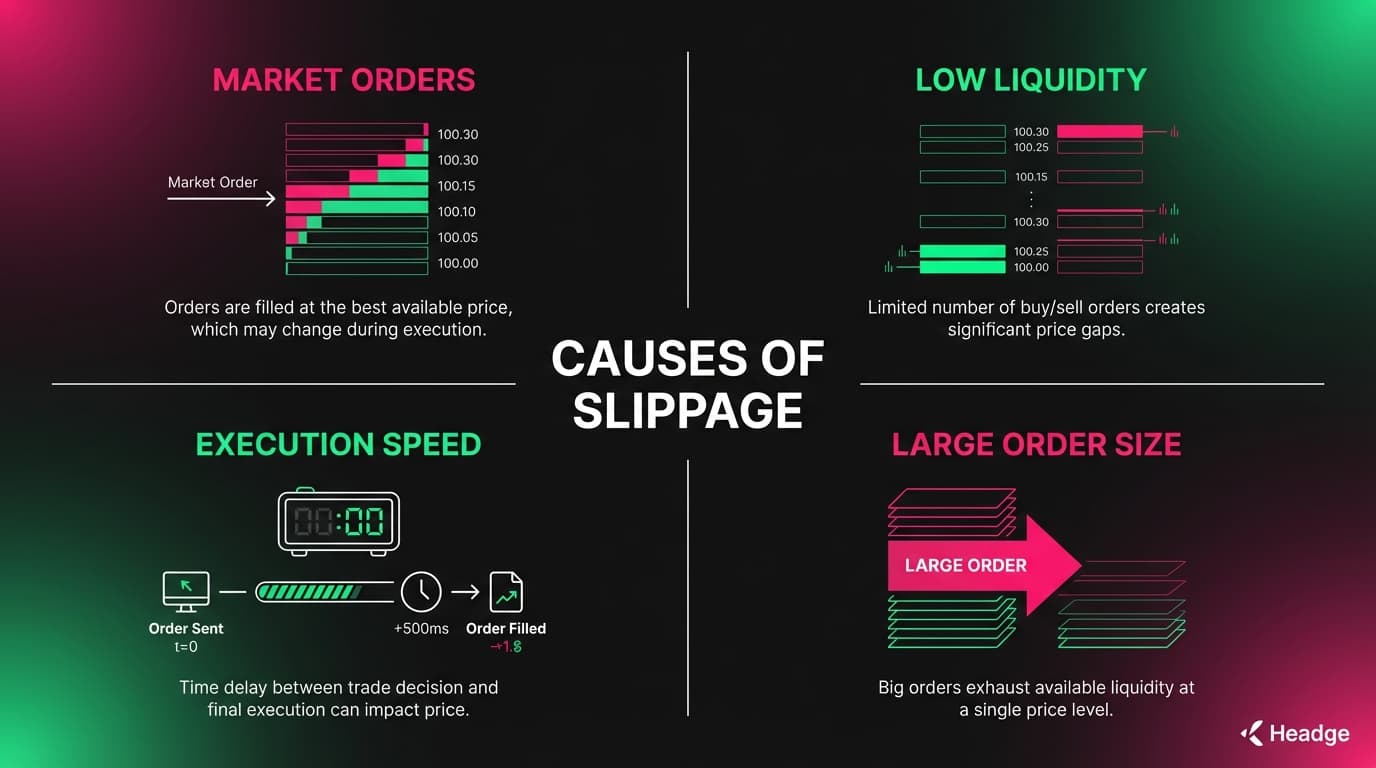
Understanding why slippage happens helps you minimize the damage. When you use a market order, you are saying fill me now at whatever price is available. That is a recipe for slippage. The quote shows 4500.00 bid and 4500.25 ask. You submit a market buy. But by the time your order reaches the exchange, the ask might be 4500.50. Or there might only be 2 contracts at 4500.25 and your 10-contract order eats into higher levels. Market orders guarantee execution but not price. That guarantee has a cost.
In illiquid markets, there simply are not enough contracts at each price level to absorb orders smoothly. Your order has to sweep through multiple price levels to get filled. A liquid contract like ES might have 500 contracts at the best ask. Your 10-contract order fills entirely at that level. A thin micro contract might have 2 contracts at the best ask. Your order consumes that immediately and marches up the book.
Markets move fast. In the milliseconds between you clicking buy and your order actually executing, the price can change. Professional traders spend millions on co-located servers and microwave towers to shave milliseconds off their execution times. You are trading through a retail broker, through the internet, probably with a slight delay at every step. By the time your order arrives, the opportunity might have moved.
Bigger orders experience more slippage, all else equal. You are consuming more liquidity, reaching further up or down the order book. The market impact of your order itself becomes a source of slippage. A 1-lot probably fills at the quoted price. A 50-lot and you are eating through multiple levels and moving the market in the process.
Here is something many traders do not realize: slippage can actually work in your favor. When you submit a limit order and the market moves favorably before execution, you get price improvement. Brokers who route through market makers often provide this. The market maker fills you at a price slightly better than your limit. On limit orders, you set a maximum price, and the market maker might fill you below that if the market dips. On market orders, the market maker might give you the NBBO or slightly better. Is this enough to offset the structural disadvantages? Usually not. But it is not zero.
Keep track of your actual execution prices versus your expected prices. Most broker platforms let you see execution quality statistics. If you are consistently getting worse prices than quoted, it is a sign to look at your order types and timing.
For larger orders, slippage is not just about the market moving. It is about your order moving the market. This is market impact. When you submit a buy order, you are adding demand. If that demand exceeds what is available at the current price, you push the price up. You are causing your own slippage.
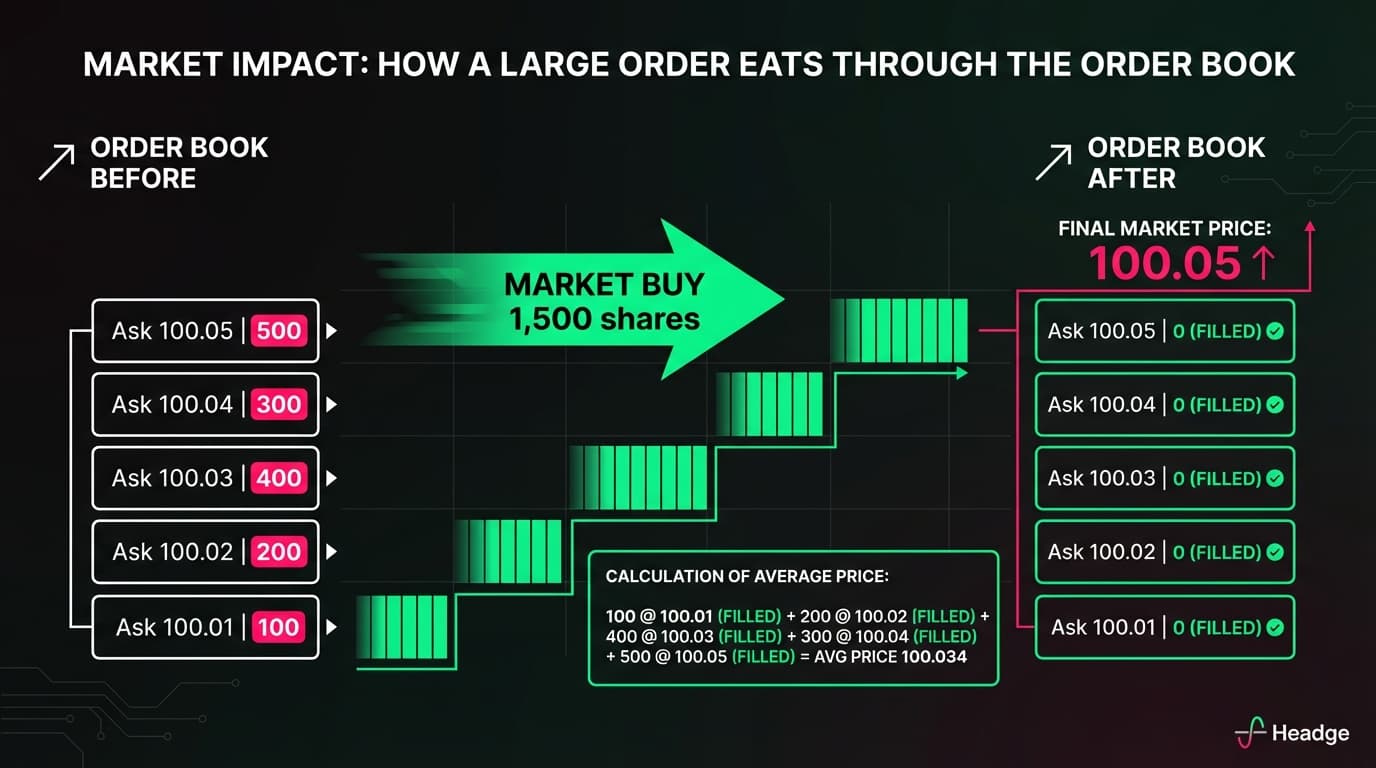
Say you want to buy 15 contracts. The order book shows 2 contracts at 4500.25, 3 contracts at 4500.50, 4 contracts at 4500.75, 3 contracts at 4501.00, and 5 contracts at 4501.25. Your market order fills across all these levels. You expected 4500.25, the quoted ask. You got 4500.80 average. That is market impact at work. And now the best ask is 4501.50 or higher because you just consumed everything below it.
For small retail orders, market impact is negligible. But as your size increases, you become a meaningful participant in price discovery. The solution is to break large orders into smaller pieces, use limit orders, or accept the impact as a cost of trading.
Professional traders obsess over execution quality. You should too. Track your fill rate. What percentage of your limit orders actually execute? A rate below 50% might mean your limits are too aggressive. Track slippage per trade. The difference between quoted price and fill price for your market orders. If you are consistently losing 0.10% on entry and 0.10% on exit, that is 0.20% per round-trip eating your returns. Track price improvement frequency. How often do you get filled better than your limit? Some brokers and routes provide more price improvement than others.
For liquid contracts during normal hours, market order slippage should typically be under 0.02%. If you are consistently seeing more than that, something is wrong.
You cannot eliminate slippage, but you can minimize it. Use limit orders for entries. You control the maximum price you will pay. Yes, you might miss fills. But you will not get destroyed by slippage. Trade liquid instruments. The more liquid the market, the less slippage. ES and NQ offer better execution than thin micro contracts. Avoid trading around news. Spreads widen, liquidity thins, slippage explodes. Wait for things to settle unless you have a compelling reason. Time your trades well. Mid-morning liquidity is typically best. Avoid lunch hour. Be careful at open and close. Break up large orders. Instead of one 50-lot order, use 5 10-lot orders spread across time. You reduce market impact at the cost of execution time. Check your routing. Some brokers let you choose where orders route. Direct exchange routing sometimes beats routing through market makers.
Slippage is fundamentally a tax on urgency and size. The more you need to trade right now, the more you will pay. The bigger you need to trade, the more you will pay. If your strategy only works with perfect fills, it does not work. The traders who survive long-term are ruthlessly honest about their execution costs. They know that a great trade idea with terrible execution is just a mediocre trade.
Be patient when you can. Factor slippage into your expected returns. Size appropriately. Track your execution. A few ticks per contract, multiplied by hundreds of contracts, multiplied by hundreds of trades, is real money.
Next up: I will take you under the hood and look at market microstructure. How exchanges work, where your orders actually go, and what happens between your click and your fill.