
Loading...
Educational Content Only
Nothing on this site constitutes financial advice, trading recommendations, or investment guidance. All content is for educational purposes only. Always do your own research and consult qualified professionals before making financial decisions.
These are the three templates I use for multi-timeframe analysis. I work from high to low: establish bias with Framing, validate with Context, and execute with precision.
High Timeframe Bias
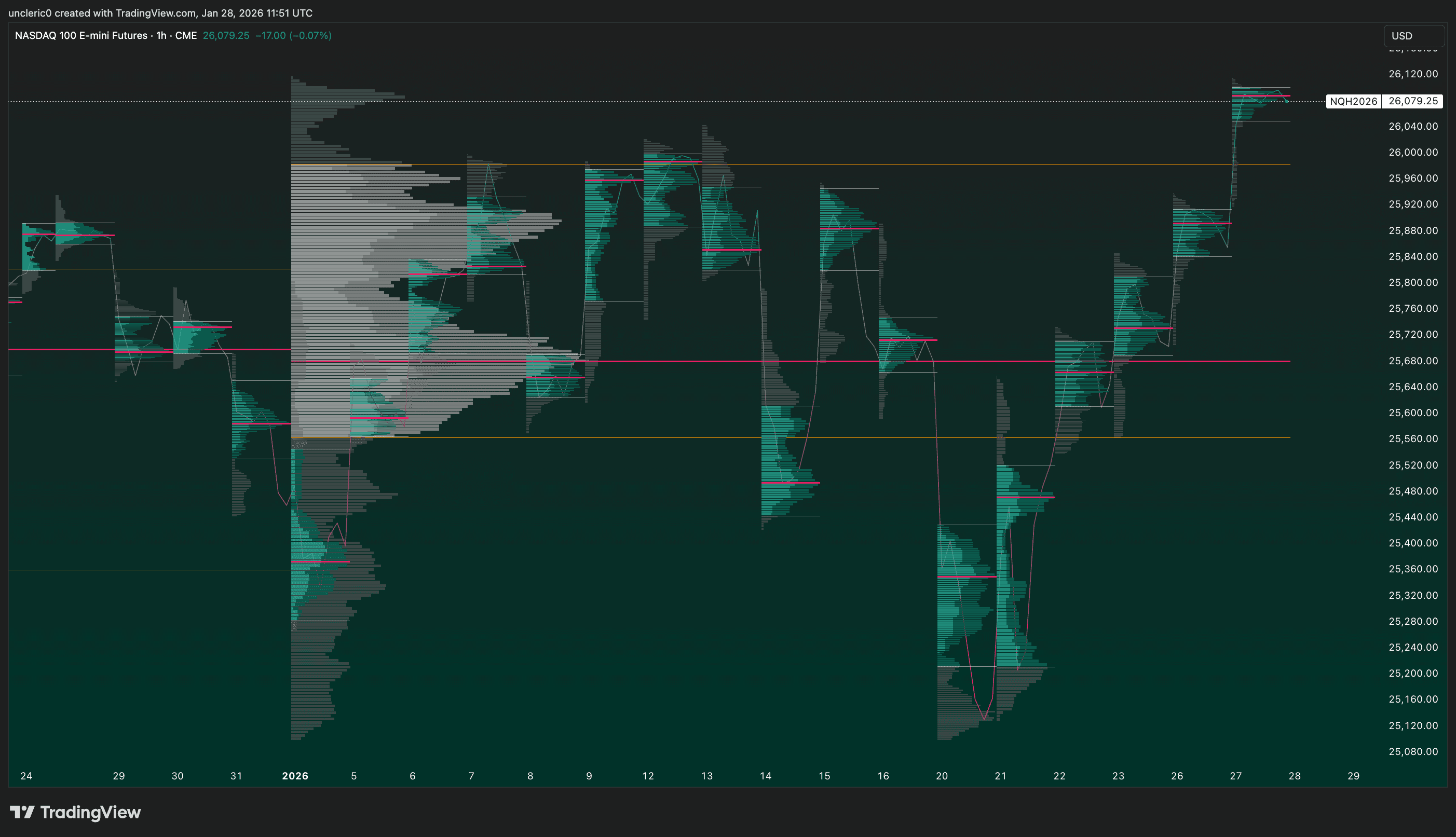
My Framing template establishes daily directional bias through volume profile analysis. I use daily volume profiles alongside a 30-day composite profile to see where institutional participants have been positioning over the medium term. The composite profile reveals the larger market structure -identifying value areas where price has spent the most time and single prints where price moved quickly through low-volume zones. I use this template during my pre-market routine to identify premium and discount zones relative to the developing value area, and to locate yesterday's Point of Control, Value Area High, and Value Area Low as potential support and resistance levels.
I configure this template to show cash session (RTH) data only. The overnight session often lacks the institutional participation that makes volume profile analysis meaningful, and including ETH can distort value area calculations. I pay particular attention to the relationship between the current composite POC and yesterday's settlement -when price opens significantly away from value, I look for rotation back toward the POC. When price opens within value and near the POC, I expect more balanced, rotational trading until a catalyst emerges. This high timeframe context prevents me from fighting the dominant order flow and helps identify whether current price action represents fair value discovery or a potential reversion opportunity.
Medium Timeframe Analysis
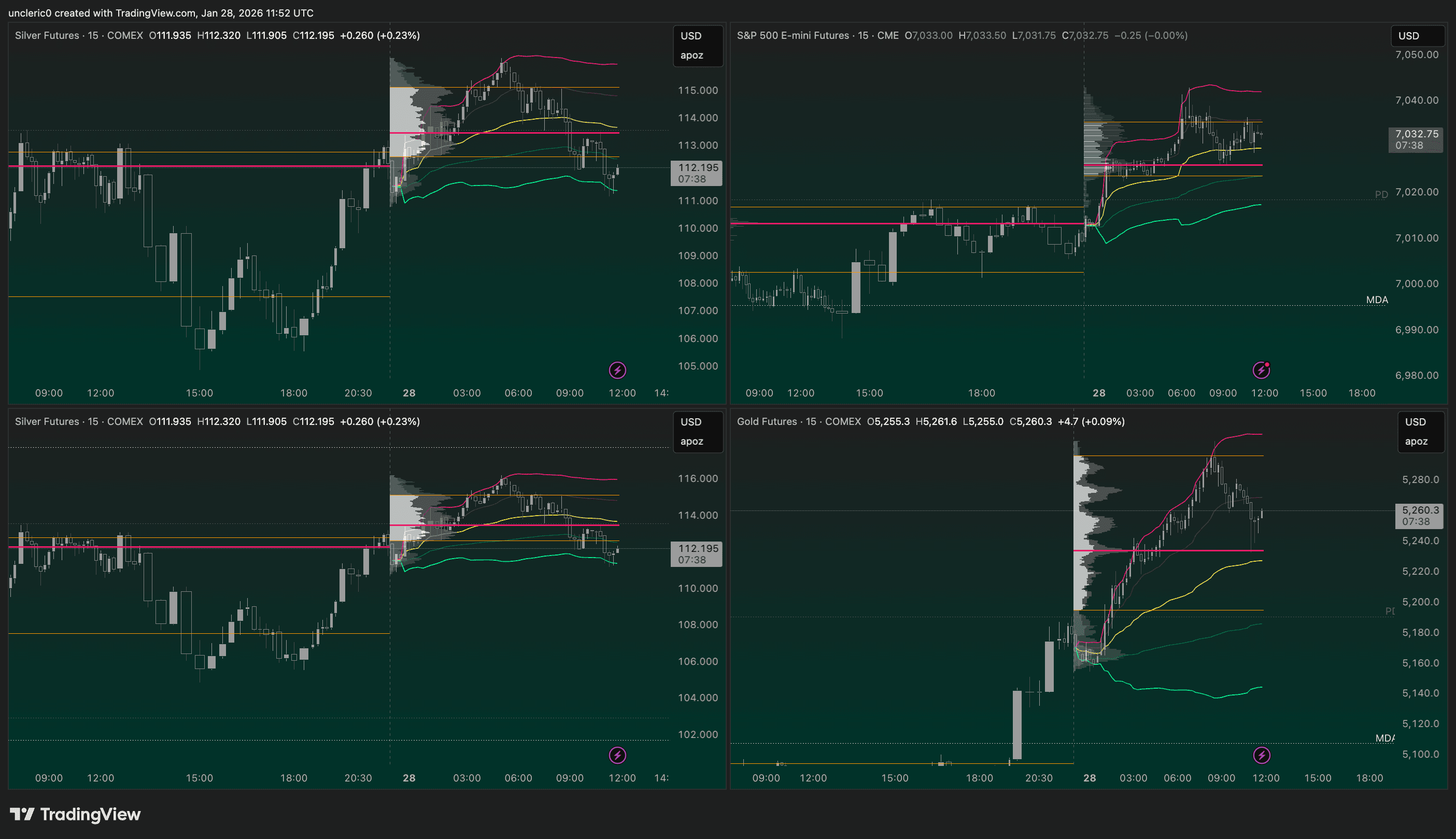
My Context template provides a 15-minute view across my primary watchlist instruments, allowing me to compare and contrast relative movements between correlated markets. I've configured this for ES, NQ, GC, and SI -the core futures I focus on that often move in tandem or diverge meaningfully during regime shifts. VWAP anchored to the session open serves as my primary reference point, with the second standard deviation bands marking statistical extremes where mean reversion becomes probable. Volume bars beneath each chart help me identify aggressive moves characterized by elevated participation, distinguishing genuine breakouts from low-conviction probes.
The daily volume profile overlay shows the current session's developing value area, helping me anticipate potential rotation targets when price reaches yesterday's VAH or VAL. I toggle between RTH and ETH based on what I'm analysing -RTH provides cleaner institutional footprints while ETH captures overnight positioning that may influence the regular session. The real power of this template comes from cross-market analysis: when ES is making new highs but NQ diverges, or when gold and silver decorrelate from their typical relationship, these divergences often precede significant moves. I use this context to validate or question my bias from the Framing template before committing to execution.
Low Timeframe Entries
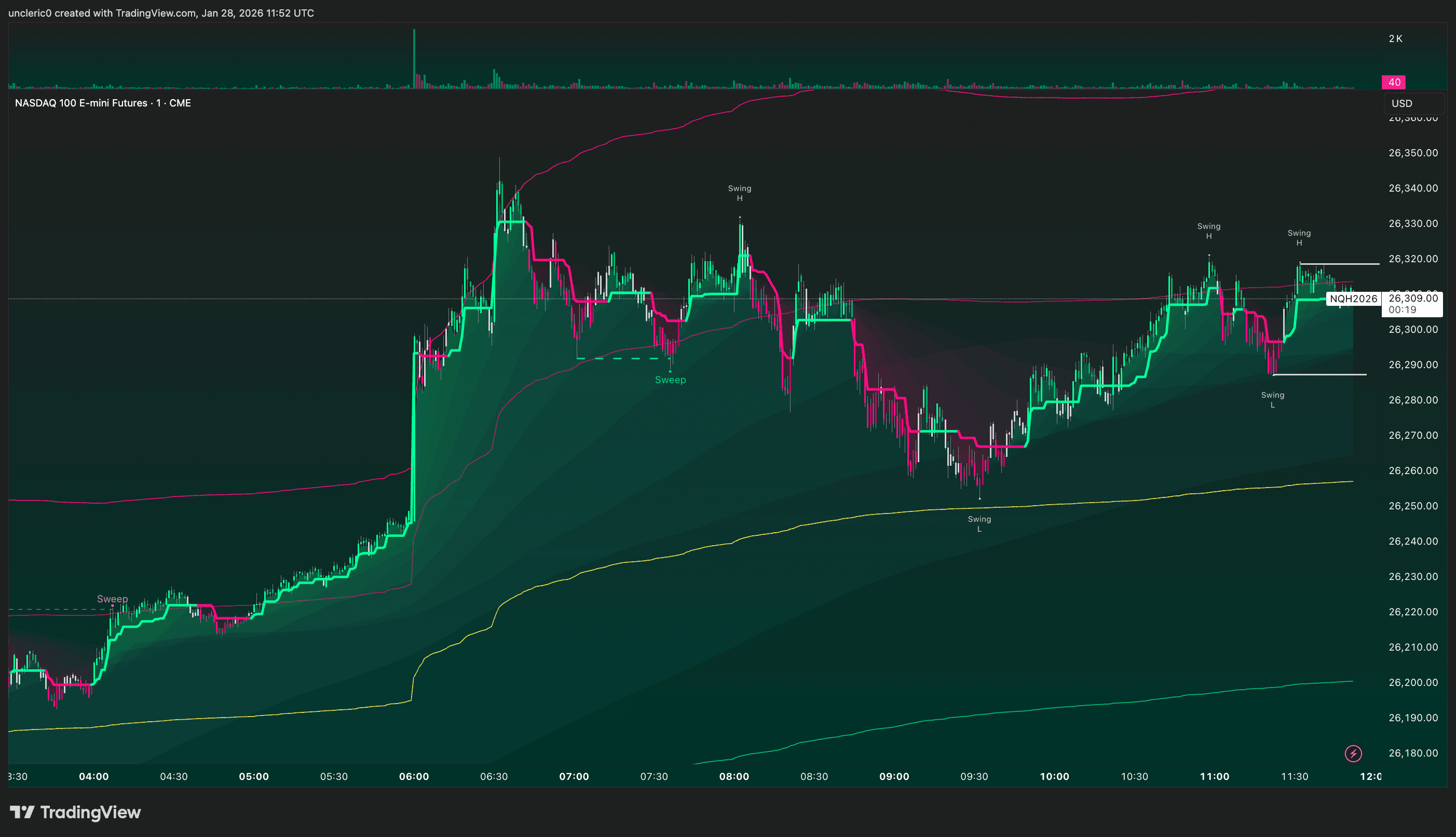
My Execution template is my surgical instrument for precise entry and exit timing on 1-minute and 5-minute charts. I combine the Range Filter for low timeframe trend identification with key VWAP levels that act as intraday support and resistance. The GUPPY multiple moving average ribbons give me a visual representation of momentum and trend strength -when the fast group pulls away from the slow group, I have confirmation of directional conviction. Swing point markers automatically identify local highs and lows, giving me clear reference points for stop placement and target zones.
I use this template for execution only, not analysis. By the time I'm here, I already have my high timeframe bias from Framing and my cross-market context from the Context template. I use Execution to find optimal entry points within my predetermined direction -waiting for price to reach VWAP bands, watching for Range Filter colour changes that confirm my bias, or identifying failed breakouts of recent swing points. The combination of multiple confirmation signals reduces the noise inherent in low timeframe trading while keeping me nimble enough to capture intraday opportunities. I never let this template override my higher timeframe analysis -it exists to refine my timing, not define my direction.