
How Prices Actually Get Made
What is ES worth? Is it 4500 or 4600 or 5000? Ask a dozen analysts and you will get a dozen answers, each backed by elaborate models and confident projections. Here is the truth that takes time to accept: there is no correct price. There is only the price where the last buyer and seller agreed to transact. That is it. Everything else is opinion.
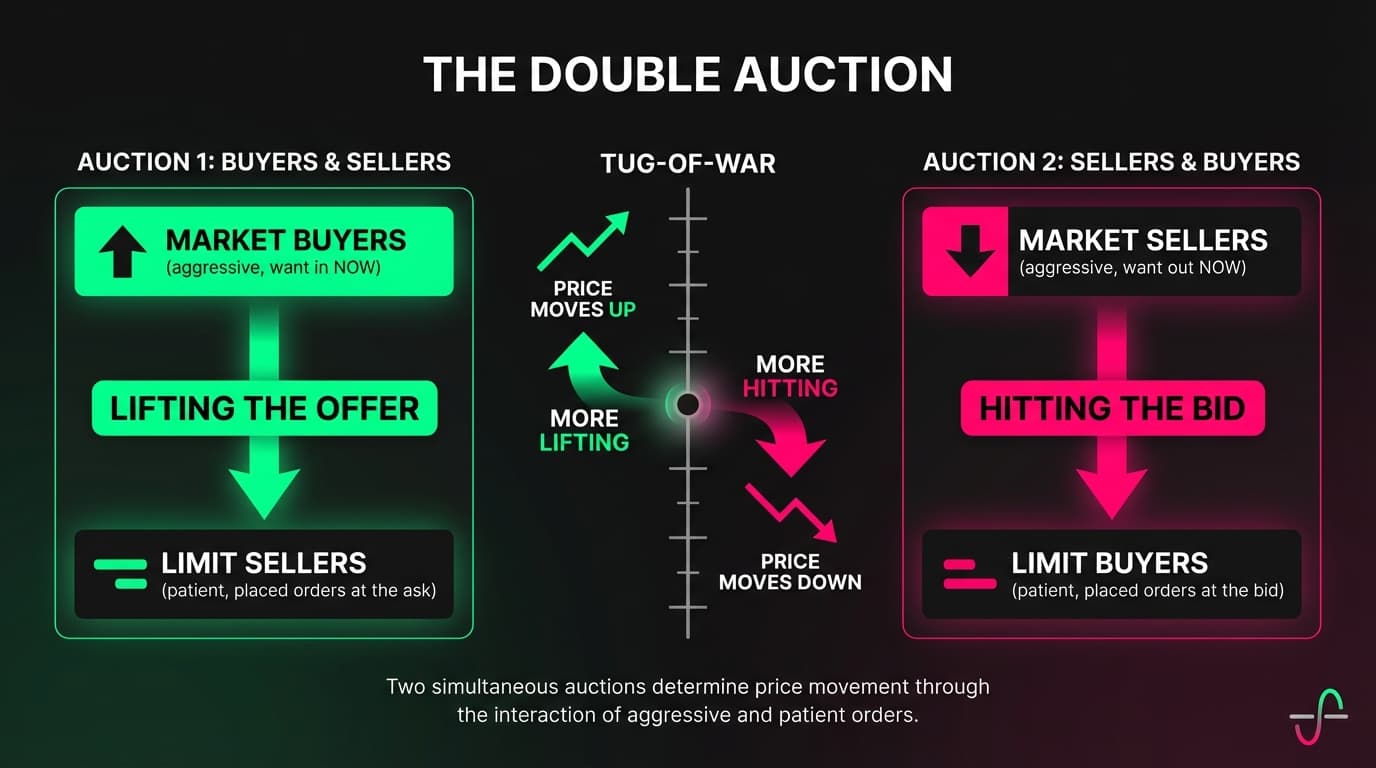
Most trading education gets something wrong when they talk about the auction as if it is one thing. It is not. There are actually 2 auctions happening simultaneously, and understanding this changes how you read markets.
On one side, you have aggressive buyers using market orders who want in now. They are willing to pay the ask price, which is called lifting the offer. On the other side, you have patient sellers who placed limit orders at the ask, waiting for someone to come to them. When a market buyer lifts an offer, they are trading with a limit seller. The buyer paid up to get in. The seller got their price by being patient.
The mirror image happens on the other side. Aggressive sellers using market orders want out now. They are willing to sell at the bid price, which is called hitting the bid. Patient buyers placed limit orders at the bid, waiting to buy at their price. When a market seller hits a bid, they are trading with a limit buyer. The seller gave up edge to get out. The buyer got a good price by waiting.
Price moves when one side is more aggressive than the other. When there is more lifting than hitting (more market buyers than market sellers), price moves up. Offers get eaten, the ask rises, and the bid follows. When there is more hitting than lifting (more market sellers than market buyers), price moves down. Bids get hit, the bid drops, and the ask follows.
This is the heartbeat of the market. Every tick, every candle, every trend, it all comes down to this balance between aggressive buyers and aggressive sellers. When you learn to read order flow, you are essentially watching these 2 auctions play out in real time.
Markets are a continuous double auction. One auction matches aggressive buyers with patient sellers at the ask. The other matches aggressive sellers with patient buyers at the bid. Price direction is determined by which side is more aggressive.
Right now, as you read this, someone is deciding ES is overvalued and hitting bids to get out. Someone else is deciding it is undervalued and lifting offers to get in. Whoever is more aggressive wins the tug-of-war, and price moves in their direction.
Price is where trades happen. Value is an opinion about where trades should happen. Every trader who loses money eventually learns that the market does not care about their opinion of value. It only cares about what buyers will actually pay and sellers will actually accept.
If price is just the intersection of supply and demand, the question becomes what changes supply and demand. Information moves prices. New earnings reports, economic data, management changes, product launches, scandals. When new information arrives, participants reassess what they think something is worth, and their bids and offers adjust. Fast information moves prices fast. When the Fed chair speaks, prices can move 2% in seconds because everyone is watching and reacting simultaneously. Slow information moves prices slowly. Institutional investors might spend weeks accumulating a position based on research that is not public. The price grinds up imperceptibly as they bid up contracts, other participants gradually notice, and eventually the move becomes obvious.
Sometimes prices move not because of new information but because of liquidity dynamics. A large seller needs to exit and there are not enough buyers at current prices. The price drops until enough buyers show up. Nothing fundamental changed. Just supply and demand mechanics. This is why you see weird moves in less liquid contracts. A fund redemption forces selling, or a margin call triggers forced liquidation. The price tanks on no news, and a week later it is back where it started.
Fear and greed are real forces in markets. When everyone is afraid, they sell regardless of fundamentals. When everyone is greedy, they buy regardless of price. Sentiment creates feedback loops where rising prices attract buyers, driving prices higher still. This is how bubbles form and how crashes accelerate. Price discovery gets overwhelmed by emotion.
By the time you know something, it is usually priced in. The market is very, very good at processing information. When major economic data is released, the market moves in milliseconds. Algorithms are parsing the data before any human can analyze it. Professional traders with direct feeds react in seconds. Active retail traders see the move and react in minutes. Casual traders notice hours later.
Where are you in that chain? If you are reading about it in the news the next morning, you are at the end. The move already happened. This does not mean you cannot make money on information. It means you need to be realistic about your information advantage. You are probably not competing on breaking news. You might be competing on better interpretation of widely known information. Or better patience in waiting for overreactions to correct. Or better understanding of obscure situations that nobody else cares about.
If your trading strategy depends on knowing things before others, you are probably in the wrong game. The strategies that work for retail traders usually involve longer time horizons, different information sources, or simply waiting for markets to offer good prices rather than chasing them.
Not all price discovery is the same. Modern markets use different mechanisms for different situations:
-
Continuous trading is regular market hours. Orders match as they arrive, one by one, in real time. Fast traders have advantages. Prices update tick by tick.
-
Opening auction happens before the market opens. Orders accumulate but do not execute. At the open, all the orders are matched at once at a single clearing price. This prevents the chaos of everyone trying to trade simultaneously and gives a cleaner opening price. If you have ever placed a market order at the open and gotten a strange fill, this is why. You are participating in an auction that clears at one calculated price.
-
Closing auction is when many institutional traders, especially index funds, need to trade at the closing price. Orders accumulate in the final minutes and then clear at 4:00 PM at a single price. The closing auction can be one of the most liquid moments of the day. If you need to trade size, this is often better than fighting the tape all afternoon.
Sometimes price discovery breaks. The market closes at 4500 and opens at 4480 the next morning. No trades happened in between. This is a gap. Gaps happen when new information arrives while markets are closed. Economic data after hours. Weekend news. International events overnight. The market processes all of it at once when it reopens, and the price jumps to a new level without trading through the prices in between.
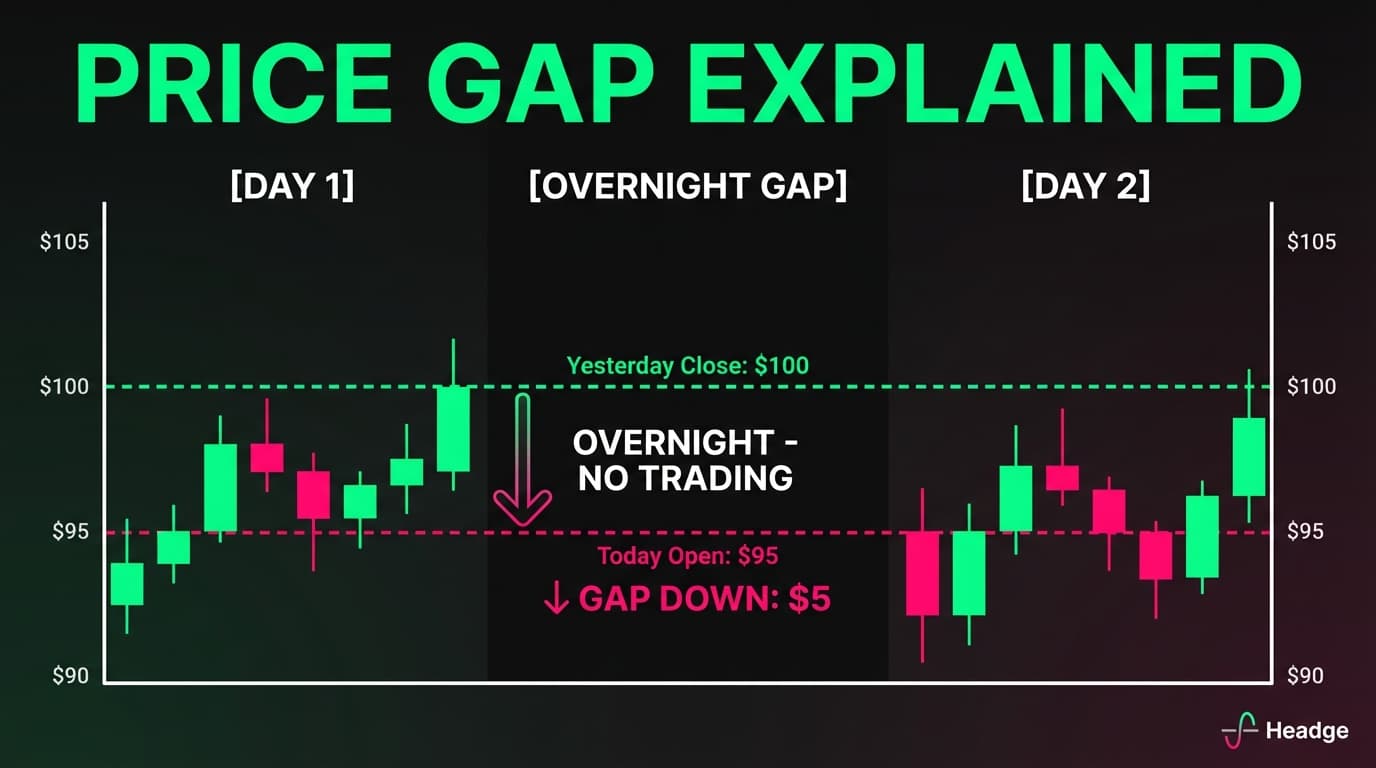
For traders, gaps are tricky. Stop-loss orders do not protect you from gaps. If your stop is 4495 and the market gaps to 4480, your stop triggers at the first available price, which might be 4480 or worse. Gap risk is one reason many traders avoid holding overnight or over weekends. While markets are closed, you are at the mercy of whatever happens in the world.
You have probably heard the phrase "efficient market." The academic theory says that prices reflect all available information, so you cannot systematically beat the market. Here is my take: markets are efficient enough that easy money does not exist, but inefficient enough that hard money does.
If there was a simple, obvious pattern that predicted prices, it would get arbitraged away immediately. Millions of smart people are looking. If it was easy, it would already be gone. But markets are made up of humans and algorithms programmed by humans. They overreact. They underreact. They get things wrong for extended periods.
The old saying is that markets are voting machines in the short run and weighing machines in the long run. Short-term prices reflect sentiment, positioning, and liquidity more than fundamentals. Long-term prices eventually gravitate toward something like fair value. Your job is to figure out which game you are playing and position accordingly.
The traders who consistently make money understand something fundamental about price discovery. You are not trying to be right about value. You are trying to anticipate where the next trade will happen. That might sound cynical, but it is actually liberating. You do not need to know what a contract is really worth. You need to know whether more people will want to buy or sell it in the near future. Those are different questions.
The best traders have strong opinions held loosely. They develop a view on price direction. They position for it. But when the market tells them they are wrong, they listen. They do not argue with the tape. They do not insist their analysis was right even as prices move against them. Because ultimately, there is only one price that matters. The one where you actually trade.
Next up: I will cover liquidity, the crucial factor that determines whether you can actually execute your trades at the prices you expect.