
Volume as the Truth Teller
Price can move for many reasons. A single large order in a thin market. Algorithmic noise. Option hedging flows. A fat finger. Price movement alone does not tell you whether real participants with real conviction are behind that move. Volume is harder to fake. High volume means lots of participants agreed that prices should change. It means actual capital was deployed, actual risk was taken, actual positions were established. When price moves on high volume, that move has weight behind it.
Price advertises. Time regulates. Volume confirms. This phrase is attributed to Jim Dalton, and understanding what it actually meant fundamentally changed how I read markets.
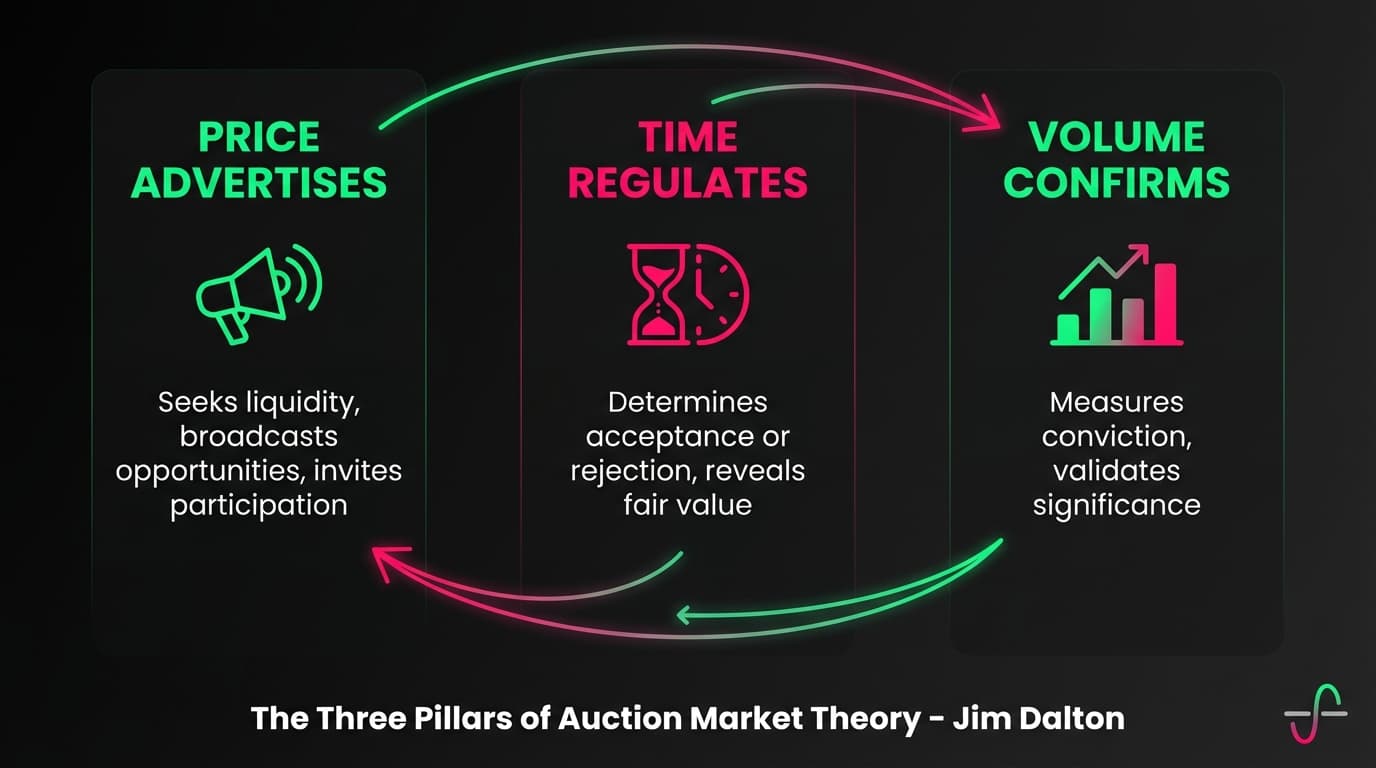
Price is an advertisement. It is the market's way of broadcasting opportunities to potential participants. When price moves to a new level, it is essentially asking whether anyone wants to trade here. Think of it like a store putting items on sale. The price drop is an advertisement designed to attract buyers. In markets, price moves up to attract sellers who want to sell at higher prices and moves down to attract buyers who want to buy at lower prices. Price is constantly searching for levels where 2-sided trade can occur. When price moves sharply in 1 direction, it is advertising aggressively, saying current prices are not attracting enough participation and the market needs to try somewhere else.
Time is the judge. It determines whether advertised prices get accepted or rejected by participants. If price spends significant time at a level with lots of back-and-forth trading, that level is being accepted. Participants agree it is fair value. The market is balanced and a value area is forming. If price moves quickly through a level, spending minimal time there, that level is being rejected. Participants do not want to trade there. They are either holding out for better prices or rushing to trade before price moves further away. This is why I watch how long price stays at a level, not just where price goes. A price that touches a specific level and immediately reverses tells a different story than a price that trades at that level for hours. Time reveals acceptance or rejection.
Volume is the conviction meter. It tells you whether the activity at any price level represents real participation or just noise. High volume at a price level means lots of participants agreed that trades should happen there. Real capital was deployed, real positions were established. That price level now has significance because real money validated it. Low volume means nobody cared. Price might have visited that level, but it was a ghost town. No conviction, no significance.
Price advertises opportunities by moving to seek liquidity. Time regulates by revealing whether participants accept or reject those prices. Volume confirms the conviction behind any acceptance or rejection. Together, these 3 elements tell you everything about what the market is actually doing versus what it appears to be doing.
When analyzing a market, I am always asking where price is advertising, how much time is being spent there, and what volume tells me about conviction. If all 3 align, you have a high-probability read on market direction. If they do not align, you have a warning that something is not what it seems.
Price shows direction. Volume shows conviction. A move on high volume represents genuine agreement among participants that prices should be different. A move on low volume is just noise waiting to reverse.
Consider 2 breakouts that look identical on a price chart. Contract A breaks above resistance on 3 times average volume. Thousands of traders and institutions decided this was the moment to commit capital. The breakout has broad participation. Contract B breaks above resistance on half average volume. Barely anyone cared. The breakout happened, but nobody showed up for it. Which breakout would you trust? The charts look identical. Only volume reveals the difference.
The relationship between volume and price creates 4 basic scenarios that you see constantly:
-
Price up, volume up - You have strong buying interest. The move has conviction. Buyers are actively competing to acquire contracts, willing to pay higher prices to get filled. This suggests trend continuation is likely because real demand is present.
-
Price up, volume down - You have weakening buying interest. The move is losing steam. Fewer participants are willing to buy at these higher prices. This suggests potential exhaustion and caution about chasing.
-
Price down, volume up - You have strong selling pressure. This could be capitulation or distribution. Sellers are actively competing to exit, willing to accept lower prices to get out. This suggests either panic and a potential bottom, or distribution and more downside coming. Context matters here.
-
Price down, volume down - You have lack of selling interest. The decline is running out of sellers. Those who wanted out are already out. This suggests potential stabilization because selling pressure is exhausted.
This framework is simple but powerful. Before reacting to any price move, check the volume. The move's meaning changes entirely based on whether participation confirmed or contradicted it.
Significant volume shifts often happen before significant price shifts. This is something most traders miss. Institutions cannot buy thousands of contracts without leaving footprints. They try to hide their activity, but the volume shows up. You might see periods of elevated volume while price goes nowhere, then suddenly price breaks out. The volume told you something was happening. Price eventually confirmed it. This lead-lag relationship works in reverse too. A trend that is been running on declining volume is a trend running out of fuel. Price might still be rising, but the warning sign is already visible to anyone watching volume.
When volume diverges from price, trust volume. If price is making new highs but volume is declining, that is a warning. If price is drifting sideways but volume is building, that is anticipation of a move.
Raw volume numbers mean nothing without context. 10,000 contracts traded might be huge for 1 contract and tiny for another. Volume must be compared to something meaningful. Most traders compare today's volume to a moving average, often 20 or 50 periods. 2 times average volume means twice the typical participation. You should also compare to recent volume. How does today compare to the last few sessions? A spike after quiet trading means something different than continued heavy trading. Look at volume at specific prices. Where did the volume occur? Heavy volume at support means aggressive buying. Heavy volume at resistance might mean distribution. Consider time of day. Volume patterns shift throughout the day. High volume at the open is normal. High volume in the middle of the day is more significant.
Volume reveals participation and conviction, but it has limits. It does not tell you who is trading. Retail, institutions, algorithms? Heavy volume is heavy volume. You need other tools to infer participant type. It does not tell you direction of intent. High volume during a price rise means lots of transactions, but every transaction has a buyer and a seller. The interpretation requires price context. Volume can be distorted. Index rebalancing, options expiration, and other mechanical flows can create volume that has nothing to do with directional views. It is historical. By the time you see the volume bar, the transactions are complete. Volume confirms, it does not predict. These limitations do not diminish volume's value. They define its proper use as confirmation and context, not as a standalone signal.
Volume behaves differently in different market conditions. In trends, healthy trends show volume expanding in the direction of the trend and contracting on pullbacks. An uptrend should see higher volume on up periods and lower volume on down periods. The opposite pattern suggests the trend is weakening. In ranges, range-bound markets often show volume declining overall as participants wait for resolution. Volume spikes at range boundaries tell you whether a breakout attempt has conviction. At reversals, major reversals typically feature volume climaxes. Capitulation bottoms show massive selling volume as the last bears give up. Distribution tops show elevated volume as smart money exits into strength.
Developing volume awareness changes how you see markets. Instead of asking where price is going, you start asking who is participating and how aggressively. A price chart is a record of transactions. Volume tells you how many transactions occurred. Together, they tell a story that neither tells alone. The traders who learn to read this story see opportunities others miss and avoid traps others fall into. They understand that markets are not abstract lines on a chart but aggregations of human decisions, each with varying degrees of conviction and capital behind them.
Next up: I will dive into delta analysis, where I separate volume into its buying and selling components to see the battle between bulls and bears in real time.