
Under the Hood
You click buy. Contracts appear in your account. Magic happens in between. Except it is not magic. It is a complex system of exchanges, matching engines, market makers, dark pools, and regulations, all operating in microseconds while your order winds its way to execution. Understanding this machinery will not make you rich, but it helps explain why trades do not always work out the way you expect.
An exchange is fundamentally just a matching engine. It takes buy orders and sell orders and pairs them up according to rules, usually price-time priority. CME, ICE, NYSE, NASDAQ, they are all doing the same basic thing. But the details matter enormously.
The heart of any exchange is the matching engine, a computer system that receives orders, organizes them in the order book, and executes trades when orders cross. Modern matching engines process orders in microseconds. They can handle hundreds of thousands of orders per second. They are designed for speed, reliability, and fairness of a sort. When your order arrives, the matching engine checks if it can be immediately filled against existing orders. If yes, execution happens. If no, your order joins the book and waits.
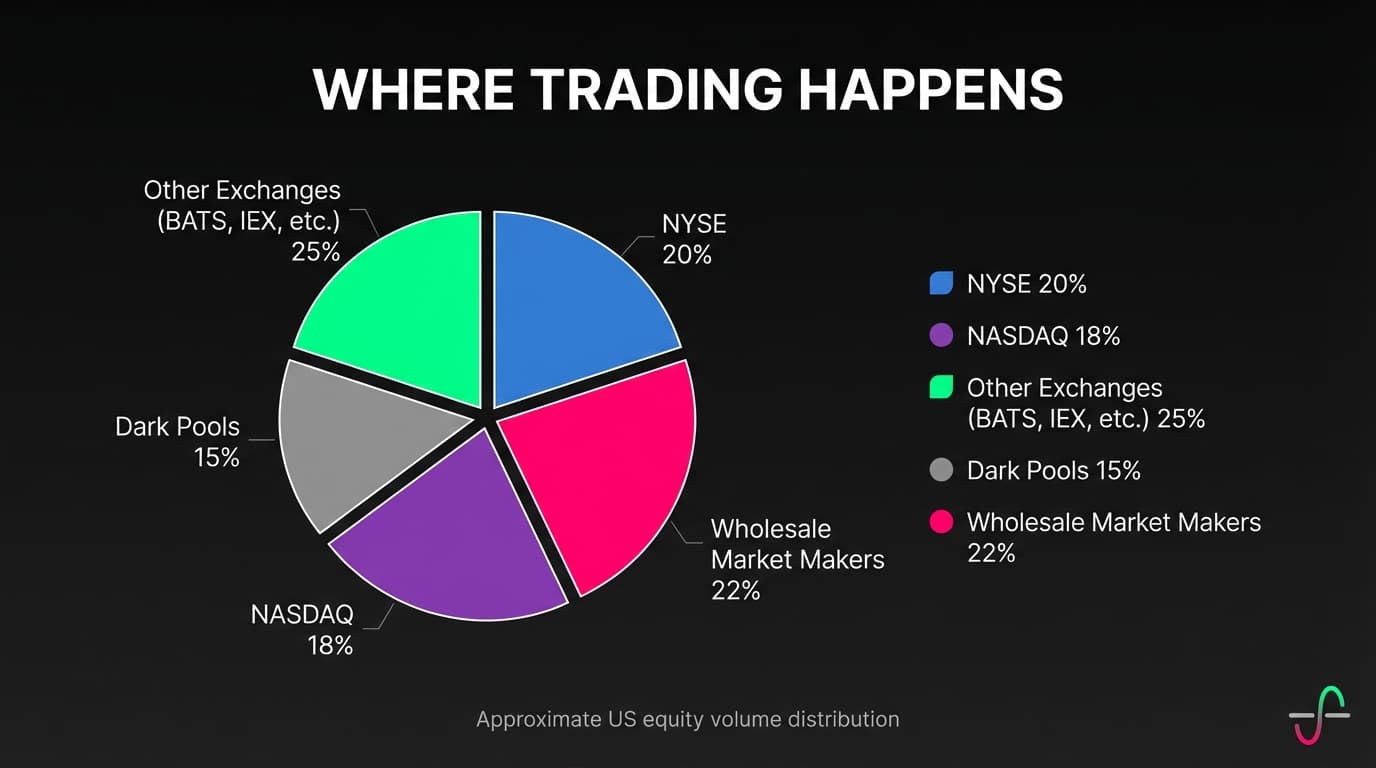
Here is where it gets interesting. Exchanges rent space in their data centers to trading firms. The closer your servers are to the matching engine, the faster your orders arrive. Some firms have literally measured the speed of light through different cables to shave microseconds off their execution times. They have strung microwave towers and laser networks between data centers. Differences measured in millionths of a second. You, trading from your laptop through a retail broker, are nowhere near this speed. By the time your order arrives, the fast traders have already seen it, analyzed it, and possibly traded ahead of it.
Unless you are prepared to spend millions on infrastructure and PhDs, speed is not your edge. Do not try to trade like an HFT firm. Trade on timeframes where your speed disadvantage does not matter.
There is not one market. There are many. The CME Group operates the largest futures exchanges in the world, including the E-mini S&P 500 (ES) and E-mini NASDAQ-100 (NQ) contracts. These are fully electronic markets with centralized order books and transparent price discovery.
Then there are other venues like ICE (Intercontinental Exchange) for various commodity and equity index products, as well as smaller exchanges and alternative trading venues. Each has slightly different rules, fee structures, and specializations. Competition drives innovation and theoretically better execution for everyone. But it also creates complexity.
Dark pools are private trading venues where orders do not show up in the public order book. Why would anyone want that? Institutional protection is one reason. When a big fund wants to buy thousands of contracts, displaying that order publicly invites front-running. Everyone sees the demand and buys ahead of them. Dark pools let them trade without revealing their intentions. Price improvement is another reason. Some dark pools match orders at the midpoint of the NBBO, giving both sides a better price than the public market.
Dark pools are not inherently problematic, but they are not pure either. Some have been caught leaking order information to HFTs. Some prioritize certain participants over others. And trades happening off-exchange do not contribute to public price formation. On the other hand, large orders can execute without market impact, midpoint matching can give better prices, and there is reduced information asymmetry for informed traders.
For retail traders, your orders probably are not large enough to benefit from dark pools. The orders that do go to dark pools are often those from market makers filling your retail flow.
Payment for order flow is probably the most controversial topic in market structure for retail traders. When you trade through a commission-free broker or most major retail brokers, your order usually does not go to an exchange. It goes to a wholesale market maker (Citadel Securities, Virtu, and others) who pays your broker for the privilege of filling your order.
Why would they pay? Because retail order flow is profitable to trade against. Retail traders are statistically uninformed, meaning they are not trading on special information that could disadvantage the market maker. This makes retail flow low-risk and profitable to match.
For most retail traders, payment for order flow is acceptable. The execution quality is usually reasonable. The price improvement is real, if small. You are not getting ripped off in any obvious way. But if you are trading size or you are sophisticated enough to care about execution quality, look at brokers that offer direct exchange routing. You will pay a small commission, but you might get better fills.
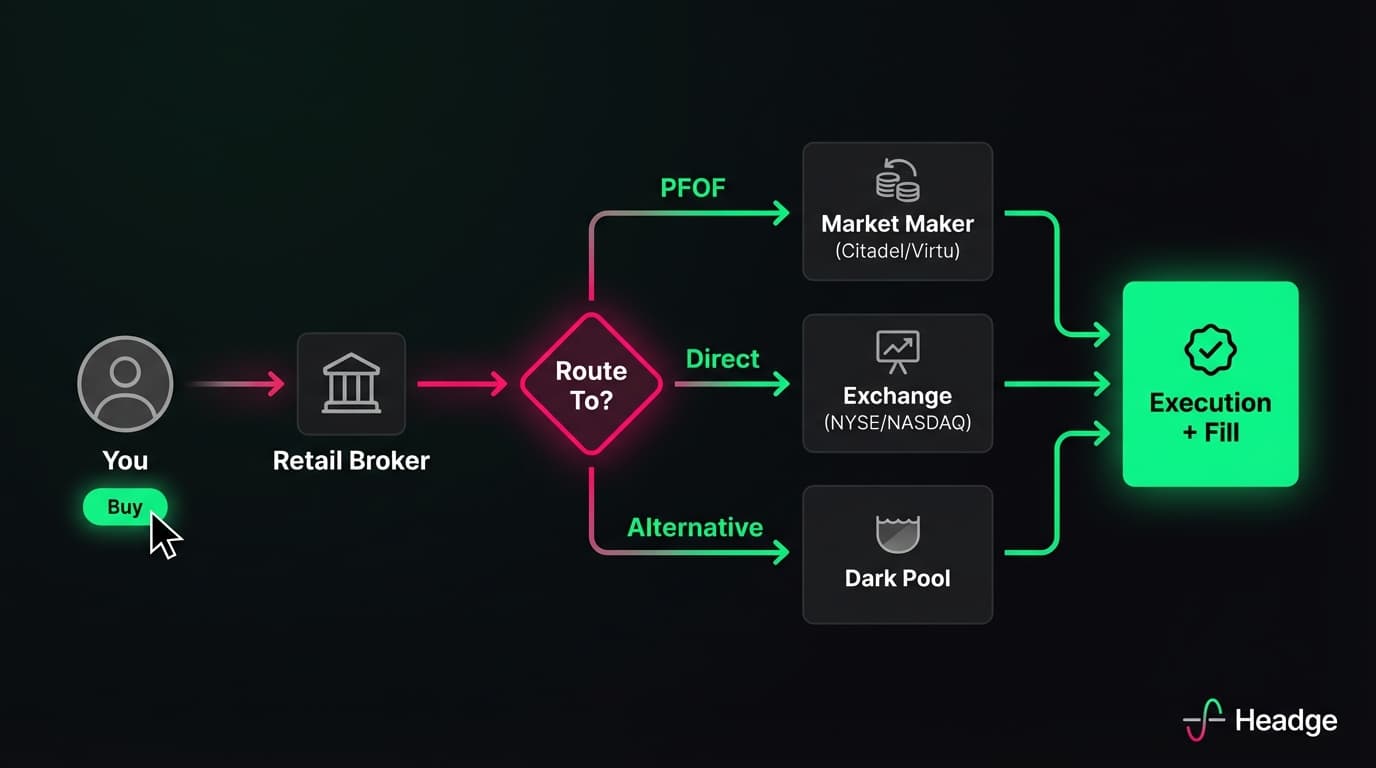
The path from your click to execution involves several decision points. You submit an order through your broker's platform. Your broker receives the order and decides where to send it (order routing). The order goes to either a wholesale market maker (most common for retail), directly to an exchange, or rarely, a dark pool. The receiving venue executes your order against available liquidity, or queues it if it is a limit order that cannot immediately fill. Confirmation flows back through the chain to you.
This all happens in milliseconds. You never see it. But at each step, there are potential conflicts of interest and decisions being made that affect your execution quality.
HFT firms account for a huge portion of market volume. They trade in microseconds using sophisticated algorithms. They provide liquidity and tighten spreads through competition among HFTs. They reduce volatility in normal conditions by arbitraging away mispricings. But they also front-run slower traders, create phantom liquidity that disappears when you try to hit it, can cause flash crashes when algorithms feed on each other, and profit from infrastructure advantages unavailable to regular traders.
HFT is not going away. If you are competing with HFTs on their turf, trying to scalp tiny moves in liquid markets, you will lose. If you are trading on longer timeframes with different information sources, their existence is mostly neutral to positive for you through tighter spreads and more liquidity.
Regulation governs how markets operate. In futures markets, the CFTC (Commodity Futures Trading Commission) oversees exchange operations. Key principles include best execution (brokers must route orders to the venue offering the best price), transparency (exchanges must provide fair and equitable access to market data), and market manipulation prohibitions (spoofing, layering, and other manipulative practices are illegal).
Best execution is not just about price. It includes speed, certainty of execution, and total cost. A fill at a slightly better price that takes a second longer might not actually be better in a fast market. Regulators recognize this complexity, which creates gray areas that sophisticated players exploit.
All this complexity can feel overwhelming. Here is what really matters for your trading. The spread costs you more than any microstructure issue. Trade liquid instruments with tight spreads. Do not try to compete on speed. You will lose. Trade on timeframes where milliseconds do not matter. Use limit orders. They protect you from many execution quality issues by defining your maximum price. Understand your broker's routing. Most brokers disclose this in their reports. It will not change your life, but you should know where your orders go. Be skeptical of free. If you are not paying commissions, you are paying in other ways. That is not necessarily bad, but understand the trade-off.
The market microstructure is designed by and for sophisticated institutional participants. As a retail trader, you are a small player in a game built by giants. But the giants compete with each other, which benefits you through tighter spreads and abundant liquidity. The solution is not to fight it. It is to play a different game.
Next up: I will teach you to read the tape. The time and sales data that shows you actual transactions happening in real time. It is old-school, but it is still one of the most direct windows into what the market is actually doing.