
The Invisible Tax on Every Trade
Here is something most new traders do not fully grasp. If you use a market order to enter a position, you are already losing money the moment you get filled. Not because the market moved against you. Not because you picked a poor setup. But because of a built-in cost called the spread. This is not inevitable. If you use limit orders and get filled at your price, you can avoid paying the spread entirely. In fact, you can even collect it. But most traders, especially when starting out, use market orders because they want in immediately. That impatience has a price. Until you understand the spread and how to work with it, you are trading with a blindfold on.
The bid-ask spread is the difference between the highest price a buyer is willing to pay (the bid) and the lowest price a seller is willing to accept (the ask). Suppose ES is quoted at 4500.00 bid and 4500.25 ask. If you want to buy immediately with a market order, you are paying 4500.25. If you want to sell immediately, you are receiving 4500.00. The 0.25 point difference is the spread. Here is the uncomfortable reality: if you buy at 4500.25 and immediately try to sell, you will get 4500.00. You just lost 0.25 points per contract without the market moving at all. That is the spread in action, an instant loss the moment you enter.
Think of the spread as starting a race a few steps behind the line. You need the market to move in your favor by at least the spread amount just to break even. On a tight spread like 0.25 points in ES, that is trivial. On a wide spread, you might need a significant move just to get back to zero.
Spreads are not arbitrary. They are compensation for market makers who provide liquidity. Consider what a market maker does. They stand ready to buy from you when you want to sell, and sell to you when you want to buy. That is a risky business. If a market is trending down and everyone wants to sell, the market maker is stuck accumulating inventory that is losing value by the second. The spread is their compensation for taking that risk. It is how they make money without betting on direction. Buy at the bid, sell at the ask, collect the difference, millions of times per day across thousands of securities.
When you see a tight spread, it means high liquidity, fierce competition among market makers, and low perceived risk in holding inventory. When you see a wide spread, it means low liquidity, market makers demanding more compensation, and higher uncertainty or risk.
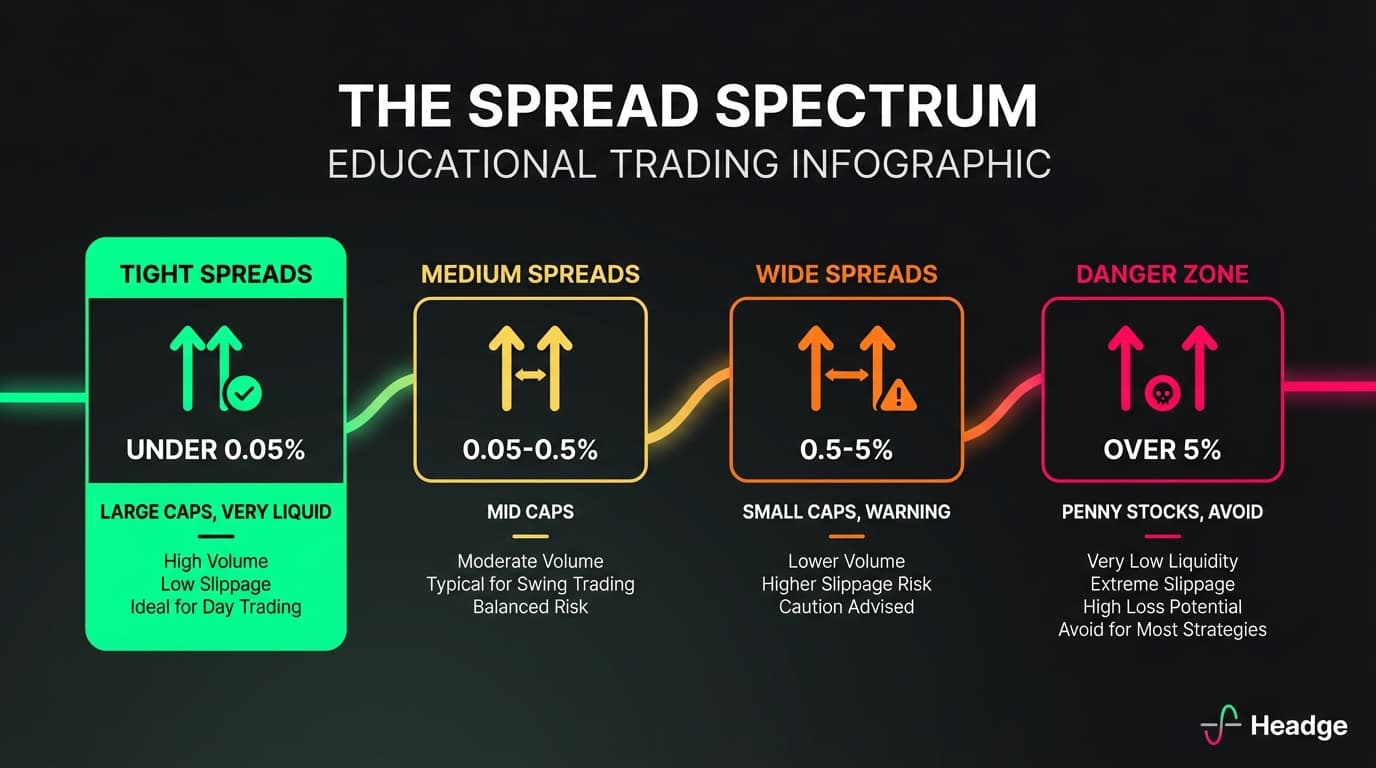
Not all spreads are created equal. The variation is enormous, and it should directly impact how you trade. Tight spreads under 0.05% are what you see in large-cap, actively traded instruments. ES at 4500.00 bid and 4500.25 ask is a spread of 0.25 points, or 0.006%. The spread is almost irrelevant to your trading costs. Day traders prefer these because they can get in and out without giving up much to the spread.
Medium spreads between 0.05% and 0.5% start to matter. A less liquid futures contract might have a 2-tick spread in normal conditions. If you are day trading and expecting a 10-point move, that 0.5-point spread means you need the market to move 1 point just to break even. You pay it on entry and exit.
Wide spreads over 0.5% are warning territory. An illiquid options contract or thinly traded micro contract might have a spread of 5% or more. You are giving up 5% instantly. For the round trip in and out, you are looking at potentially 10% in spread costs alone. Your thesis better be very right and very large.
Danger zone spreads over 5% mean you are not trading, you are being robbed. You need the instrument to nearly double just to cover your execution costs.
Always check the spread before you trade. The quote is not just one price. It is 2 prices, and the gap between them is money you are giving away. If the spread is more than 0.5%, think hard about whether your expected profit justifies that cost.
Let us examine the real math because this is where most traders underestimate the impact. Every complete trade, entry plus exit, crosses the spread twice. You buy at the ask, paying higher than mid-price. You sell at the bid, receiving lower than mid-price. If the spread is 0.50 points and you are trading 10 contracts, your round-trip spread cost is $100. That is $100 your trade needs to profit just to break even.
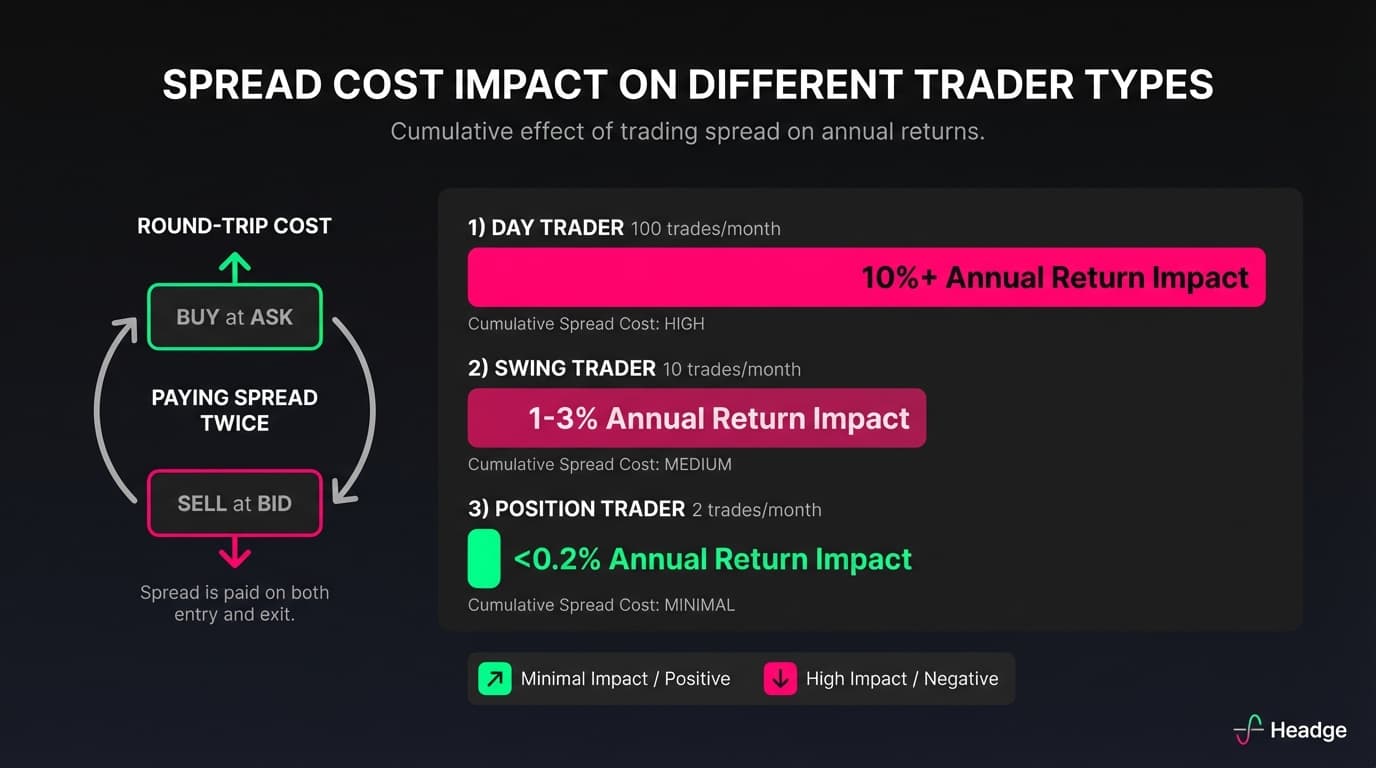
Here is where trading style matters enormously. A day trader making 100 round-trips per month on an instrument with a 0.50-point spread, trading 5 contracts each time, pays monthly spread costs of $5,000 and annual spread costs of $60,000. A swing trader making 10 round-trips per month, same instrument, pays monthly spread costs of $500 and annual spread costs of $6,000. A position trader making 2 round-trips per month pays monthly spread costs of $100 and annual spread costs of $1,200. Same spread. Same contract size. Wildly different impact.
The more you trade, the more the spread eats your returns. A 0.50-point spread seems trivial on 1 trade. It is devastating across hundreds of trades. This is why many high-frequency strategies fail for retail traders. The spread advantage goes to the market makers, not you.
Spreads are not static. They widen and tighten based on market conditions. Knowing when to expect wider spreads can save you considerable money. During high volatility, when markets are panicking, spreads explode. Market makers face greater risk holding inventory, so they demand more compensation. During the March 2020 crash, spreads on some instruments widened 10 times or more. Major news events like Fed decisions, economic data releases, and earnings announcements cause spreads to widen in the minutes before and after because nobody wants to be caught on the wrong side. Pre-market and after-hours spreads are typically 2 to 5 times wider than regular hours. Fewer participants, less liquidity, more risk for market makers. Holiday periods and summer Fridays see spreads quietly widen when participation drops.
The spread is the market's way of taxing activity. The more you trade, the more you pay. The less liquid your instruments, the more you pay. The worse your timing during volatility, news, or off-hours, the more you pay. This is not conspiracy. It is economics. Market makers provide a service, and that service is not free.
Factor spread into your expected returns. If you are targeting a 2% gain and the round-trip spread is 0.5%, you need to actually make 2.5% to hit your target. Trade liquid instruments. Unless you have a compelling edge in thin markets, the spread cost will consume most of your advantage. Trade less frequently. Every trade has a cost. Make sure the expected value of each trade justifies paying that cost. Time your entries. Regular market hours, mid-day liquidity, non-event periods. These small optimizations add up.
The traders who last are the ones who respect these costs. The ones who blow up often ignored them until it was too late.
Next up: I will show you how prices actually form, the continuous negotiation between buyers and sellers that determines what anything is worth at any given moment.