
Who's On The Other Side?
Every trade has two sides, and the person on the other side believes they are the smart money. Every single time. If you do not know who you're trading against, you are likely at a disadvantage. Understanding the four main types of market participants will change how you view every position you take.
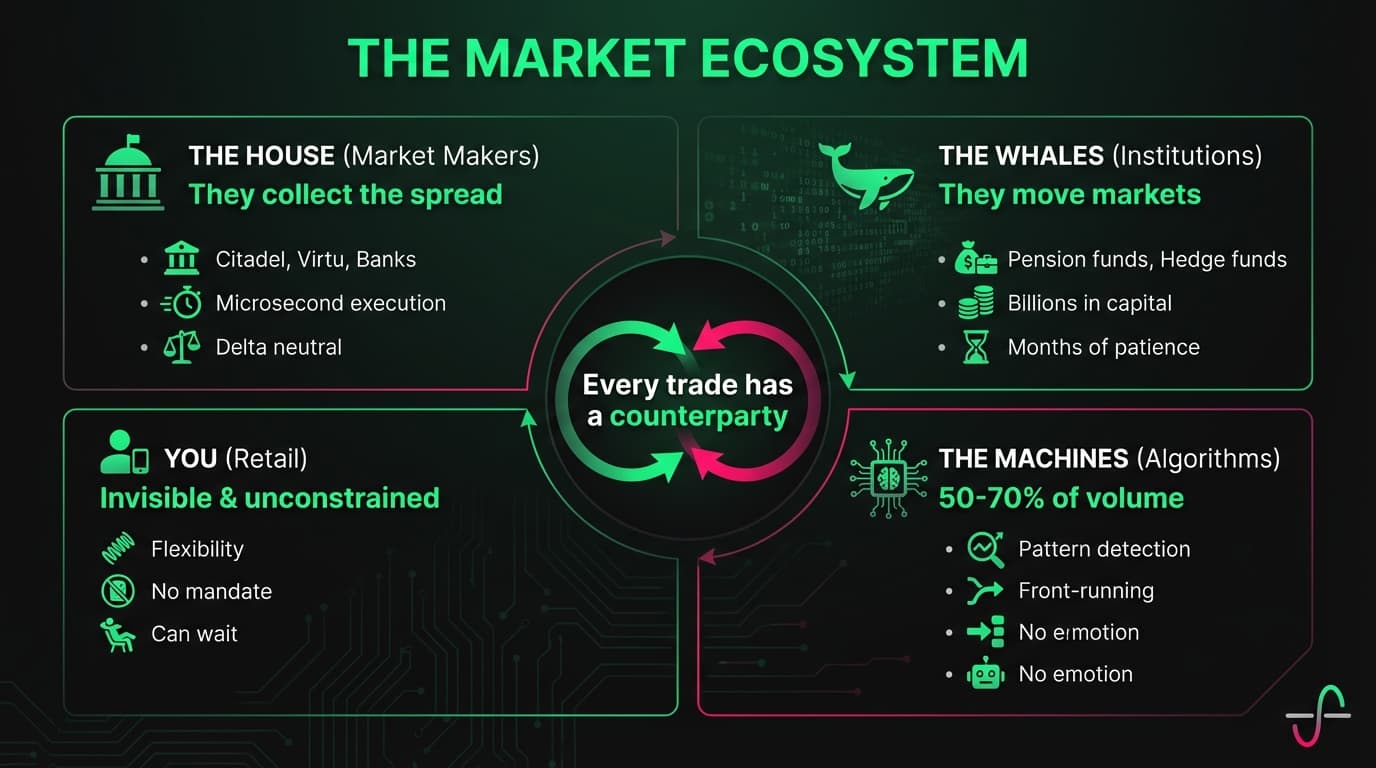
Market makers provide the liquidity that makes markets function. They stand ready to buy at the bid and sell at the ask, collecting the spread millions of times per day across thousands of instruments. On ES or NQ, they might capture a quarter point or less per contract, but they do this across enormous volume. The math is compelling. They are not predicting direction. They are providing a service and getting paid for the risk they assume. When markets become volatile, they widen spreads because holding inventory becomes riskier. This is not manipulation. It is simply pricing risk correctly.
Institutions represent pension funds, mutual funds, hedge funds, and other large players. When a major fund wants exposure to the S&P 500, they are not buying 1 contract. They are buying thousands. And they face a fundamental problem that retail traders do not have: they move the market simply by trading.
You can see this in the tape when large size starts hitting consistently. Price grinds higher on no obvious news. Volume patterns shift. They attempt to hide their activity using algorithms that slice orders into smaller pieces, but footprints that large cannot be completely concealed. Institutions have research teams and resources that individual traders will never match, but they also operate under constraints. Mandates, quarterly reports, and investor pressure limit their flexibility. They cannot simply move to cash because the market looks uncertain. You can close your positions whenever you choose.
Algorithms now account for 50% to 70% of volume in major markets. Some are straightforward, buying when the 50-period moving average crosses above the 200-period. Others employ sophisticated machine learning to identify patterns invisible to most participants. The more advanced algorithms act as predators, detecting when institutions are accumulating and positioning ahead of them.
Algorithms can also create instability. Flash crashes occur when algorithms feed on each other's signals in feedback loops. Price moves because other algorithms are moving, not because fundamentals have changed. This is simply how modern markets operate.
Retail traders are the fourth participant type. Studies indicate that 70% to 90% of retail traders lose money over time. Common mistakes include overtrading, chasing momentum, allowing emotions to drive decisions, and using excessive leverage.
However, retail traders possess advantages that institutions would value highly:
- Invisibility - A 5-contract order in ES does not move the market
- Flexibility - No quarterly reports, no investor calls, no benchmarks to beat
- Speed of decision - Change strategy instantly without committee approval
- Specialization - Focus on specific setups that do not work at institutional scale
You can step away from the market at any moment. A fund manager overseeing billions cannot simply sit in cash because they are concerned about market conditions. They have mandates, investors expecting returns, and career risk. You have freedom.
Here is how these participants interact in practice. An institution decides to increase their equity exposure and begins accumulating E-mini S&P 500 contracts. They cannot simply place a large market order because that would spike the price and destroy their returns. Instead, they use a VWAP algorithm to buy in smaller increments throughout the day, attempting to blend into normal market noise.
But other algorithms are watching. They detect the sustained buying pressure, the slight volume increase, the way bids keep refreshing. They begin buying ahead of the anticipated demand. Market makers notice their inventory depleting and adjust their quotes, nudging price higher and widening spreads slightly. Retail traders see ES moving up, check the news, see nothing significant, and assume someone knows something. They buy. By the close, ES is up 15 points on no major news.
The game is not about being the best at everything. It is about finding the specific situations where your advantages matter and their advantages do not.
You will not out-analyze institutions. You do not have their research budgets. You will not out-speed algorithms. You will not out-capitalize anyone. But you can find the games they cannot play. When an algorithm is designed to trade liquid large-caps, it does not care about your specialized micro-cap setup. When an institution needs to deploy a billion dollars, they cannot touch the same opportunities you can.
The market is not one game. It is thousands of games happening simultaneously. Trading only the most efficient, algorithmically-dominated markets like ES and NQ during peak hours provides limited edge for most retail participants. When you shift to specialized setups, smaller timeframes, or less efficient corners of the market, you can compete. Not because you became smarter, but because you changed the game.
Stop playing their game. Find yours.
Next up: I will look at how orders actually work. The journey from clicking buy to actually holding a position is more complicated than you might think, and understanding it changed how I trade.