
Candlestick Basics
A Japanese rice trader named Munehisa Homma developed candlestick charting in the 1700s to track rice prices. 3 centuries later, these same patterns appear on every trading screen in the world. Candlesticks survived because they work, they compress price action into a visual format that reveals what happened during any time period at a glance. Before indicators, before algorithms, before everything else in technical analysis, you need to read candles. Those wicks tell stories that bar charts cannot. A long upper wick means sellers stepped in. A long lower wick means buyers defended. The body size shows conviction or indecision.
Every candlestick shows 4 prices. Open is where price started for that period. High is the highest price reached. Low is the lowest price reached. Close is where price ended. The body is the rectangle between open and close. It shows the net change. A green or white body means price closed higher than it opened, buyers won. A red or black body means price closed lower, sellers won. The wicks or shadows extend above and below the body. The upper wick shows how high price went before retreating. The lower wick shows how low price went before recovering.
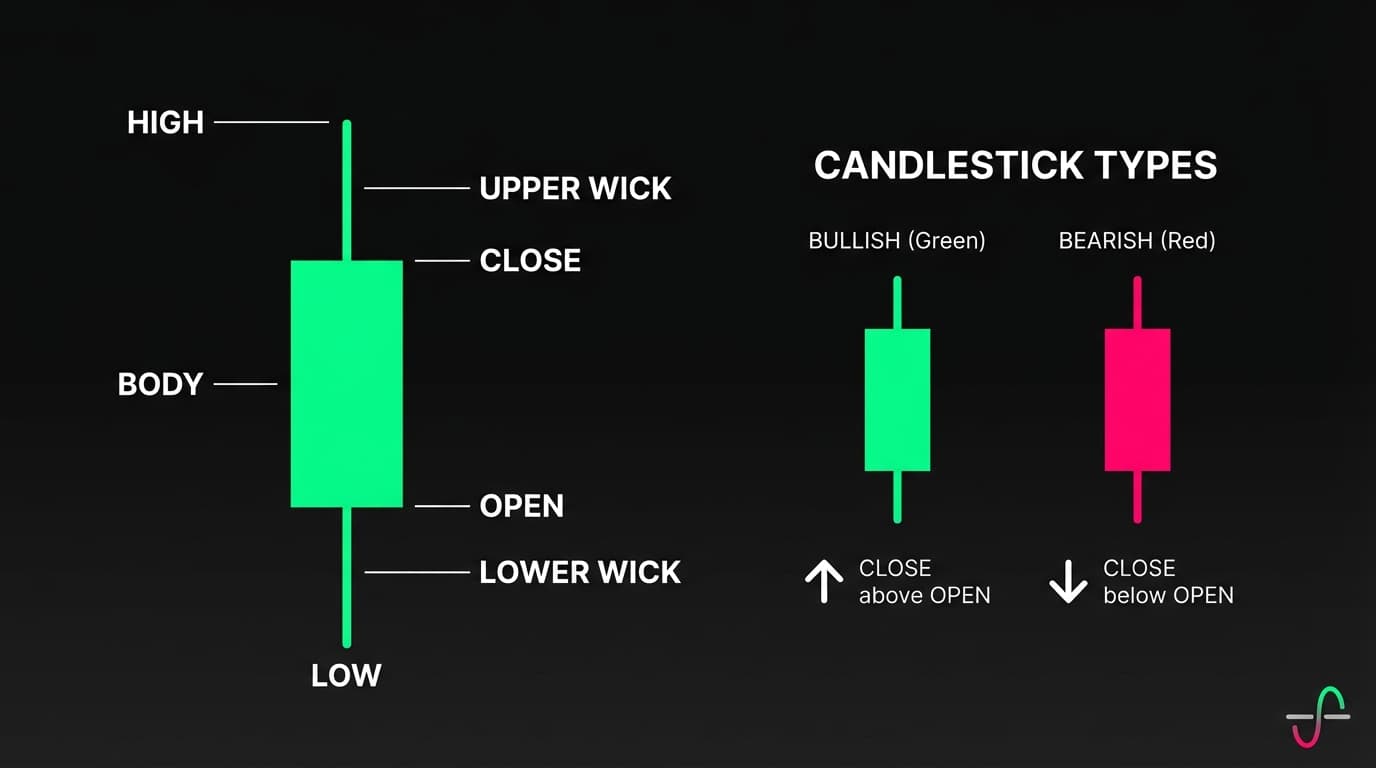
A candle with a large body and small wicks shows conviction, price moved in 1 direction and stayed there. A candle with a small body and large wicks shows rejection, price tried to move but got pushed back. Learning to read this narrative is the foundation of price action trading.
Marubozu means full body with no wicks and represents the most decisive candle. A green marubozu opened at its low and closed at its high, buyers dominated from start to finish with no successful pushback. A red marubozu is the opposite. These show strong momentum. Large body with small wicks shows similar conviction, with minor probes in the opposite direction that failed. Still a strong signal of directional control.
Doji means open and close are virtually identical, creating a cross shape. Neither buyers nor sellers won. The length of the wicks shows how much fighting occurred. Dojis often appear at turning points but need confirmation. Spinning top has a small body in the middle with wicks on both sides. Like a doji but with slightly more directional bias. Still represents indecision.
Hammer is bullish with a small body at the top and long lower wick with little or no upper wick. Price dropped significantly during the period but buyers pushed it back up. When this appears after a downtrend, it signals potential reversal, sellers tried to continue lower but got rejected. Shooting star is bearish with a small body at the bottom and long upper wick with little or no lower wick. Price spiked up but sellers pushed it back down. After an uptrend, this signals potential reversal. Inverted hammer has a small body at the bottom with long upper wick, appearing after a downtrend. Buyers tried to push up but could not hold gains. Despite the failure, it shows buyers are attempting to take control and can precede reversals with confirmation. Hanging man has the same shape as a hammer but appears after an uptrend. Despite the bullish shape, it warns that sellers are becoming active.
A hammer in isolation means nothing. A hammer at a major support level after a steep decline means something. A hammer in the middle of a range is just noise. The same candle pattern has different implications depending on where it appears, at support, resistance, moving averages, or in open space, what preceded it, after a strong trend, during consolidation, or at the start of a move, the volume, with high volume rejection candles carrying more weight than low volume ones, and confirmation, whether the next candle follows through on the pattern's implication.
Memorizing candle patterns without understanding context leads to poor trading. A shooting star that appears mid-trend often fails. A doji in a ranging market means nothing. Always ask where is this happening before assigning significance to any candle.
Long-legged doji is a doji with very long wicks on both sides. Extreme indecision, price moved significantly in both directions before settling near the open. High volatility, no resolution. Gravestone doji is a doji with long upper wick and no lower wick. Price spiked up then crashed back to open. Bearish implications, especially at resistance. Dragonfly doji is a doji with long lower wick and no upper wick. Price dropped then recovered to open. Bullish implications, especially at support. High wave candle has a small body with extremely long wicks. Similar to long-legged doji but with slight directional bias. Signals major indecision and potential reversal.
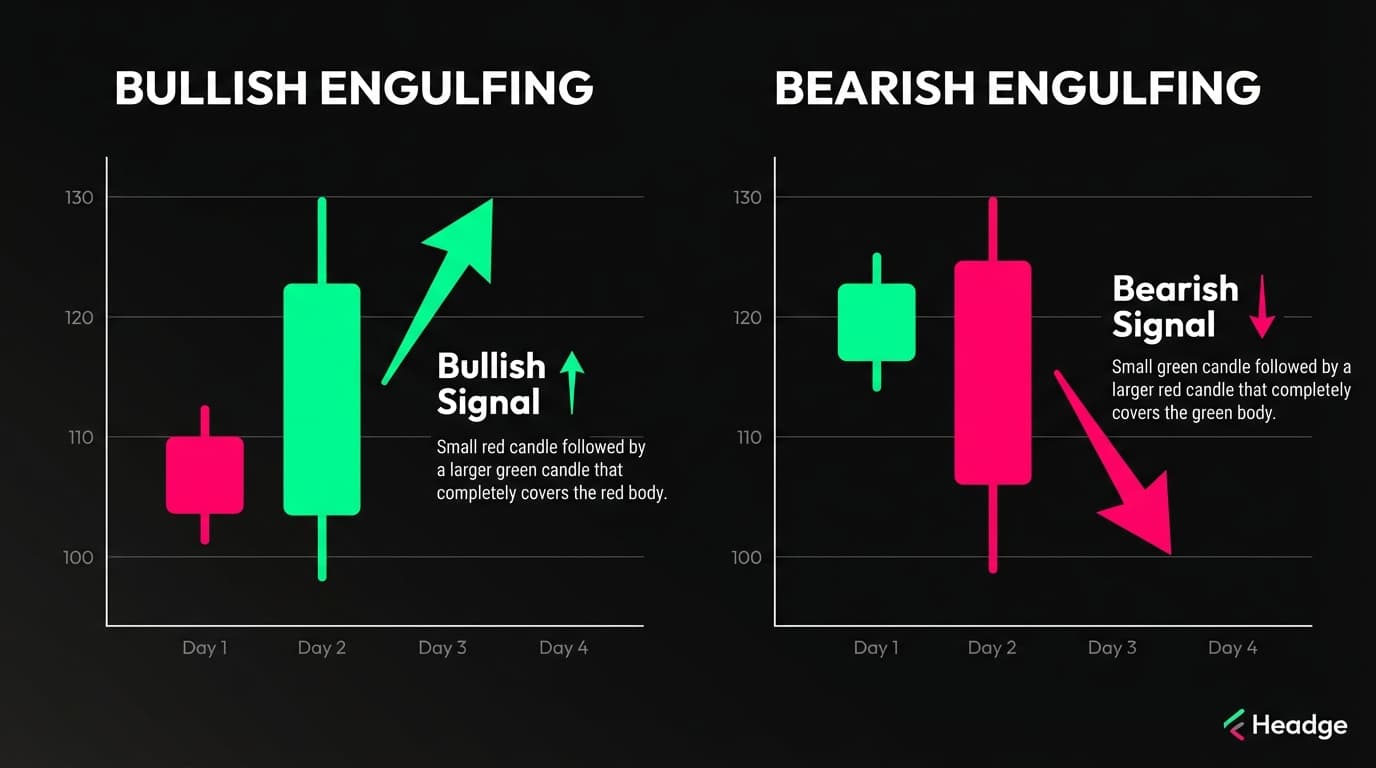
Bullish engulfing is a red candle followed by a larger green candle that completely engulfs the previous body. Shows buyers overwhelming sellers. Most significant at support after a downtrend. Bearish engulfing is a green candle followed by a larger red candle that engulfs the previous body. Sellers overwhelmed buyers. Most significant at resistance after an uptrend.
Piercing line is bullish. A red candle followed by a green candle that opens below the previous low but closes above the midpoint of the previous body. Sellers started in control but buyers took over. Dark cloud cover is bearish. A green candle followed by a red candle that opens above the previous high but closes below the midpoint of the previous body. Buyers started in control but sellers took over.
Morning star is bullish with a 3-candle pattern. First is a large red candle. Second is a small-bodied candle of any color that gaps down. Third is a large green candle that closes well into the first candle's body. The star in the middle shows selling exhaustion, and the third candle confirms buyer return. Evening star is bearish and the opposite of morning star. Large green, small star gapping up, large red closing into the first candle. Shows buying exhaustion and seller return.
When analyzing live charts, start with the current candle's story. Is it showing strength, weakness, or indecision? What does the wick structure tell you about intraperiod action? Compare to recent candles. Is this candle larger or smaller than recent ones? Is it in the same direction or opposite? Breaking new ground or staying in range? Note the location. Is price at a significant level where reaction is expected? Or in open space where trends tend to continue? Wait for closes. An unfinished candle can change completely in its final minutes. Do not make decisions based on incomplete candles.
Candlestick analysis supports trading decisions in several ways. Entry timing means waiting for a confirming candle pattern at your level. Do not just buy support, buy support with a hammer or bullish engulfing. Stop placement means placing stops beyond the wick of the signal candle. If a hammer's low gets taken out, the pattern failed. Momentum assessment means large-bodied candles show conviction and small bodies and dojis show hesitation. Match your position management to the conviction level. Reversal warning means when momentum candles give way to indecision candles, the trend may be weakening. Prepare for potential reversal even if it has not happened yet.
Candlesticks are not magic. They are a visual representation of the battle between buyers and sellers in any given period. Learn to read that battle, and you can see what the market is telling you, before indicators catch up.
Next, I will examine support and resistance, the key price levels where candlestick patterns tend to matter most.