
The Invisible Force That Makes or Breaks Your Trades
You identify what looks like the perfect setup. The chart appears ideal, a clean breakout pattern, volume building exactly as expected. You click buy and your order fills at a price so far from what you expected that your trade is already underwater before you have time to process what happened. Welcome to the liquidity lesson.
Liquidity is your ability to trade without significantly moving the price. That is it. Everything else is details. In a liquid market, you can buy or sell quickly, at prices close to the quoted price, in meaningful size. In an illiquid market, your very act of trading pushes the price against you.
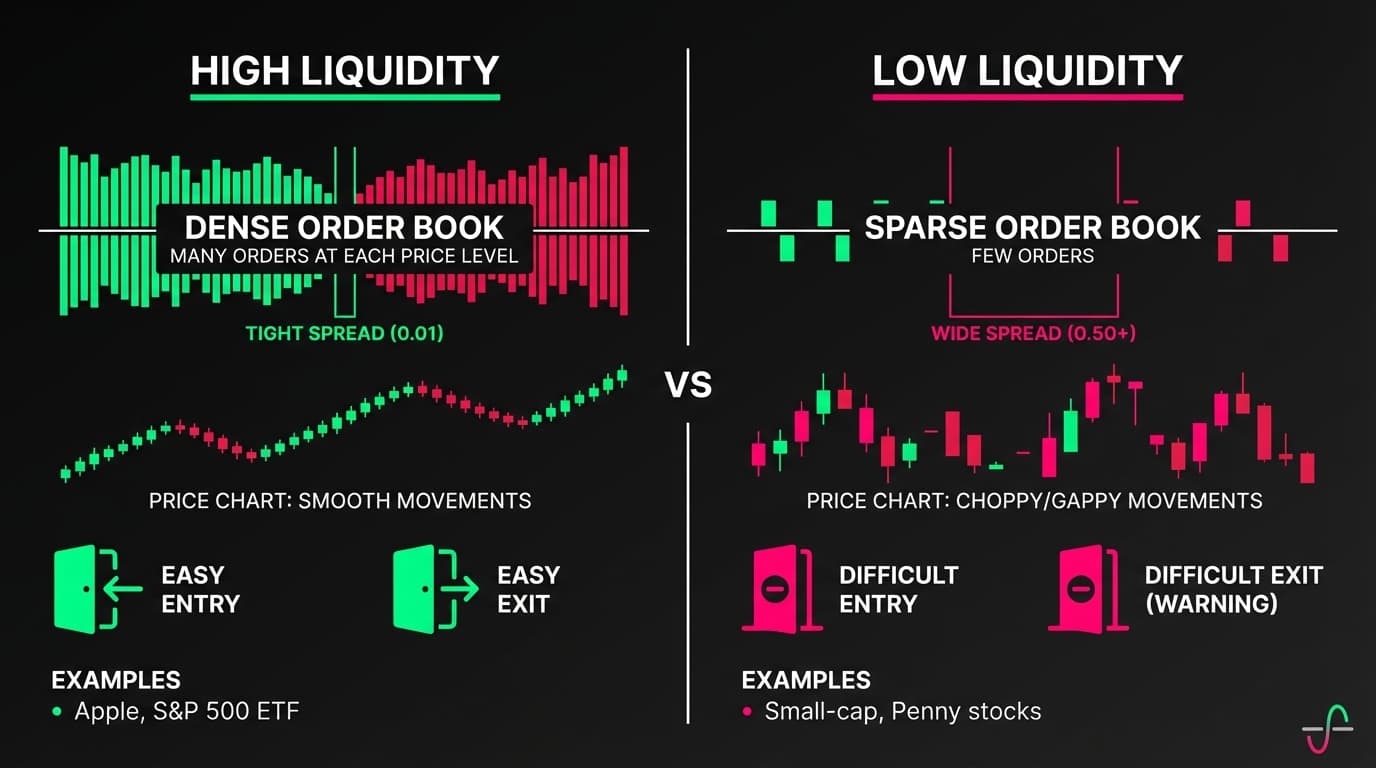
Think of it like selling a house versus selling a futures contract on ES. If you need to sell your house today, you will probably have to accept a significant discount. There simply are not many buyers standing by with cash. But ES trades hundreds of thousands of contracts daily. Your 5-contract order is a drop in an ocean. Nobody notices.
Liquidity determines the real-world friction of executing your ideas. A brilliant trade idea in an illiquid market might be worthless because you cannot execute it at prices that make sense. Liquidity is not glamorous, but it is often the difference between paper profits and real ones.
Liquidity is not one thing. It is several factors, and understanding each helps you assess whether you can actually trade something. Volume indicates how many contracts trade per day. High volume typically means high liquidity. ES trades over 1 million contracts daily. A thin micro contract might trade 5,000. The difference is enormous. But volume alone can mislead. A single large block trade could account for most of the day's volume while actual minute-to-minute liquidity remains thin. Look for consistency, not just totals.
The bid-ask spread tells you something important. A tight spread suggests liquid conditions, meaning many participants are competing to trade. Wide spread means fewer participants and higher friction. When examining a new instrument, the spread is your first liquidity check. If the spread is 3%, you already know execution will be expensive.
Market depth shows how much size sits at each price level in the order book. A contract might have a tight spread but only 10 contracts at the best bid. Your 50-contract order will sweep through multiple levels and your average price will be worse than the quoted price. Depth tells you whether you can actually trade the size you want at reasonable prices.
For futures and options, open interest shows how many contracts are outstanding. High open interest generally means more liquidity. Low open interest means you might be the only one trying to trade that specific contract.
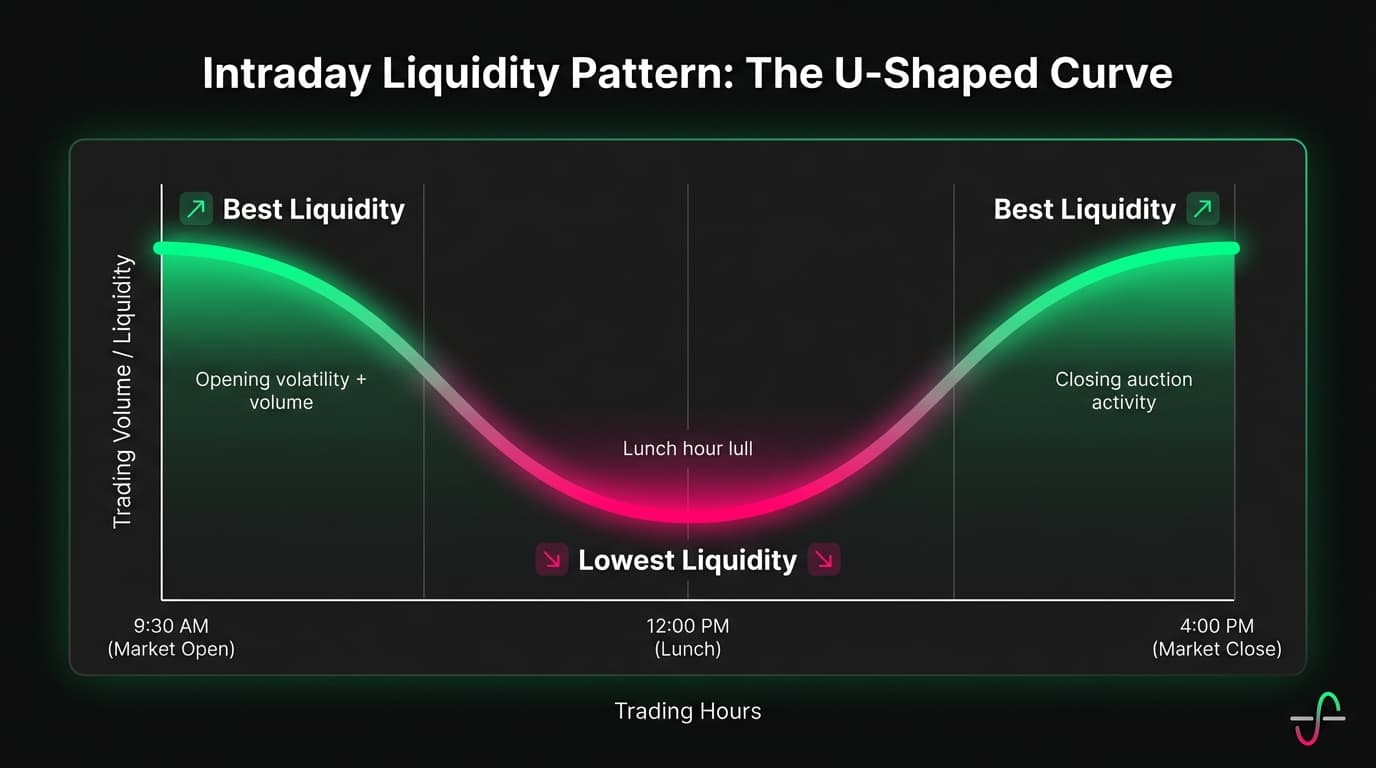
Liquidity is not constant. It varies dramatically depending on when you trade. Understanding these patterns is essential:
-
Market open (9:30 AM ET) - The first 15 to 30 minutes can be chaotic. Large order imbalances, overnight news being digested, wide spreads, volatile prices. Liquidity exists but it is choppy. Many traders stay on the sidelines until things settle.
-
Mid-morning (10:00 to 11:30 AM) - Things typically calm down. Spreads tighten, depth improves, volatility decreases. This is often the best time to execute if you need liquidity.
-
Lunch hour (11:30 AM to 2:00 PM) - Traders go to lunch. Literally. Volume drops, spreads widen slightly, moves can feel random on low participation. Not an ideal time to trade if you can avoid it.
-
Afternoon session (2:00 to 4:00 PM) - Things pick up as the close approaches. The last hour can see significant volume as institutions finish their trading for the day. The close itself often has excellent liquidity.
-
Extended hours - Pre-market (4:00 to 9:30 AM) and after-hours (4:00 to 8:00 PM) have drastically reduced liquidity. Spreads widen, depth shrinks, unusual things happen. Unless you have a compelling reason, stay away.
The best time to trade for most retail traders is mid-morning, after the open has settled but before lunch. The worst times are the first 15 minutes of the day, lunch hour, and extended hours. These patterns exist for a reason: institutional participation follows predictable schedules.
Your trading style needs to match the liquidity available to you. Scalping requires excellent liquidity. You are trying to capture tiny moves, and any slippage destroys your edge. This only works in the most liquid instruments: ES, NQ, major index futures. Do not try to scalp a thin contract with a 1% spread.
Day traders can work with slightly less liquidity, but still need to be selective. A day trading strategy that works perfectly in ES might fail completely in a thin micro contract because execution costs consume the profits.
Swing traders have more flexibility. You can enter and exit over time, using limit orders, waiting for good fills. You can trade moderately liquid instruments if you are patient.
Position traders can handle even lower liquidity. You are building positions slowly, holding for extended periods. The execution costs matter less when you are targeting larger moves.
The worst time to need liquidity is when everyone else needs it too. In a market panic, liquidity evaporates precisely when you want it most. This is counterintuitive but important. Under stress, market makers widen spreads to protect themselves. Traders pull bids. What looked like a liquid market becomes a thin one.
In March 2020, even the most liquid instruments saw spreads blow out and depth vanish. Stops triggered and filled at horrible prices. Strategies that worked fine in normal conditions got destroyed.
Liquidity is always available until you really need it. The markets that look liquid in calm conditions may turn illiquid in stress. This is why position sizing matters. This is why stops cannot save you from gaps. This is why leverage kills.
You cannot control market liquidity, but you can manage your exposure to liquidity risk. Trade liquid instruments. Unless you have a specific edge in illiquid markets, stick to instruments where execution is easy. The opportunities in illiquid names need to be much bigger to compensate for the execution friction. Size positions appropriately. If your position size is a meaningful percentage of daily volume, you are going to have trouble getting in and out without moving the market. Use limit orders. In less liquid conditions, market orders are dangerous. Limit orders let you control your fill price, even if it means not getting filled. Avoid trading during liquidity vacuums. Extended hours, lunch, and market stress are times to be cautious. Have a plan for exits. Before you enter a trade, think about how you will get out if it goes against you. In an illiquid instrument during a selloff, "just sell" might not be a realistic plan.
The traders who survive understand that liquidity is as important as direction. Getting the direction right does not help if you cannot execute.
Next up: I will dig into slippage. The gap between the price you expect and the price you actually get, and how to minimize this constant drain on your trading results.