
VWAP and Deviation Bands
VWAP, Volume Weighted Average Price, is one of the most important tools in institutional trading. It is not a magic indicator. It is a benchmark. And understanding how institutions use it will change how you think about price levels. Every institutional trader watches VWAP. Every execution algorithm considers it. Every fund manager gets measured against it. If you are not paying attention to VWAP, you are missing what the biggest players in the market are tracking.
VWAP is the average price paid for all volume traded during a session, weighted by that volume. It answers a simple question. On average, what price did participants pay today? The formula is cumulative price times volume divided by cumulative volume. Each transaction updates VWAP. A 1,000 contract trade at 4500 moves VWAP more than a 10 contract trade at 4499. The more volume at a price, the more that price influences VWAP. By the end of the day, VWAP represents the true average cost of all contracts traded.
VWAP is not a trading signal, it is a benchmark. Institutions measure execution quality against VWAP. Beating VWAP means buying below average or selling above average. Understanding where price sits relative to VWAP tells you whether current prices favor buyers or sellers.
Here is why VWAP matters so much to institutions. Execution measurement. When a fund buys a large position, they measure whether they did well or poorly by comparing their average fill price to VWAP. Beating VWAP by even a few ticks on thousands of contracts is real money. Algorithmic execution. VWAP algorithms are among the most common. They slice large orders into small pieces timed throughout the day to match typical volume patterns, aiming to get fills close to VWAP. Fair value reference. Throughout the day, VWAP serves as a reference for fair value. Trading above VWAP suggests buyers are willing to pay a premium. Trading below suggests sellers are accepting a discount. End-of-day positioning. Many algorithmic funds use VWAP as a target or benchmark. This creates real order flow around VWAP levels, particularly near the close. When you see price gravitating toward or respecting VWAP, it is not coincidence. It is institutional execution at work.
VWAP alone is useful, but VWAP with standard deviation bands is powerful. Standard deviation bands are drawn at 1, 2, and sometimes 3 standard deviations above and below VWAP. They show how far price has stretched from the average. The first standard deviation is normal trading range. Price often oscillates within this band during balanced sessions. The second standard deviation is extended territory. Price reaching plus or minus 2 standard deviations suggests significant short-term overextension. The third standard deviation is extreme extension. Rarely reached and rarely sustained.
These are not arbitrary lines. In a normal distribution, roughly 68% of data falls within 1 standard deviation, 95% within 2 standard deviations, and 99.7% within 3 standard deviations. While market prices are not perfectly normally distributed, the statistical framework still provides useful context for what is normal versus extreme.
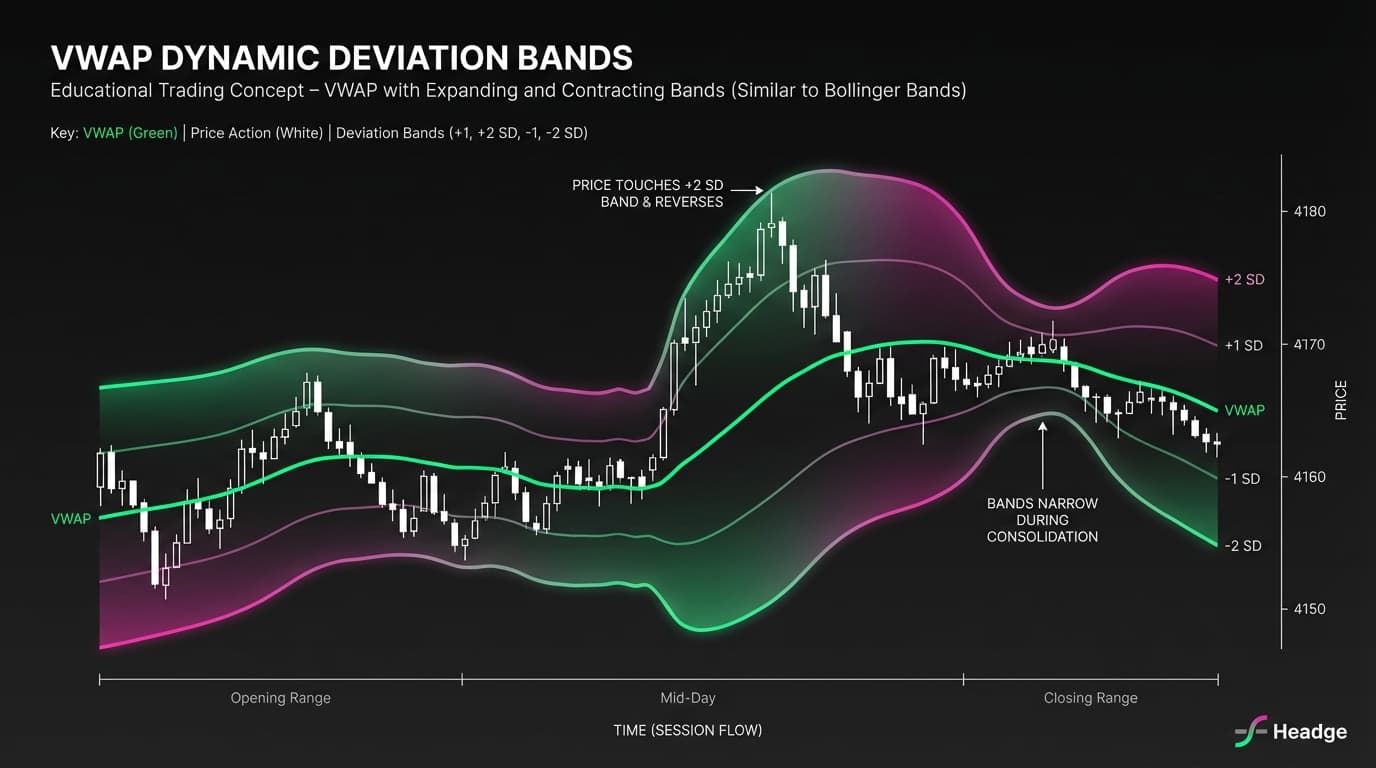
Pay close attention to the second standard deviation band. This is where I consistently see institutional participation. When price reaches the second standard deviation band, it is significantly extended from fair value. This is where institutions often get involved. At plus 2 standard deviations, price is stretched to the upside. Institutions may see this as expensive and begin selling, either taking profits on longs or initiating shorts. At minus 2 standard deviations, price is stretched to the downside. Institutions may see this as cheap and begin buying, either covering shorts or accumulating longs.
I do not trade this blindly. Reaching 2 standard deviations does not automatically mean reversal. But when I see price hit the second standard deviation band and show signs of rejection, absorption on the tape, delta divergence, failed auction, I pay attention. That is often where real supply and demand emerges.
The second standard deviation band often acts as dynamic support or resistance. Unlike fixed horizontal levels, VWAP and its bands move throughout the day based on actual trading. This makes them responsive to current session conditions.
VWAP bands create dynamic support and resistance levels that update in real-time. VWAP itself acts as support or resistance. In a ranging day, price often bounces between VWAP and the deviation bands. VWAP itself acts as a magnet during consolidation. Deviation bands act as extremes. The plus or minus 1 and plus or minus 2 standard deviation bands mark the edges of normal and extended moves. Reversals often start at these levels. Trend confirmation. In a trending day, price staying above VWAP in an uptrend or below VWAP in a downtrend confirms directional bias. Failing to reclaim VWAP after a pullback is bearish in an uptrend and bullish in a downtrend.
What makes this powerful is the institutional context. These are not just arbitrary technical levels. They are benchmarks that actual large participants use for execution decisions. That creates real order flow, real supply and demand.
Here is how I use VWAP and deviation bands in my trading. Morning context. Where is price relative to developing VWAP? Above suggests bullish bias, below suggests bearish bias. This shapes my directional thinking for the session. Entry identification. When looking for entries, I watch for price approaching the second standard deviation band with signs of rejection. A touch of plus 2 standard deviations with delta rolling over, or minus 2 standard deviations with buying absorption, often provides good entry points. Mean reversion setups. On balanced days, fading extreme moves back toward VWAP can be profitable. If price spikes to plus 2 standard deviations and shows exhaustion, targeting a return to VWAP offers a defined trade. Trend day recognition. When price holds above VWAP all day, walking up the upper bands, that is a trend day. I do not fade trend days. VWAP helps me recognize when the market is trending versus ranging. Exit targets. VWAP makes a reasonable profit target for mean-reversion trades. Deviation bands provide targets for extended moves.
Avoid these errors with VWAP. Treating VWAP as a signal. VWAP is context, not a trigger. Price touched VWAP, buy, is not a strategy. Use VWAP alongside other tools like delta, CVD, and footprints to confirm trade ideas. Ignoring the trend. On strong trend days, price can stay above VWAP or below for the entire session. Trying to short every touch of plus 1 standard deviation in an uptrend is a losing approach. Using daily VWAP for swing trades. VWAP resets each session. A daily VWAP level has no relevance the next day. For multi-day trades, you would need anchored VWAP from a significant swing point. Over-reliance on exact levels. VWAP bands are not precise to the tick. Do not expect perfect reversals at exactly plus 2 standard deviations. Use them as zones, not lines.
Both VWAP and Volume Profile use volume, but they measure different things. VWAP is time-weighted average price across the session. It shows where the average transaction occurred over time. Volume Profile shows volume distribution across price levels. It shows where the most transactions occurred regardless of time. They complement each other. Volume Profile shows you the important price levels based on historical acceptance. VWAP shows you the current session's fair value and extensions from it. Use both. The POC from Volume Profile might not equal VWAP, and that is fine. They are answering different questions. POC asks where did the most volume trade. VWAP asks what was the average price paid.
VWAP and deviation bands give you a real-time map of institutional fair value and extension. When price reaches extreme bands and shows signs of rejection, that is often where the bigger players step in. I do not trade VWAP in isolation. It is 1 lens alongside delta, CVD, volume profile, and market structure for understanding what is happening. But it is a lens that aligns with how institutions actually operate, and that makes it valuable.
Next up: I will cover big trades and large order bubbles, how to identify when institutions are hitting the market aggressively and what those footprints mean for price.