
Delta Analysis
Total volume tells you how much trading happened. Delta tells you who was more aggressive. When a buyer places a market order, they lift the offer, buying at the ask price. When a seller places a market order, they hit the bid, selling at the bid price. Delta measures the difference between these 2 types of aggression. This distinction matters because aggression moves prices. Passive orders sit and wait. Aggressive orders execute immediately and consume liquidity. Understanding who is being aggressive reveals the real pressure behind price movement.
Delta is simply volume at ask minus volume at bid. Or in plain terms, aggressive buying minus aggressive selling. When you buy at the ask price, which is a market buy, that volume gets counted as volume at ask. When you sell at the bid price, which is a market sell, that volume gets counted as volume at bid. Positive delta means more aggressive buying than selling. Buyers are lifting offers faster than sellers are hitting bids. Negative delta means more aggressive selling than buying. Sellers are hitting bids faster than buyers are lifting offers. Near-zero delta means balanced aggression. Neither side is dominating.
A candle might show 1,000 contracts traded. Total volume is 1,000. But if 700 were bought at the ask and 300 were sold at the bid, delta is plus 400. That single number tells you buyers were significantly more aggressive during that period.
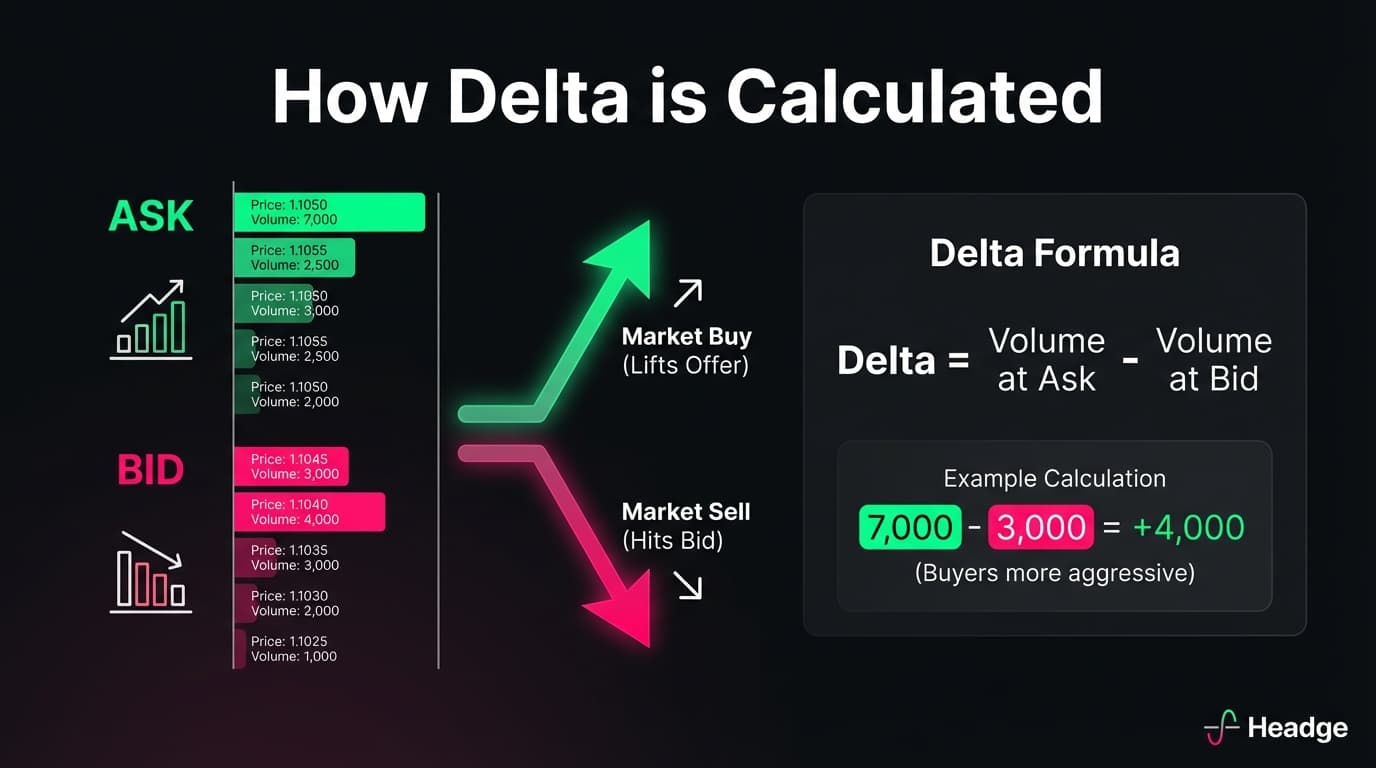
Delta does not measure all buying and selling. It measures aggressive buying and selling. Passive limit orders that provide liquidity do not show up in delta until someone aggresses against them.
Remember the 4 participant types from Market Mechanics? Delta only counts 2 of them, the aggressive ones. Aggressive buyers using market orders want in now. They are willing to pay the ask price for immediate execution. Their volume adds to positive delta. Aggressive sellers using market orders want out now. They are willing to accept the bid price for immediate execution. Their volume adds to negative delta. Passive buyers and sellers place limit orders and wait. They do not directly affect delta. They absorb the aggression of others. This is why delta is powerful. It filters out the passive participants and shows you only the volume that is actively pushing price.
Delta appears in several forms on trading platforms. Per-candle delta shows total delta for each time period. A series of positive delta candles suggests sustained buying aggression. Cumulative delta is the running total of delta over time. Rising cumulative delta means buyers have been more aggressive overall. Falling cumulative delta means sellers have dominated. Delta at price shows delta for each price level, revealing where aggressive buying or selling concentrated. The pattern matters as much as the absolute number. 3 consecutive candles with increasing positive delta tells a different story than 3 candles with decreasing positive delta, even if both periods were net positive.
Just like volume and price, delta and price together reveal more than either alone.
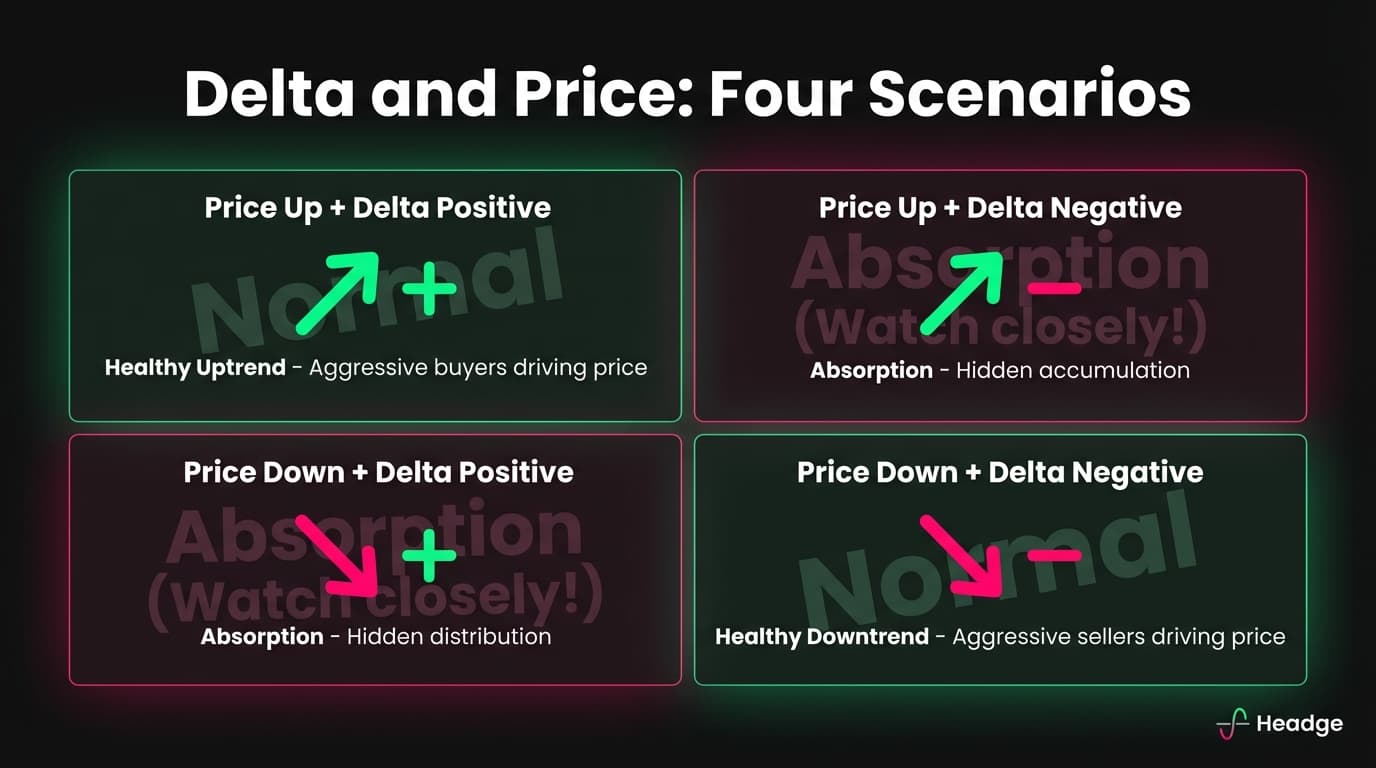
When price is up and delta is positive, you have aggressive buyers driving price higher. This is the healthy uptrend scenario. Price rises because buyers are actively lifting offers. This suggests genuine buying pressure and that the trend is likely to continue.
When price is up but delta is negative, price is rising despite more aggressive selling. How? Passive buyers are absorbing the selling. This is absorption. Someone is quietly accumulating by placing large limit orders that eat the selling pressure. This suggests hidden accumulation and that price may continue higher once selling exhausts.
When price is down and delta is negative, you have aggressive sellers driving price lower. This is a healthy downtrend. Price falls because sellers are actively hitting bids. This suggests genuine selling pressure and that the trend is likely to continue.
When price is down but delta is positive, price is falling despite more aggressive buying. Passive sellers are absorbing the buying. Large limit sell orders are eating the buying pressure without prices rising. This suggests hidden distribution or strong resistance. Supply is overwhelming demand despite aggressive buyers.
The diagonal scenarios, price up with delta positive and price down with delta negative, are straightforward. The off-diagonal scenarios, price up with delta negative and price down with delta positive, are where the interesting information hides.
Absorption occurs when aggressive volume is absorbed by passive liquidity without moving price proportionally. It is visible through the delta-price divergence. Imagine aggressive buyers hitting the market, lifting offers repeatedly. Normally, price would rise as they consume available liquidity at each level. But if a large passive seller has stacked limit orders above, those aggressive buys get absorbed. Price barely moves despite significant aggressive buying. This absorption tells you something important. There is a large passive participant on the other side. When institutions distribute, they often do it through absorption, letting aggressive retail buyers hit their limit sell orders rather than selling into the bid themselves.
When you see high delta without corresponding price movement, look for absorption. Someone with size is quietly taking the other side of all that aggression.
Extremely high positive or negative delta often marks exhaustion points rather than continuation signals. A buying climax shows as a massive positive delta spike, often at a high. Every buyer who wanted in has market-bought simultaneously. Who is left to buy? This often marks short-term tops. A selling climax shows as a massive negative delta spike, often at a low. Capitulation. Everyone who wanted out has market-sold at the same time. Who is left to sell? This often marks short-term bottoms. The logic is simple. Extreme aggression in 1 direction means that side has likely exhausted itself. If everyone who wanted to buy has already bought aggressively, the buying pressure will fade. The same applies to selling. Watch for delta extremes that do not produce proportional price movement. A massive positive delta spike that fails to push price significantly higher suggests the buying is being absorbed by even larger passive selling.
Before adding delta to your analysis, understand what questions it answers. Who is aggressive right now? Current delta tells you whether buyers or sellers are more willing to pay the spread for immediate execution. Is this move genuine? Price movement confirmed by delta in the same direction has more conviction than price movement diverging from delta. Is someone absorbing? Delta-price divergence often reveals large passive participants accumulating or distributing. Is this exhaustion? Extreme delta spikes, especially when price fails to follow, often mark reversal points.
Delta does not predict the future. It reveals the current battle between aggressive buyers and sellers. Used alongside price and total volume, it adds a dimension of information that price charts alone cannot show.
Next up: I will cover Cumulative Volume Delta, CVD, where I track delta over time to see the longer-term battle between bulls and bears.