
Introduction to Footprint Charts
A candlestick shows you 4 prices: open, high, low, close. That is it. A footprint chart shows you what happened at every price level inside that candle. How many contracts traded at the bid, how many at the ask, where the volume concentrated, where imbalances occurred. If a regular candle is a summary, a footprint is the full transcript.
This level of detail is not necessary for every trader. But for those who want to understand the micro-structure of price action, where exactly buyers stepped in, where sellers overwhelmed demand, how a reversal actually formed, footprint charts reveal what other charts hide.
A standard footprint displays volume information at each price level within a candle. The most common format shows bid volume times ask volume. At each price, you see 2 numbers: how many contracts were sold at the bid, aggressive selling, and how many were bought at the ask, aggressive buying. For example, at price level 4150, 250 times 180 means 250 contracts hit the bid and 180 lifted the ask. Delta at this price is 180 minus 250 equals negative 70, meaning sellers were more aggressive. The footprint shows this for every price the candle touched, creating a detailed map of the battle between buyers and sellers.
While candlesticks summarise, footprints detail. You see exactly where aggressive buyers and sellers concentrated, which price levels saw the most activity, and where imbalances occurred. This granularity reveals turning points invisible on regular charts.
The standard layout places bid volume on the left and ask volume on the right at each price level. Reading this candle from bottom to top, at 4148 you see strong aggressive buying with plus 215 delta. At 4149, strong aggressive selling with negative 225 delta. At 4150, moderate aggressive selling with negative 70 delta. At 4151, nearly balanced. At 4152, strong aggressive buying with plus 75 delta. This tells a story. Buyers were aggressive at the low and high of the candle, but sellers dominated in the middle. A standard candlestick would show none of this detail.
Here is something critical that trips up many traders. Imbalance detection uses diagonal comparison, not same-row comparison. Think about what is actually happening in the order book. The ask at price 4150 sits directly above the bid at price 4149. When a buyer lifts the ask at 4150, they are trading with a limit seller at 4150. When a seller hits the bid at 4149, they are trading with a limit buyer at 4149. These 2 prices are adjacent in the order book but appear on different rows in the footprint.
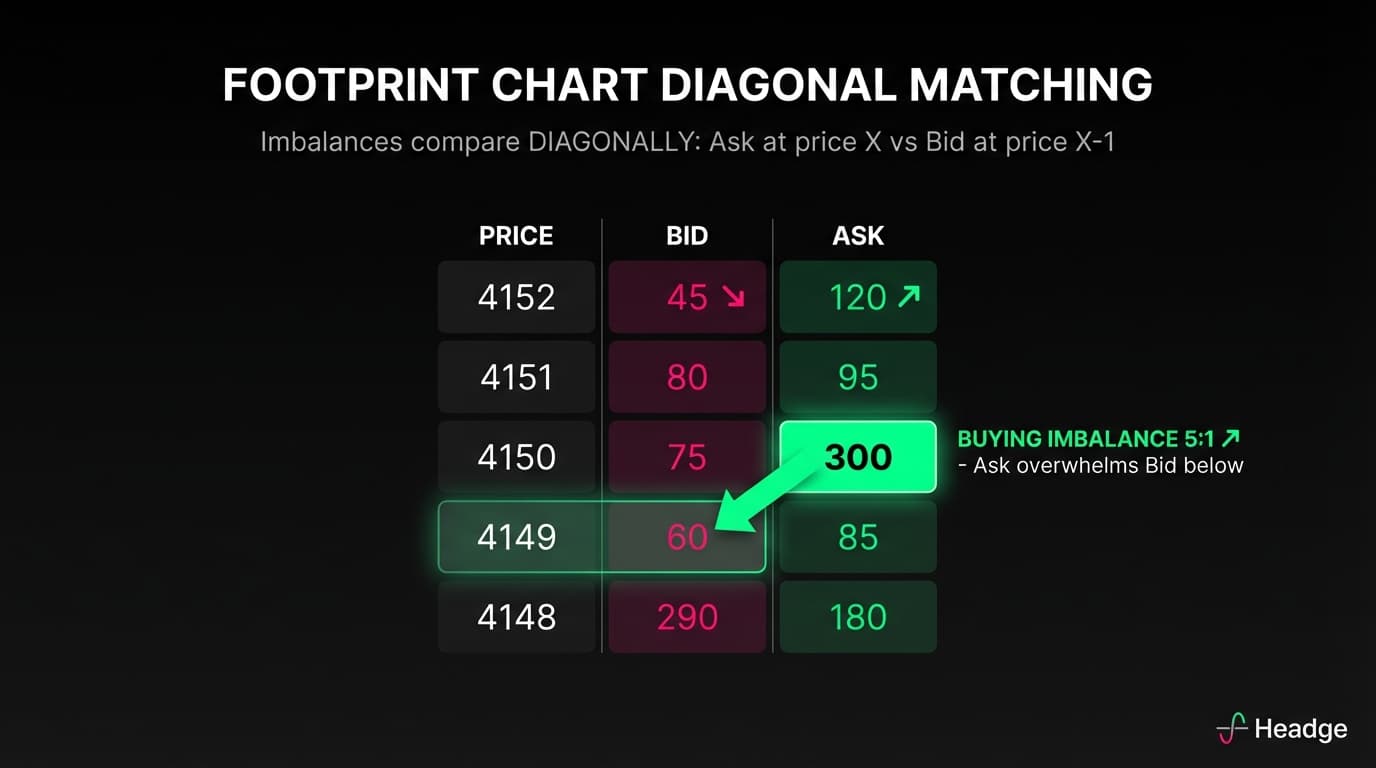
To detect true buying pressure overwhelming selling pressure, you compare diagonally. Buying imbalance at 4150 means comparing ask volume at 4150 with bid volume at 4149, the diagonal below. If 4150 ask is 300 and 4149 bid is 75, that is a 4-to-1 buying imbalance. Aggressive buyers overwhelmed the level. Selling imbalance at 4150 means comparing bid volume at 4150 with ask volume at 4151, the diagonal above. If 4150 bid is 400 and 4151 ask is 100, that is a 4-to-1 selling imbalance.
Delta, same row, tells you net aggression at 1 price. Diagonal comparison tells you whether aggressive buyers overwhelmed the offers above or aggressive sellers overwhelmed the bids below. Both are useful, but diagonal imbalances often mark the most significant price levels.
An imbalance occurs when 1 side overwhelms the other, detected using the diagonal comparison explained above. Common thresholds are 3-to-1 or 4-to-1 ratio. A buying imbalance means the ask volume at 1 price dramatically exceeds the bid volume at the price below diagonally. This shows aggressive buyers lifting offers faster than sellers can hit bids, real buying pressure. A selling imbalance means the bid volume at 1 price dramatically exceeds the ask volume at the price above diagonally. This shows aggressive sellers hitting bids faster than buyers can lift offers, real selling pressure.
Stacked imbalances are multiple consecutive price levels showing diagonal imbalances in the same direction. 3 or more stacked buying imbalances suggests strong institutional buying. Someone is aggressively accumulating and overwhelming each price level. Stacked selling imbalances suggests distribution or panic liquidation.
Absorption appears when high volume occurs at a level without corresponding price movement. On a footprint, you would see large numbers on both sides meaning high volume, relatively balanced delta meaning aggression absorbed, and price unable to push through despite the activity. This often occurs at key support or resistance. Someone with size is absorbing the aggression, preventing price from moving.
Exhaustion shows as declining volume and delta as price extends. The footprint might show heavy volume at the start of a move, progressively smaller volume at each new price level, and final prices with minimal participation. The move ran out of fuel. Fewer participants were willing to chase at extreme prices.
Initiative activity is aggressive trading that pushes price to new levels. On a footprint, you see imbalances and volume leading the direction. Responsive activity is aggressive trading that rejects a price level and pushes back. You see the price probe to a level, meet responsive aggression, and reverse. At support, responsive buyers step in with aggressive buying. At resistance, responsive sellers appear. The footprint shows exactly where they entered.
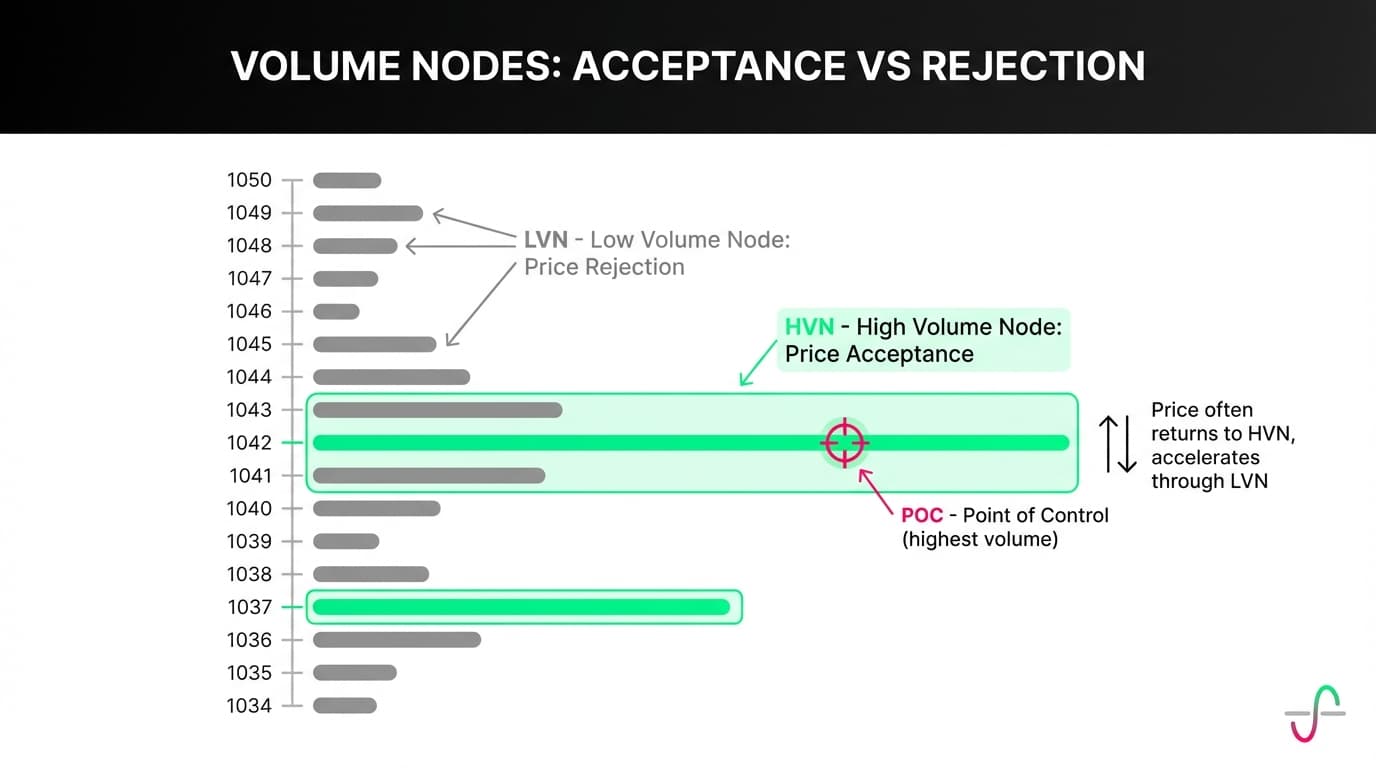
Footprints reveal which price levels attracted the most trading. High Volume Nodes are prices with unusually large volume. These often become future support or resistance. The market accepted this price. Lots of business got done there. Low Volume Nodes are prices with minimal volume. The market rejected these prices, moving through quickly. Price often accelerates through LVNs on retests.
Within a single candle, you might see heavy volume at the open, initial auction, light volume as price trends, and heavy volume at the close, final auction. This internal structure tells you whether the move was decisive or struggled.
When analyzing footprint charts, focus on where imbalances occurred. Mark prices with 3-to-1 plus imbalances. These levels often become future reference points. Look at the delta distribution. Was aggressive buying concentrated at lows, support, or highs, breakout? Was selling concentrated at highs, resistance, or lows, capitulation? Find where the volume was. High volume areas show price acceptance. Low volume areas show rejection. The Point of Control, highest volume price, often acts as a magnet. Read the narrative. Read the footprint like a story. Buyers were aggressive at support, pushed price up through light resistance, met responsive sellers at the high, but the selling was absorbed, and buyers finished strong.
Start with identifying just 1 thing: where was the highest volume price, and where were the imbalances? This alone provides valuable context that regular candles cannot show.
Different platforms offer different footprint styles. Bid times ask is the standard format showing volume at bid and ask at each price. Delta footprint shows only the delta, ask minus bid, at each price. Simpler but loses the individual bid/ask detail. Volume footprint shows total volume at each price without bid/ask separation. Profile footprint combines footprint data with a volume profile on the side. The bid times ask format provides the most information, but simpler formats can be easier to read quickly.
Footprint charts are not for everyone. The detail can be overwhelming. Focus on specific patterns rather than trying to process everything. Accurate bid/ask attribution requires quality data feeds. Poor data produces misleading footprints. Swing traders holding for days rarely need intra-candle detail. Footprints are most valuable for short-term and intraday traders. Reading footprints takes practice. Start with replay data where you can pause and study patterns before trading live.
For traders who want to see the market at its most granular level, footprint charts reveal the actual battle between buyers and sellers. They show not just what price did, but how and why it got there.
Next up: I will show you volume profile, the horizontal view of volume that shows where price spent time and where it just passed through.