
Volume Profile
Most charts show volume as bars beneath price, plotted over time. Volume profile rotates that view 90 degrees. Instead of asking how much volume occurred at each time, it shows how much volume occurred at each price. This horizontal view reveals something time-based charts cannot. It shows where the market actually did business versus where it simply passed through.
A price level with heavy volume is a price the market accepted. Participants found it fair, and transactions happened. A price level with light volume is a price the market rejected. It moved through quickly, finding few willing counterparties. This distinction creates a roadmap for future price action that has saved me from bad entries more times than I can count.
A volume profile displays horizontal bars extending from each price level. Longer bars mean more volume at that price. The result is a histogram that shows the distribution of trading activity across prices. The Point of Control or POC is the price with the highest volume. This is where the most trading occurred, the fairest price according to participants during that period. The Value Area or VA is the price range containing approximately 70% of all volume. This represents where most business got done, the zone of acceptance. The Value Area High or VAH is the upper boundary of the value area. The Value Area Low or VAL is the lower boundary. High Volume Nodes or HVN are price levels with significantly higher volume than surrounding levels. Multiple HVNs can exist within a profile. Low Volume Nodes or LVN are price levels with significantly lower volume than surrounding levels. These gaps in the profile show rejected prices.
The volume profile shows you where price was accepted, high volume, versus rejected, low volume. Price tends to spend time at accepted levels and move quickly through rejected ones. The POC acts as a magnet and the value area defines fair price range.
The Point of Control has a gravitational pull on price. Markets tend to trade back toward the POC, especially during balance phases. The POC represents the price where the most business was transacted. Both buyers and sellers found it acceptable. It is the market's consensus on fair value for that period. When price moves away from the POC, it is exploring. It is asking whether value is really higher or lower. If the exploration fails to find acceptance, meaning volume does not build at new prices, price often returns to the POC. Think of the POC as home base. Price ventures out, but frequently returns unless it establishes a new home.
The value area encompasses roughly 70% of total volume, 1 standard deviation around the POC. Prices within this range are fair according to the market's collective action. When price is above the value area, buyers are willing to pay more than recent fair value. Either something changed, or price will reject back into value. When price is below the value area, sellers are accepting less than recent fair value. Either something changed, or price will bounce back into value. When price is within the value area, that is normal trading. Price is within the range most participants found acceptable.
Watch for value area tests. When price returns to the VAH or VAL from outside the value area, that boundary often acts as support or resistance. A failure to re-enter value can signal trend continuation.
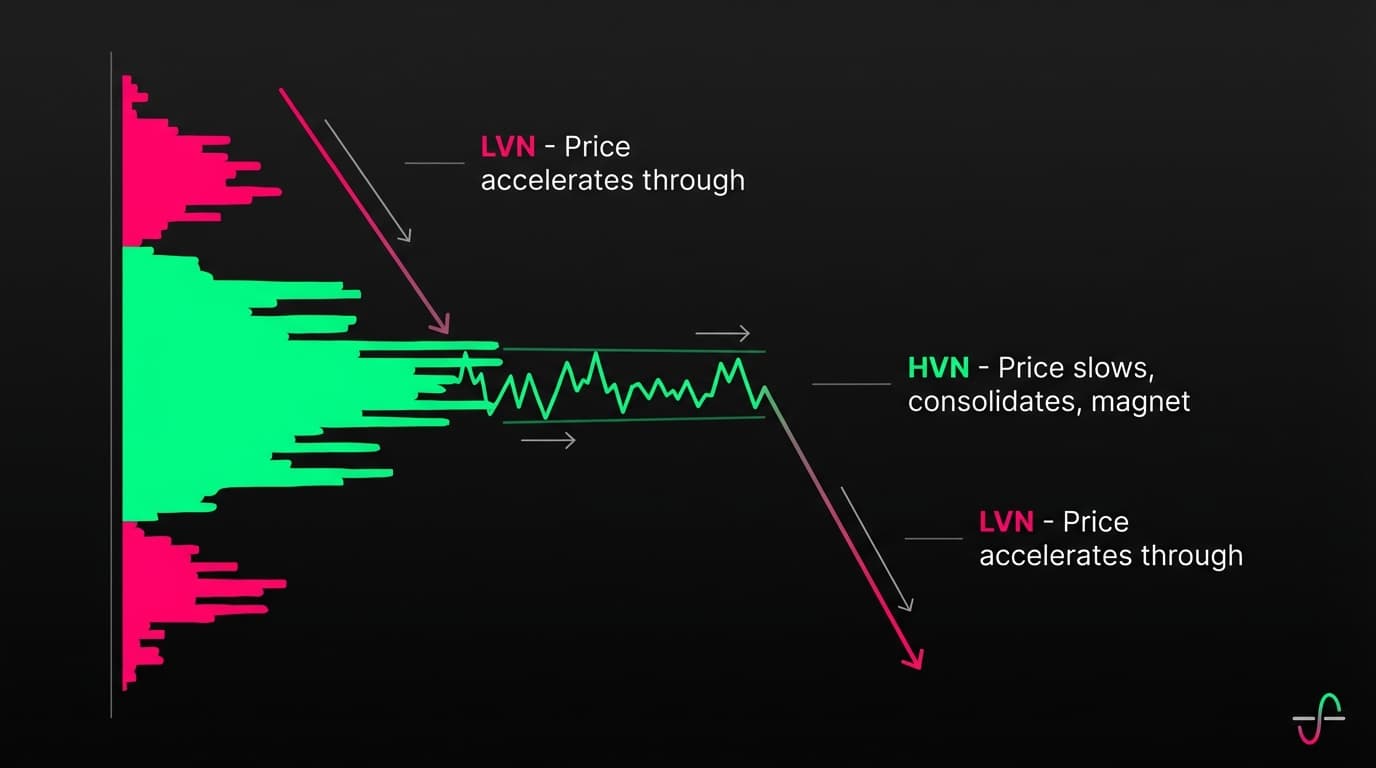
Beyond the POC and value area, the profile's shape tells a story. High Volume Nodes are areas where volume concentrated. These act as magnets where price tends to gravitate, speed bumps where price often slows or consolidates, and support or resistance levels where HVNs from prior sessions can act as future support and resistance. When price approaches an HVN, expect slowdown and potential consolidation. Lots of transactions happened there before. Participants may have interest at that level again.
Low Volume Nodes are areas where volume was thin. These act as rejection zones where price was not accepted, acceleration zones where price tends to move quickly through LVNs, and breakout signals where clearing an LVN often leads to fast moves to the next HVN. When price approaches an LVN, watch for acceleration. If it breaks through, the move often continues rapidly until it hits the next significant volume level.
Different profile periods serve different purposes. A session profile shows volume distribution for a single trading session. It is useful for day trading reference points, understanding today's market structure, and identifying session-specific support and resistance. A composite profile shows volume distribution across multiple sessions. It is useful for swing trading reference points, identifying major acceptance zones, and understanding broader market structure. A developing profile updates as the session progresses. It is useful for real-time context, watching the value area develop, and identifying when the market is building acceptance versus rejecting. A fixed range profile shows volume distribution for any custom price or time range. It is useful for analyzing specific moves, finding volume gaps in historical swings, and custom reference points.
Market Profile was developed by J. Peter Steidlmayer and uses time instead of volume. Each 30-minute period gets a letter, TPO for Time Price Opportunity. The profile shows how many time periods price spent at each level. Volume Profile shows actual volume traded at each level. When they agree, both show similar shapes, confirming acceptance and rejection zones. When they differ, a level might show high time, meaning price lingered, but low volume, meaning few transactions, or low time, meaning quick move through, but high volume, meaning lots of business at those prices. Volume profile generally reflects actual participation better. Most modern traders prefer volume profile for its direct measurement of transactions, though some combine both views.
When using volume profile, identify the POC first. Where was the most volume? This is your anchor point. Expect price to gravitate here during balance. Mark the value area. Know the VAH and VAL. These boundaries often act as support and resistance. Find HVNs and LVNs. Mark significant nodes on your chart. Expect slowdown at HVNs and acceleration through LVNs. Compare to current price. Is price above value, below value, or within value? This context shapes your bias. Layer multiple profiles. Yesterday's profile, the weekly profile, and today's developing profile each provide different information. Watch for single prints. Areas of the profile with minimal volume, single prints or low volume, often get revisited. They represent unfinished business.
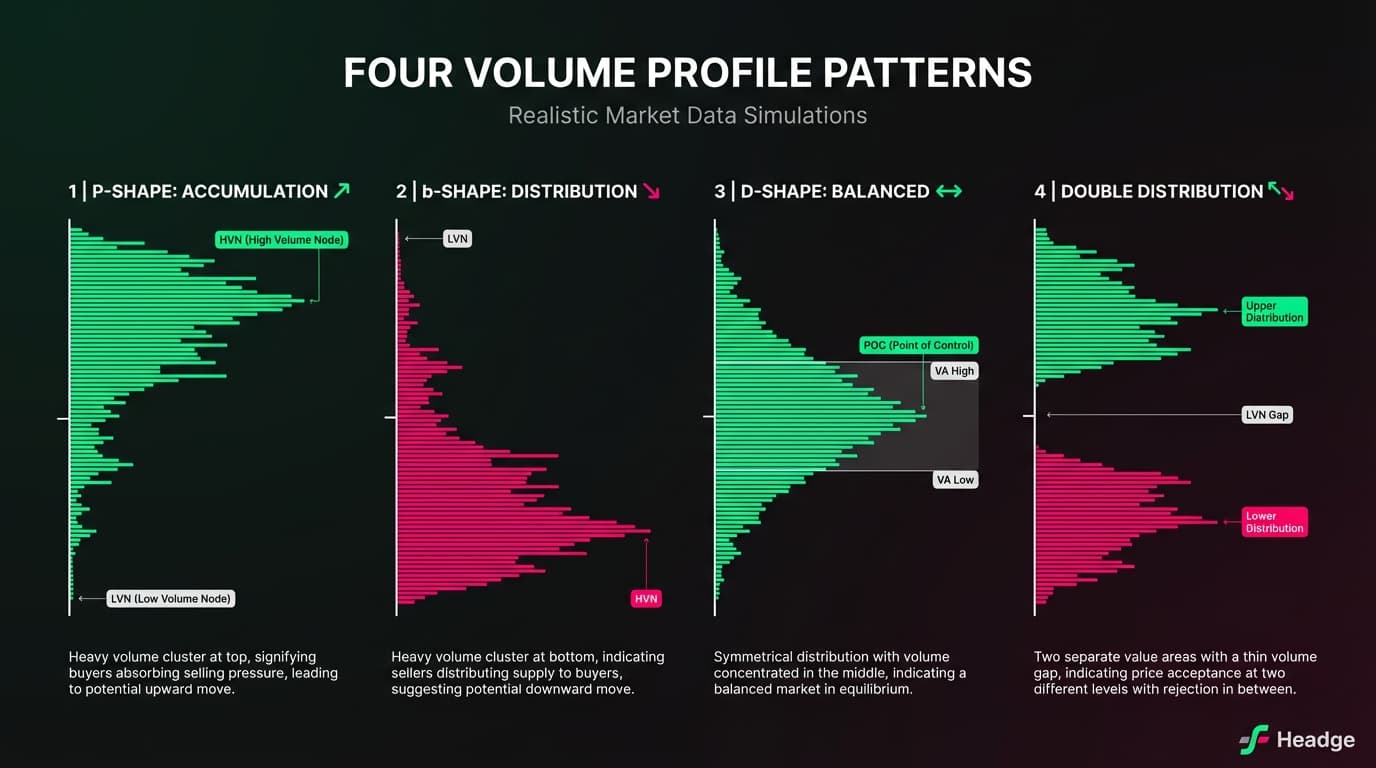
There are common volume profile patterns to watch for. A P-shape shows heavy volume at upper prices and thin volume below. This suggests accumulation. Longs established at higher prices. A b-shape shows heavy volume at lower prices and thin volume above. This suggests distribution. Shorts established at lower prices. A D-shape or normal distribution shows a bell curve with most volume in the middle. This is a balanced, rotational market where fair value is clear. A double distribution shows 2 distinct volume clusters with an LVN between. The market is divided between 2 value areas. Watch for which side captures volume going forward. These shapes provide context for bias. A P-shape above yesterday's value suggests bullish continuation. A b-shape below suggests bearish continuation.
Next up: I will cover VWAP and deviation bands, the institutional benchmark for fair value and how traders use standard deviation bands for entries.