
Volume Divergences
Price makes a new high. The crowd cheers. But volume is lower than the previous high. Delta is weaker. CVD is flat. The new high looks impressive on the chart, but the internals tell a different story. This is a divergence. When price says 1 thing and volume says another. Divergences do not guarantee reversals, but they are often the first warning that a move is losing steam. Learning to spot these disagreements gives you an edge. You see the weakness before it shows up in price.
A divergence occurs when price action and volume-based indicators move in opposite directions or fail to confirm each other. Bearish divergence happens when price makes a higher high, but volume, delta, or CVD makes a lower high or fails to confirm. The move up has less participation than before. Bullish divergence happens when price makes a lower low, but volume, delta, or CVD makes a higher low or fails to confirm. The move down has less participation than before. The logic is simple. If a trend is healthy, each new extreme should have at least as much participation as the last. When participation declines while price extends, the trend is running out of fuel.
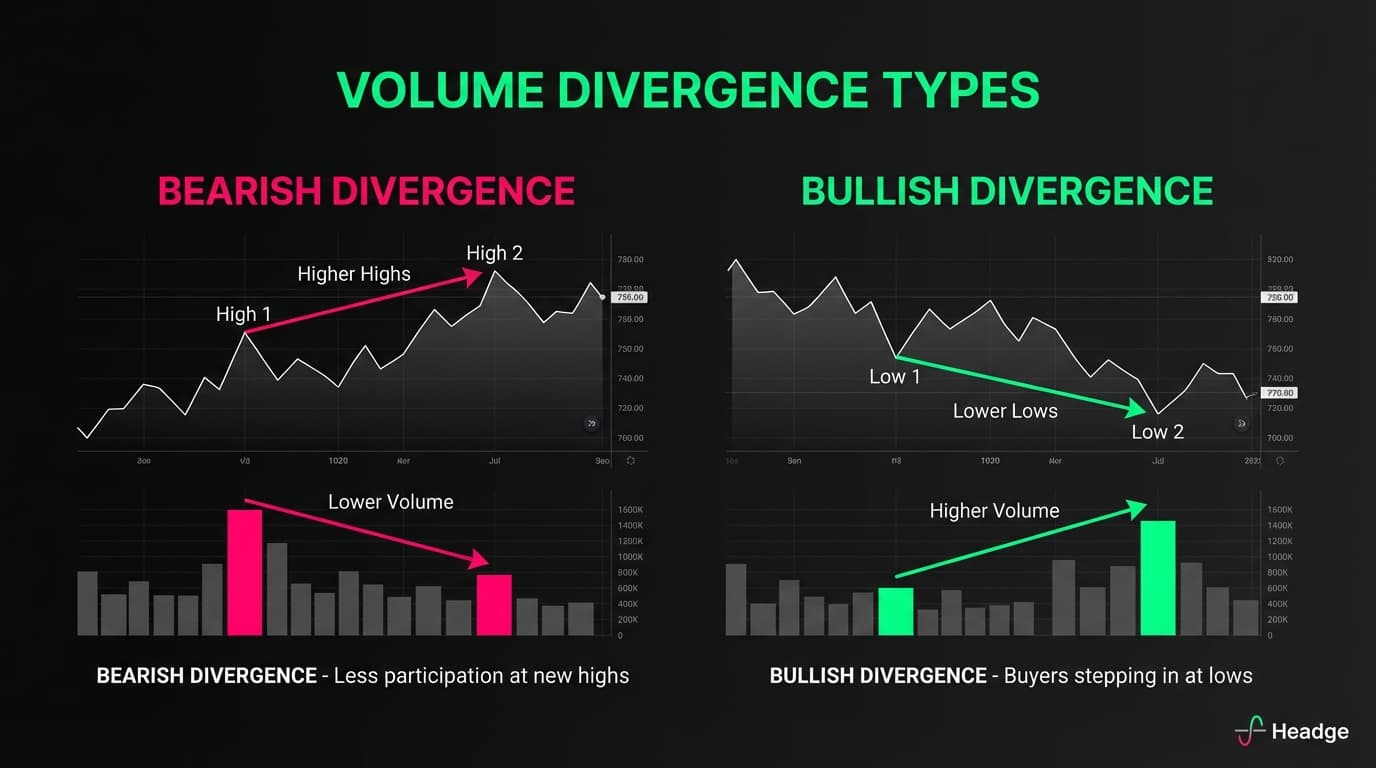
The most basic divergence compares price highs and lows to volume. At tops, price makes a new high but volume is lower than at the previous high. The interpretation is that fewer participants are willing to buy at these elevated prices. At bottoms, price makes a new low but volume is lower than at the previous low. The interpretation is that selling pressure is exhausting and fewer participants are willing to sell at these depressed prices.
Healthy trends show volume expanding as price extends. When new price extremes occur on declining volume, it signals that conviction is fading. The move may continue briefly, but the foundation is weakening.
This does not mean sell immediately at a bearish divergence or buy immediately at a bullish 1. It means be alert. The trend is showing cracks.
Delta divergence adds precision by measuring aggressive participation. Bearish delta divergence happens when price makes a higher high but delta at the new high is lower, meaning less aggressive buying, or when delta is negative despite the new high, meaning aggressive sellers are present. Bullish delta divergence happens when price makes a lower low but delta at the new low is less negative, meaning selling pressure is weakening, or when delta is positive despite the new low, meaning aggressive buyers are stepping in. Delta divergence often leads price-volume divergence because it measures the aggressive component specifically. You might see healthy total volume but weak delta. Lots of transactions, but the aggressive side is fading.
CVD divergences track the running battle over time. Bearish CVD divergence happens when price trends higher or makes new highs but CVD is flat or declining. The interpretation is that aggressive buyers are not winning. Despite higher prices, sellers are absorbing or dominating. Bullish CVD divergence happens when price trends lower or makes new lows but CVD is flat or rising. The interpretation is that aggressive sellers are not winning. Despite lower prices, buyers are absorbing or dominating.
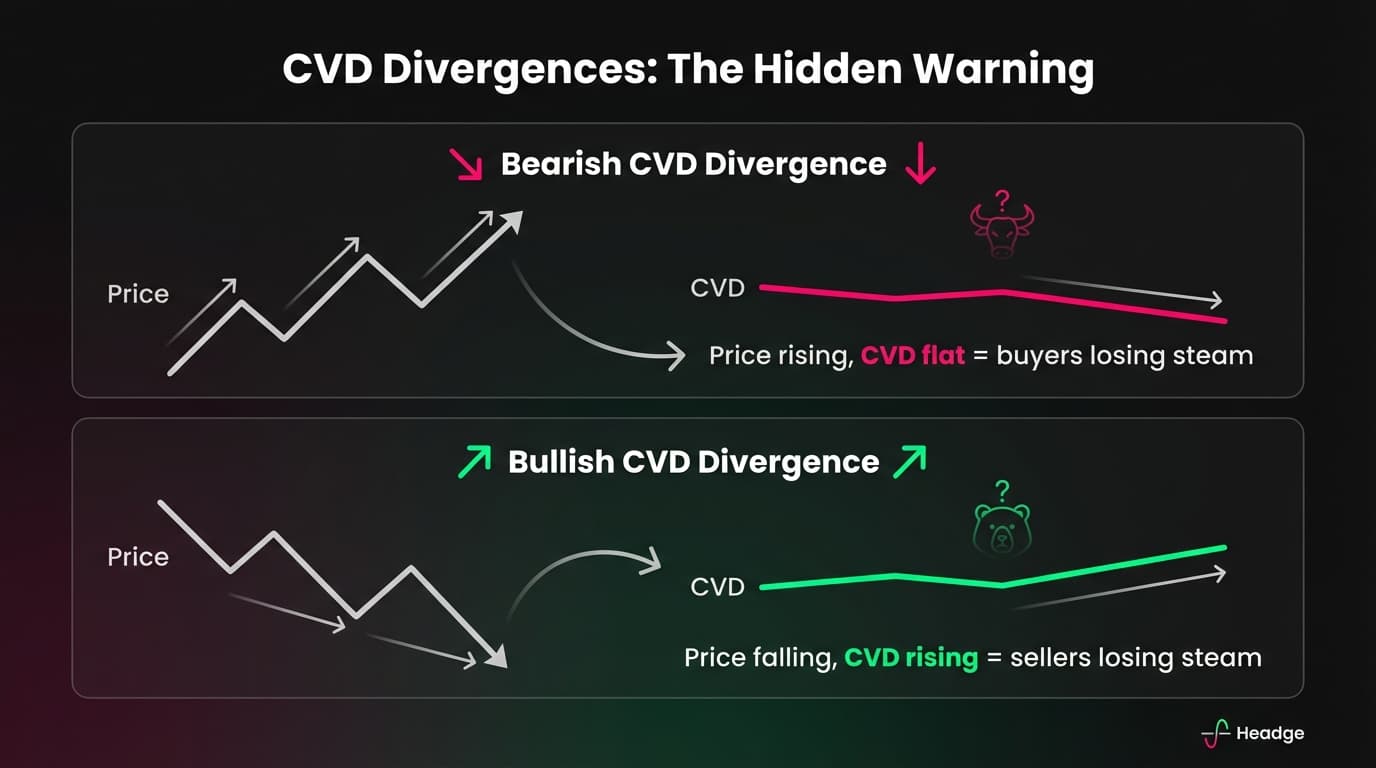
CVD divergences are particularly powerful because they accumulate over time. A single candle's delta might be noisy, but CVD smooths that noise and shows the persistent trend.
The strongest warning comes when price, volume, delta, and CVD all diverge together. If price is making new highs but volume is declining, delta is weakening, and CVD is flat, that is triple confirmation that the move is exhausting.
A divergence on a 5-minute chart might just be noise. A divergence on the daily chart is more significant. When multiple timeframes show the same divergence, the signal strengthens. A strong signal would be daily chart showing price at a new high with volume declining, 4-hour chart showing bearish CVD divergence, and 1-hour chart showing delta weakening at each push higher. A weak signal would be 5-minute chart showing price at a new high with volume slightly lower, while higher timeframes show no divergence and all confirming. Always check higher timeframes before acting on lower timeframe divergences. Minor divergences in the direction of the larger trend often fail.
Not every divergence leads to reversal. Common false divergence scenarios include when the trend is too strong. In powerful trends, divergences can persist for extended periods. Price keeps making new highs on declining volume, then makes another new high, then another. The divergence was right about weakening conviction but wrong about timing. Low volume environment is another scenario. During quiet periods, volume naturally declines. A new high on slightly lower volume might not be meaningful if absolute volume is low anyway. News or event distortion is another case. If a divergence coincides with a major news event, the context changes. Volume patterns around events do not follow normal rules. Single-candle anomaly is another. 1 candle with unusual volume can create a divergence that is not meaningful. Look for patterns over multiple swings, not just 1 comparison.
To improve divergence signal quality, require multiple swings. Do not act on the first divergence. Wait for price to make at least 2 higher highs with declining volume before considering it significant. Check the context. Divergences at obvious support or resistance levels are more likely to matter. Divergences in the middle of nowhere are more likely to fail. Confirm with price action. A divergence plus a reversal candlestick pattern plus a break of short-term structure is more meaningful than divergence alone. Respect the trend. Bullish divergences in uptrends are continuation signals, buying the dip with strong hands. Bearish divergences in uptrends are caution signals but not automatic shorts. Use appropriate timeframes. The timeframe of the divergence should match your trading timeframe. Day traders should not obsess over weekly divergences.
When you spot a potential divergence, identify the divergence type. Is it price-volume, delta, CVD, or multiple? Check the timeframe context. How significant is this timeframe for your trading? Look for confirmation. Is this the first sign or have there been multiple divergences? Assess the trend strength. Divergences against strong trends often fail. Wait for trigger. Divergence alone is not an entry signal. Wait for price to confirm with a reversal pattern or break of structure. Manage risk accordingly. If trading a divergence, stops should account for the possibility of 1 more push to a new extreme.
The best use of divergences is not as direct entry signals. It is as context for other decisions. A divergence means be cautious about chasing. A divergence means tighten stops on existing positions. A divergence means this level is more likely to hold as support or resistance. A divergence means the counter-trend setup here has better odds. Traders who treat divergences as automatic reversal signals get frustrated. Traders who treat them as warning lights that change their risk management tend to benefit. The market does not have to reverse just because participation is waning. But knowing participation is waning changes how you should position.
Next up: I will consolidate everything in a module review and test your understanding of volume analysis principles.