
Cumulative Volume Delta (CVD)
Delta tells you who won each individual battle. CVD tells you who is winning the war. Cumulative Volume Delta is simply a running total of delta over time. Each candle's delta gets added to the previous total. If delta is plus 500, CVD increases by 500. If delta is minus 300, CVD decreases by 300. The result is a line that rises when aggressive buyers dominate and falls when aggressive sellers dominate.
This running tally reveals patterns that individual delta readings miss. A series of small positive deltas might seem insignificant bar by bar, but accumulated over hours or days, they show persistent buying pressure that is quietly moving the market. The math is straightforward. CVD now equals CVD previous plus delta current candle. Starting from zero or any arbitrary starting point, you simply add each period's delta to get the running total. Even though there were 2 negative delta candles, CVD ends at plus 500 because the positive deltas outweighed the negative ones. Aggressive buyers have been winning overall.
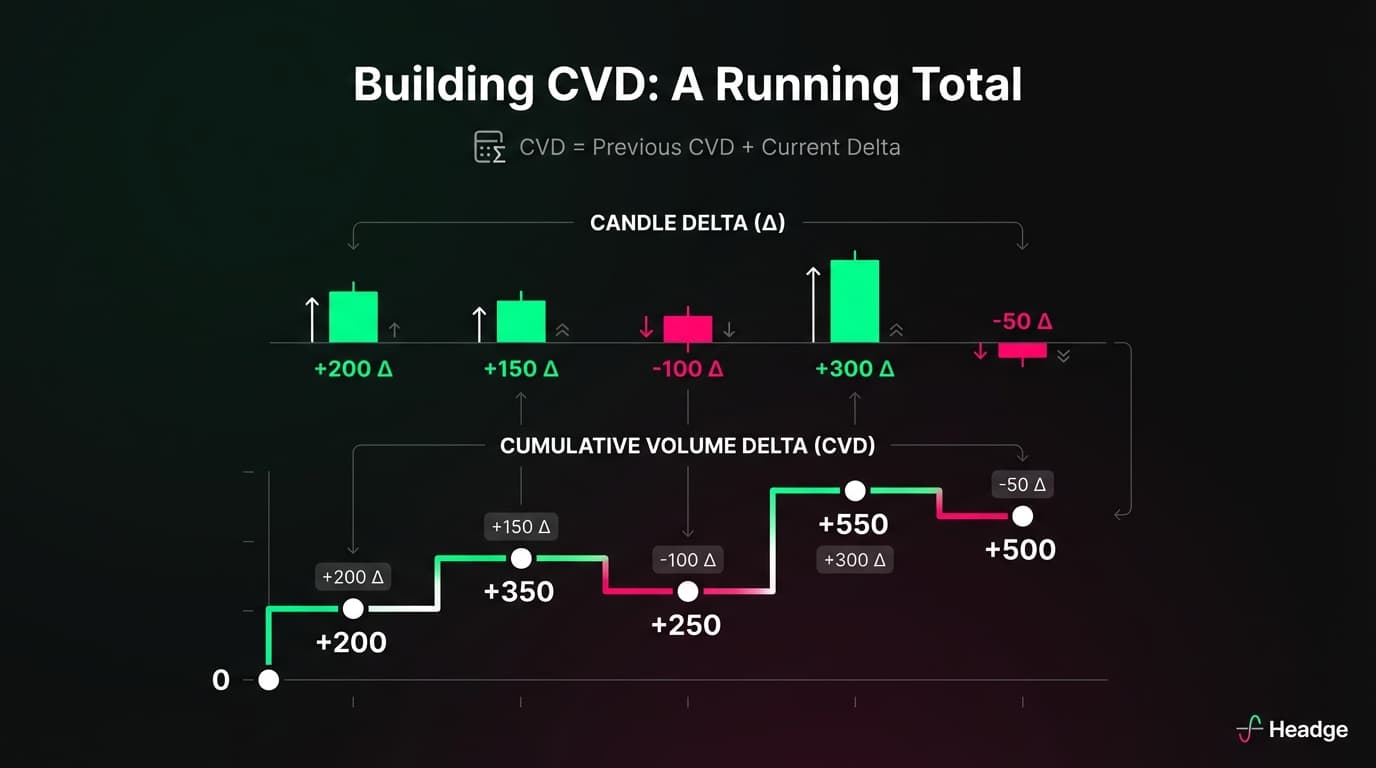
Think of CVD as a vote count in an ongoing election. Every market buy is a vote for higher prices. Every market sell is a vote for lower prices. CVD tallies all the votes. A rising CVD line means buyers have cast more votes than sellers across the measured period. The steeper the rise, the more dominant the buying aggression. A falling CVD means sellers are accumulating more votes. Flat CVD means the battle is balanced. The absolute level matters less than the trend. CVD at plus 10,000 versus plus 5,000 tells you less than whether CVD is rising, falling, or flat right now.
CVD reveals the net aggressive pressure over time. Rising CVD means aggressive buyers have outpaced aggressive sellers in total. Falling CVD means sellers have been more aggressive overall. The slope shows who is currently winning.
The real power of CVD comes from comparing it to price. When they agree, the move has conviction. When they diverge, something interesting is happening. When CVD is rising and price is rising, aggressive buyers are driving price higher. This is confirmation. The uptrend has genuine buying pressure behind it. The trend is healthy and buyers are in control. When CVD is falling and price is falling, aggressive sellers are driving price lower. The downtrend has genuine selling pressure. The trend is healthy and sellers are in control.
When CVD is rising but price is flat, aggressive buyers are accumulating but price is not rising. Where are the sells coming from? Passive sellers with limit orders are absorbing the buying. This suggests hidden accumulation. When the passive selling exhausts, price may break higher. When CVD is falling but price is flat, aggressive sellers are distributing but price is not falling. Passive buyers are absorbing the selling. This suggests hidden distribution. When the passive buying exhausts, price may break lower.
When CVD is rising but price is falling, aggressive buyers are losing despite outpacing sellers. Passive selling is overwhelming. This is bearish absorption. This suggests strong resistance or distribution. Sellers have size. When CVD is falling but price is rising, aggressive sellers are losing despite outpacing buyers. Passive buying is absorbing everything. This is bullish absorption. This suggests strong support or accumulation. Buyers have size.
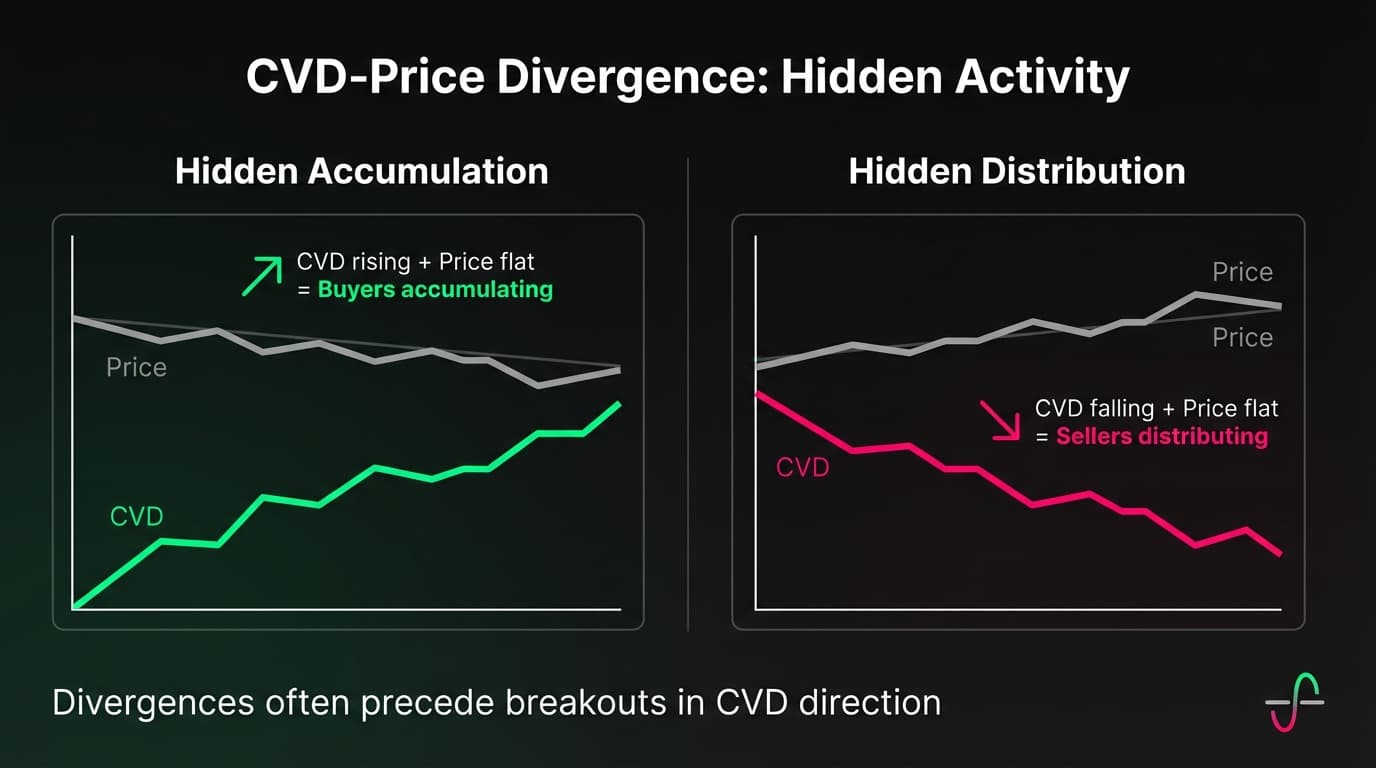
Institutions cannot buy thousands of contracts without moving the market unless they are clever. 1 technique is to place large limit orders and let aggressive sellers come to them. The signature on CVD is price going nowhere while CVD trends higher. Aggressive sellers are hitting the bid repeatedly. Normally, this would push price down. But passive buyers are stacked on the bid, absorbing every hit. CVD might even rise if some buyers are also lifting offers while the passive bids hold. When you see price consolidating while CVD builds, someone is accumulating. They are buying without lifting price against themselves. When they are done, or when the selling exhausts, price often breaks in the direction CVD was pointing.
Look for CVD divergences during consolidation ranges. If price is flat but CVD is steadily climbing, the range is more likely to break upward. If CVD is steadily falling, watch for a downside break.
Distribution is the mirror image. Institutions selling large positions do not want to hit the bid repeatedly and drive price down against their remaining contracts. Instead, they place limit sell orders and let aggressive buyers lift them. Price might even drift higher slightly, attracting more buyers. But CVD is falling. More aggression is on the sell side, or the aggressive buying is not moving the needle because passive selling is absorbing it all. When CVD diverges negatively during a rally or consolidation near highs, be suspicious. Someone may be offloading into strength.
CVD on different timeframes tells different stories. Short-term CVD on 1 to 5 minute charts captures intraday ebb and flow. It is useful for timing entries and exits but can be noisy. Medium-term CVD on 15 to 60 minute charts shows the session's character. Is today dominated by buyers or sellers? Long-term CVD on daily or weekly charts reveals the broader war. Are institutions accumulating over weeks? Is distribution happening? The most reliable signals often come when multiple timeframes align. If daily CVD is rising, hourly CVD is rising, and 5-minute CVD just turned up from a pullback, you have multi-timeframe confirmation of buying pressure.
When analyzing CVD, ask what is the trend. Is CVD rising, falling, or flat? The trend tells you who has been winning the aggression battle. Does it match price? Confirmation in the same direction suggests genuine pressure. Divergence suggests hidden activity. What is the slope? Steeper slopes mean more dominant aggression. Flattening slopes suggest the dominant side is losing momentum. Where are the divergences? Mark points where CVD and price disagreed. What happened next? This builds your pattern recognition. What is the context? CVD near session highs with falling price means something different than CVD near session lows with flat price.
CVD is not magic. It has the same limitations as delta. It does not know who is trading. It can be distorted by hedging flows and non-directional activity. It is historical. The CVD you see has already happened. Starting point is arbitrary, so absolute levels between different symbols or platforms are not comparable. Use CVD as 1 input among several. It reveals the aggression balance over time, which is valuable information. But it does not guarantee what comes next.
Next up: I will explore open interest, the often-overlooked metric that tells you when new money is entering or exiting the market.