
Support and Resistance
Price does not move randomly. It reacts to levels, prices where buyers stepped in before, prices where sellers defended, prices that the market remembers. These are support and resistance, the most fundamental concept in technical analysis. Support is a price level where buying pressure tends to overcome selling pressure, stopping declines. Resistance is where selling pressure tends to overcome buying pressure, stopping advances. Every chart is a battlefield marked by these lines. The best levels are the obvious ones. The ones that jump off the chart without squinting.
Support and resistance exist because traders remember prices. ES drops to 4,500, finds buyers, and rallies to 4,600. When it drops back toward 4,500, traders remember, it bounced here before. Some who missed the first bounce place buy orders. Some who bought at 4,500 and rode it up feel confident adding more. Sellers hesitate, wondering if they should wait for another bounce. This collective memory creates a self-fulfilling dynamic. Enough traders expecting 4,500 to hold will bid the price there, making it hold. The same logic applies to resistance. If ES repeatedly fails at 4,600, traders expect it to fail again. They sell into rallies toward that level, creating the resistance they expected.
Support and resistance are not precise prices, they are zones. Do not think 4,500 is support. Think 4,490 to 4,510 is the support zone. Markets are messy. Price often penetrates a level slightly before reversing, or falls just short of it. Treat levels as areas of interest, not exact triggers.
Support forms at prices where buying previously occurred. Previous lows are the most obvious support. If price bounced at 4,480 twice before, 4,480 is support. Multiple bounces strengthen the level. Prior resistance turned support happens when price breaks above resistance, that resistance often becomes support. The level that stopped advances now stops declines. This polarity flip is 1 of the most reliable patterns in technical analysis. Round numbers like 4,500, 4,400, and 4,000 act as psychological support and resistance because traders cluster orders there. They are not as strong as historical levels but add to confluence. High-volume areas on a volume profile mean prices where significant volume traded become support. Many traders have positions there and will defend their entry prices. Moving averages like the 20, 50, and 200-period moving averages often act as dynamic support, especially in trending markets.
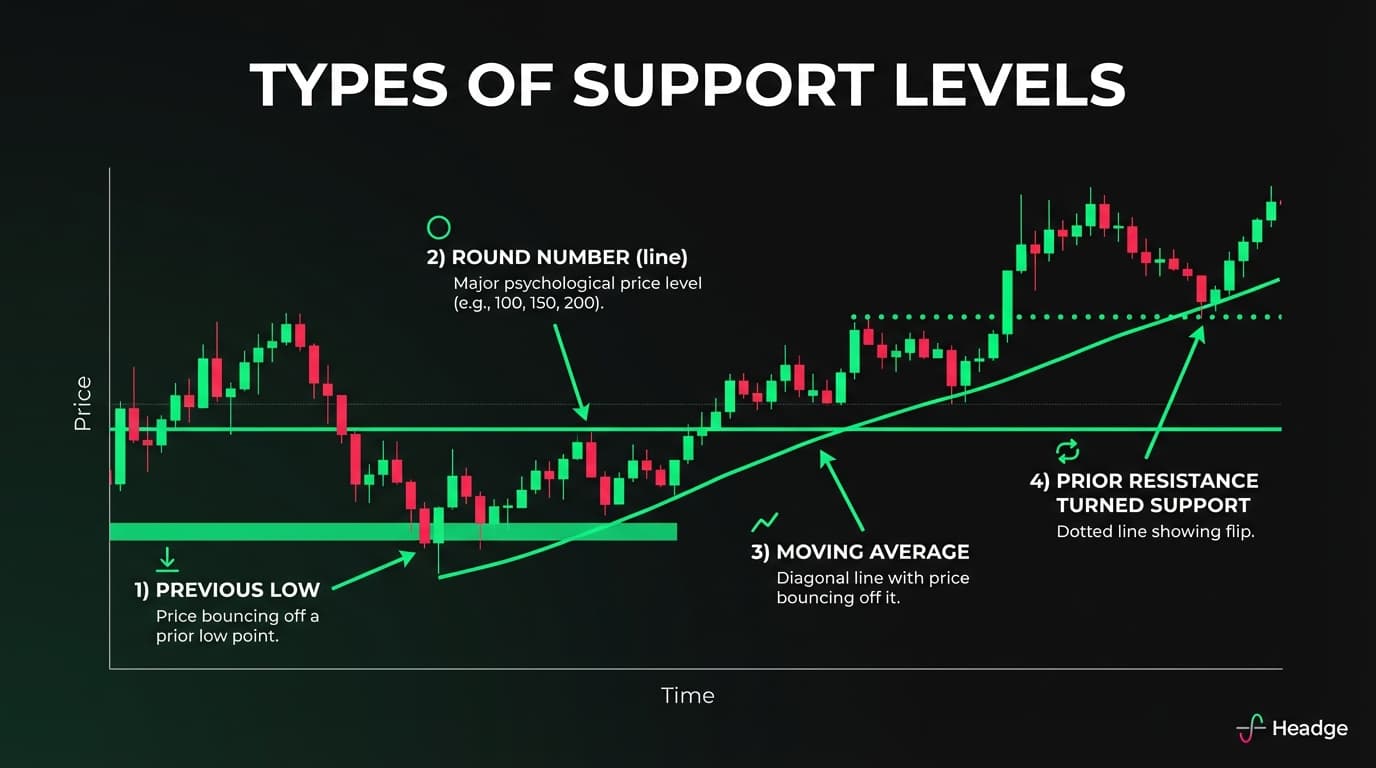
Resistance forms at prices where selling previously occurred. Previous highs mean if price failed at 4,650 multiple times, 4,650 is resistance. Each rejection reinforces the level in traders' minds. Prior support turned resistance happens when support breaks, it becomes resistance. Traders who bought at that level and held through the breakdown now have losing positions, many will sell to break even when price returns. Round numbers have the same psychology as support. Large orders cluster at round figures. Gap fills mean unfilled gaps above price act as magnetic targets and resistance. The area of the gap often sees selling when price arrives. Moving averages in downtrends act as resistance on rallies.
Not all support and resistance is equal. Stronger levels have more touches. A level that held 3 times is stronger than 1 that held once. Each touch reinforces the level's significance. Stronger levels produced strong reactions. A level that sparked a 50-point rally carries more weight than 1 that produced a 10-point bounce. The magnitude of the reaction reflects the conviction of buyers or sellers there. Stronger levels are recent. Levels from last week matter more than levels from last year. Markets change, and old levels lose relevance over time. Stronger levels occur on higher timeframes. Daily support is stronger than hourly support. Weekly resistance is stronger than daily resistance. Higher timeframe levels attract more participants. Stronger levels have confluence. A level that combines a previous high, a round number, and a moving average is stronger than any of those alone. Confluence stacks probabilities.
The strongest setups occur when multiple factors align at 1 level. If a 50-day moving average sits at a previous high that is also a round number of 4,500, you have triple confluence. Traders on different timeframes and using different methods all see the same level. That is when levels really hold or really break.
Trading support and resistance requires patience and confirmation. Wait for price to approach a support level, then look for a reversal candlestick pattern like hammer or engulfing, volume increasing as price reaches support, and higher timeframe context suggesting the level should hold. Place stops below the support zone. If support breaks, the thesis is wrong. Wait for price to approach a resistance level, then look for a reversal candlestick pattern like shooting star or bearish engulfing, momentum weakening as price reaches resistance, and higher timeframe context suggesting the level should hold. Place stops above the resistance zone.
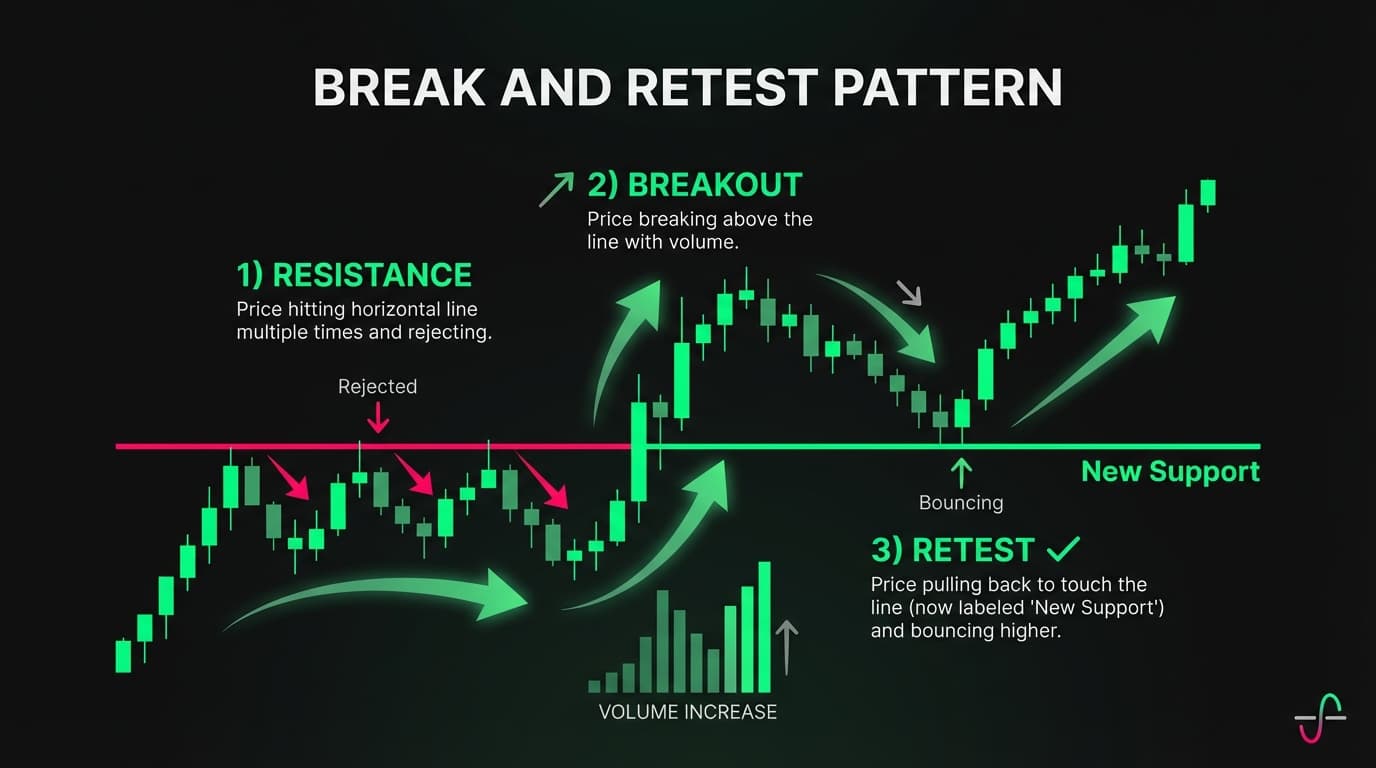
Not all support and resistance holds. Sometimes levels break. Wait for price to close beyond the level, not just touch it. Look for volume confirmation on the break. Enter on a retest of the broken level, old resistance becomes new support. Place stops on the opposite side of the breakout level. False breakouts are common. When price breaks a level then quickly reverses, the failure traps traders who bought the breakout. Their stops become fuel for the reversal. False breakouts can be traded aggressively in the opposite direction.
1 of the most reliable patterns involves broken levels. Price breaks through resistance, price pulls back to test the broken level which is now support, and price bounces off new support and continues higher. This break and retest pattern works because traders who missed the breakout get a second chance to enter, traders who shorted resistance cover their shorts, and the old resistance, now support, attracts new buying. The pattern works in reverse for support breaks. Price breaks support, rallies to retest it as resistance, then continues lower.
Common mistakes to avoid:
- Being too precise means drawing exact lines creates frustration when price misses by a few ticks. Use zones, not lines.
- Seeing levels everywhere means every chart has dozens of potential levels. Focus on the obvious ones that any trader would see. Obscure levels that require squinting are not significant.
- Ignoring breaks means support and resistance break regularly. Stubbornly buying every support touch leads to catching falling knives. Respect when levels fail.
- Forgetting context means support in a downtrend often breaks. Resistance in an uptrend often breaks. Trade levels that align with the bigger picture.
- Overcomplicating means the best levels are the obvious ones. If you have to argue why something is support, it probably is not strong support.
When analyzing a chart for support and resistance, start with the obvious. Mark the clear swing highs and lows that anyone would see. These are your primary levels. Note round numbers. Add horizontal lines at major round numbers near price. Check for polarity. Did any old support become resistance? Did any old resistance become support? These flipped levels are often the most reliable. Add moving averages. The 50 and 200-period averages on the daily chart are widely watched. Identify confluence zones. Where do multiple factors align? These are your highest-probability levels. Zoom out. Check the weekly and monthly charts for major levels you might miss on the daily.
Support and resistance is simple in concept but requires practice to apply well. The levels themselves are easy to draw, the skill is in judging their strength, trading them with proper context, and knowing when they are likely to break versus hold.
Next, I will show you trend identification, how to determine whether markets are trending up, trending down, or moving sideways.