
Trend Identification
The trend is your friend is trading's oldest cliche because it is true. Fighting trends is expensive. Aligning with trends is profitable. But before you can trade with the trend, you need to identify it, and that is harder than it sounds. Markets trend about 30% of the time. The other 70%, they chop sideways in ranges. Correctly distinguishing between trending and ranging conditions is 1 of the most valuable skills in technical analysis.
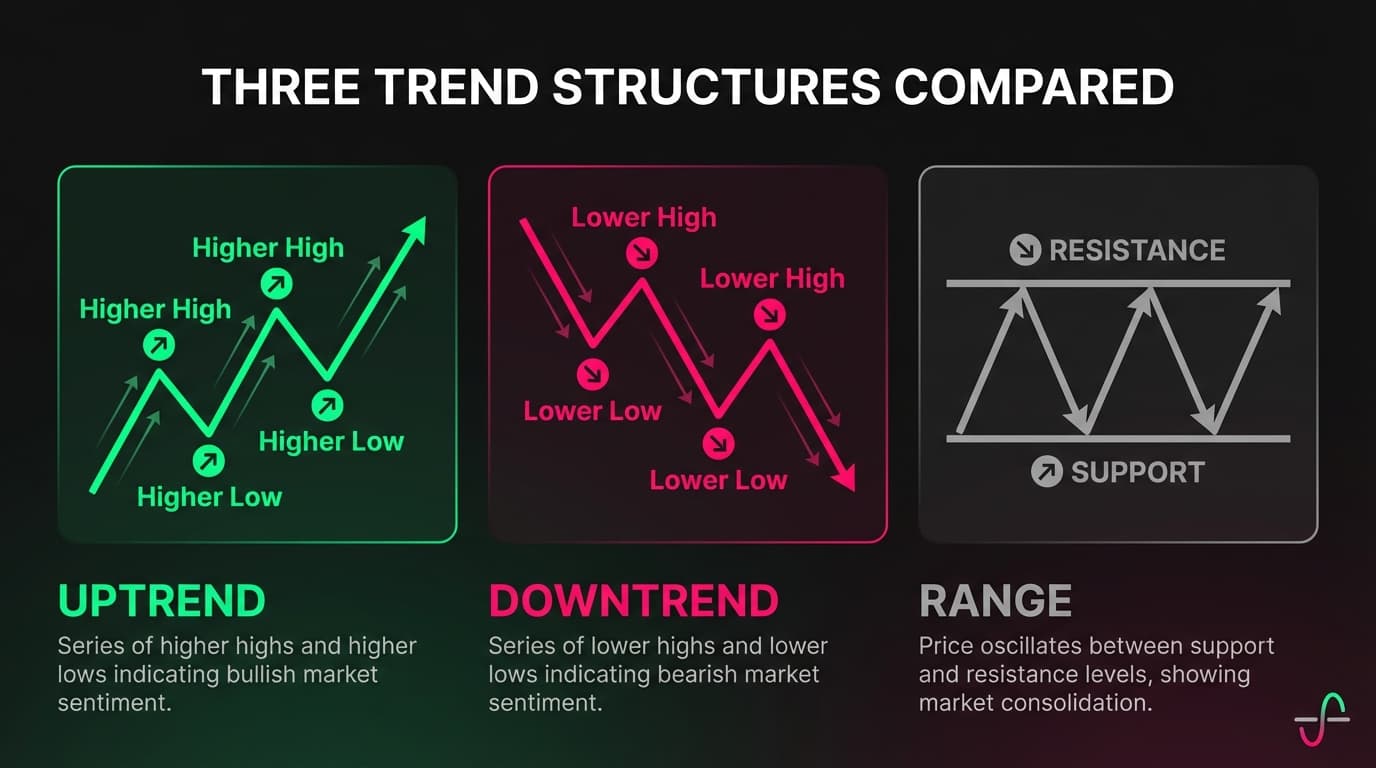
An uptrend is a series of higher highs and higher lows. Each rally pushes beyond the previous rally's peak. Each pullback holds above the previous pullback's low. Buyers are winning, they are willing to pay more for each new high and step in earlier on each dip. A downtrend is a series of lower highs and lower lows. Each rally fails to reach the previous peak. Each decline pushes beyond the previous low. Sellers are winning, they are willing to sell at lower prices and step in earlier on each bounce. A range or sideways market shows no clear pattern of higher highs and lows or lower highs and lows. Price oscillates between support and resistance without making progress in either direction.
Your opinion about where price should go is irrelevant. The structure of highs and lows tells you the trend. If price is making higher highs and higher lows, the trend is up, regardless of whether you think the market is overvalued. Trade what you see, not what you think.
To identify trends, you need to mark swing points. A swing high is a peak surrounded by lower highs on both sides. It is a local maximum where price turned down. A swing low is a trough surrounded by higher lows on both sides. It is a local minimum where price turned up. Connecting these swing points reveals the trend structure. In an uptrend, each swing low is higher than the previous swing low and each swing high is higher than the previous swing high. In a downtrend, each swing high is lower than the previous swing high and each swing low is lower than the previous swing low. In a range, swing highs cluster at similar levels and swing lows cluster at similar levels with no directional progress. The challenge is determining which swings are significant. On any chart, you can find dozens of tiny swings. Focus on the swings that are visible on your trading timeframe, the ones that represent meaningful moves, not minor noise.
Drawing trend channels helps visualize and trade trends. In an uptrend, connect 2 or more swing lows with a line, which is the trendline, then draw a parallel line touching the swing highs, which is the channel line. Price tends to bounce between these lines. In a downtrend, connect 2 or more swing highs with a line, then draw a parallel line touching the swing lows. Price tends to bounce between these lines. Channels provide trading opportunities. Buy at the lower channel line in uptrends. Sell at the upper channel line in downtrends. A break of the trendline signals potential trend change.
Do not force channels onto choppy price action. If you need to exclude multiple touches to make a channel work, the market probably is not trending cleanly. Good channels are obvious, price respects the lines with minimal violations.
Moving averages smooth price data and reveal the underlying trend. For simple trend identification, price above the 50-period MA equals uptrend bias and price below the 50-period MA equals downtrend bias. Moving average slope tells you the trend direction. MA sloping up means uptrend. MA sloping down means downtrend. MA flat means range or transition. Using multiple moving averages provides clearer signals. Fast MA above slow MA, like 20 above 50, means uptrend. Fast MA below slow MA means downtrend. MAs tangled together means range. The 200-period moving average on the daily chart is particularly significant. Institutions watch it, and price crossing above or below often signals major trend changes. Price above the 200 MA is a common filter for long-only strategies.
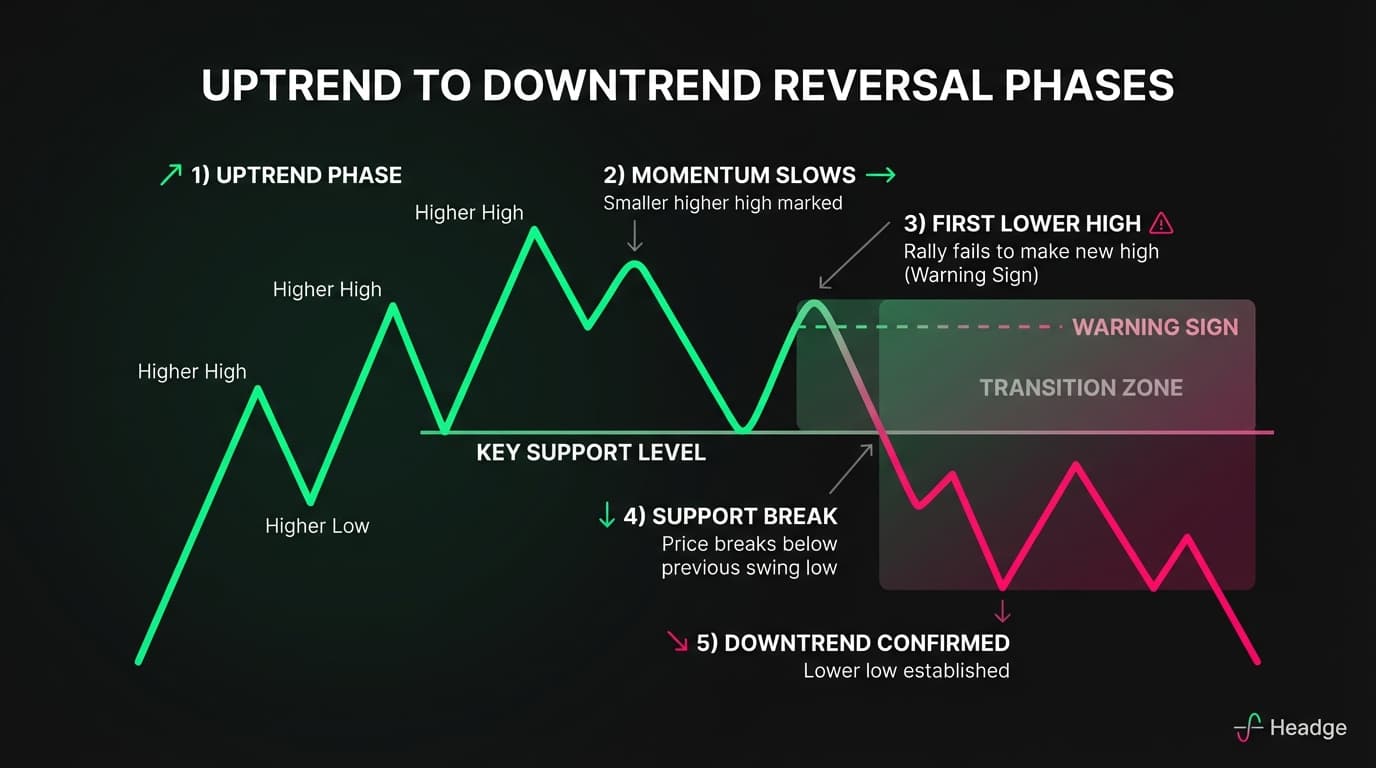
Trends do not reverse instantly. They transition through recognizable phases. From uptrend to downtrend, momentum slows first. Higher highs continue but become smaller and rallies weaken. Then comes the first lower high, a rally fails to exceed the previous high, which is the first warning sign. Next is the support break, price breaks below the previous swing low and the structure changes. Finally, the lower low is confirmed and the downtrend is established when price makes a clear lower low. From downtrend to uptrend follows the same pattern in reverse. Momentum slows with lower lows continuing but becoming smaller and declines weakening. Then the first higher low appears, a pullback holds above the previous low which is the first sign of change. Next comes the resistance break, price breaks above the previous swing high and the structure changes. Finally, the higher high is confirmed and the uptrend is established when price makes a clear higher high. The transition zone, after the first warning but before confirmation, is where many traders get chopped up. Wait for structure to confirm before declaring a new trend.
Recognizing ranges prevents you from applying trending strategies to sideways conditions. Signs of a range include price bouncing between clear support and resistance, moving averages going flat and tangling, failed breakouts in both directions, and similar swing highs and similar swing lows. When trading ranges, buy at support and sell at resistance. Expect reversals rather than continuation. Reduce position size because choppy markets are harder. Watch for eventual breakout. A range breakout happens when price closes decisively beyond the range boundary, volume increases on the breakout, old resistance becomes new support or vice versa, and the longer the range, the larger the expected move. Ranges often form after strong trends as the market consolidates gains or losses. The breakout direction usually continues the prior trend, but not always.
Trend depends on timeframe. The same market can be uptrending on the daily chart, downtrending on the hourly chart, and ranging on the 5-minute chart. This is not contradictory, it is the nature of markets. The daily uptrend contains pullbacks that look like downtrends on lower timeframes. For a practical approach, identify the trend on your trading timeframe, check the higher timeframe for context, and trade in the direction of the higher timeframe trend when possible. If the daily chart is uptrending and the hourly pulls back, buying that pullback aligns you with the bigger picture. If you are shorting an hourly downtrend while the daily is raging higher, you are fighting the larger trend.
Not all trends are equal. Strong trends have steep, consistent angles, show little overlap between candles, pull back shallowly with 30% to 50% retracements, resume quickly after pauses, and stay on 1 side of short-term moving averages. Weak trends have shallow, inconsistent angles, show significant overlap between candles, pull back deeply with 60% to 80% retracements, pause frequently and recover slowly, and repeatedly cross moving averages. Strong trends deserve aggressive position management, let winners run. Weak trends deserve tighter management, take profits quickly before the next deep pullback.
When analyzing trend, zoom out first. What is the trend on the weekly and daily charts? This provides context. Mark swing points and identify the significant highs and lows on your trading timeframe. Assess the structure. Are there higher highs and higher lows? Lower highs and lower lows? Or neither? Check moving averages. Is price above or below? Are MAs sloping or flat? Draw channels if applicable. Does price respect trendlines, or is movement too chaotic? Identify the phase. Early trend? Mature trend? Transitioning? This affects how you trade. Trend identification is not about prediction, it is about description. Describe what price is doing now, and position yourself accordingly. When the description changes, adapt.
Next, I will walk you through chart patterns, the recognizable formations that help traders anticipate continuation and reversal.