
Multiple Timeframe Analysis
A setup that looks perfect on the 15-minute chart might be a countertrend trade on the daily. A support level on the hourly might be insignificant on the weekly. Every chart tells a partial story, multiple timeframes reveal the full picture. Professional traders rarely make decisions from a single timeframe. They check higher timeframes for context and lower timeframes for precision. This layered approach improves both win rate and timing.
Think of timeframes as a zoom function. Higher timeframes show the big picture, major trends, significant support and resistance, institutional activity. They move slowly and filter out noise. Lower timeframes show detail, entry points, short-term momentum, immediate price action. They move quickly and contain more noise. A typical hierarchy runs weekly to daily to 4-hour to 1-hour to 15-minute. Each level contains roughly 4 to 5 times more detail than the 1 above. The weekly shows what takes months to develop. The 15-minute shows what happens in hours.
A support level on the weekly chart carries more significance than support on the 15-minute chart. More traders see it, more capital respects it, and more time was required to establish it. When timeframes conflict, the higher timeframe usually wins.
A practical framework uses 3 timeframes. The higher timeframe or HTF determines the trend direction and major levels. This is your big picture view. Trade in the direction of the HTF trend. The trading timeframe or TTF is where you identify setups and manage trades. This matches your holding period and trading style. The lower timeframe or LTF fine-tunes entries and exits. Provides precision without changing the overall thesis.
For a swing trader, the HTF might be weekly for trend direction, the TTF daily for setups and trades, and the LTF 4-hour for entry timing. For a day trader, the HTF might be daily for bias for the day, the TTF 1-hour or 15-minute for setups, and the LTF 5-minute for entries. For a scalper, the HTF might be 1-hour for session bias, the TTF 5-minute for setups, and the LTF 1-minute for entries. The specific timeframes matter less than maintaining consistent relationships between them.
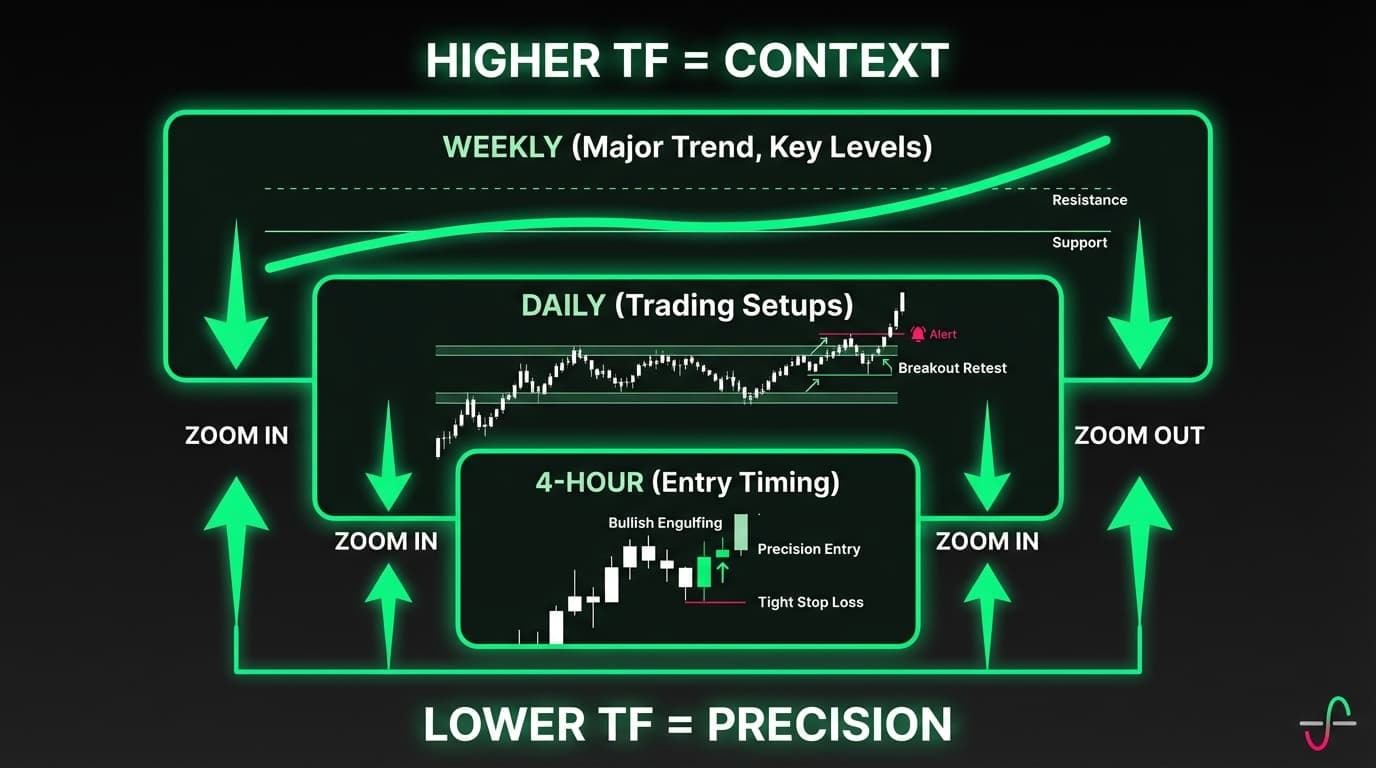
Always start with the highest timeframe and work down. Step 1 is to identify the higher timeframe trend. Check the weekly or daily chart. What is the trend, up, down, or sideways? Where are the major support and resistance levels? Is price at a significant area or in open space? This establishes your directional bias. If the weekly is uptrending, you will favor long trades. If it is downtrending, you will favor shorts. Step 2 is to find setups on the trading timeframe. Move to your trading timeframe. Is there a setup that aligns with the HTF bias? Is price approaching a level where the HTF suggests a reaction? Does the pattern or signal make sense in context? A bullish setup on the daily is stronger if the weekly trend is also bullish. A bearish setup on the hourly against a strong daily uptrend is risky. Step 3 is to time entries on the lower timeframe. Zoom into the lower timeframe. Wait for momentum to shift in your direction. Look for a specific candle pattern or indicator signal. Enter with a tight stop based on LTF structure. The lower timeframe provides precision without changing your thesis. You are not making new decisions here, you are executing the decision made on higher timeframes.
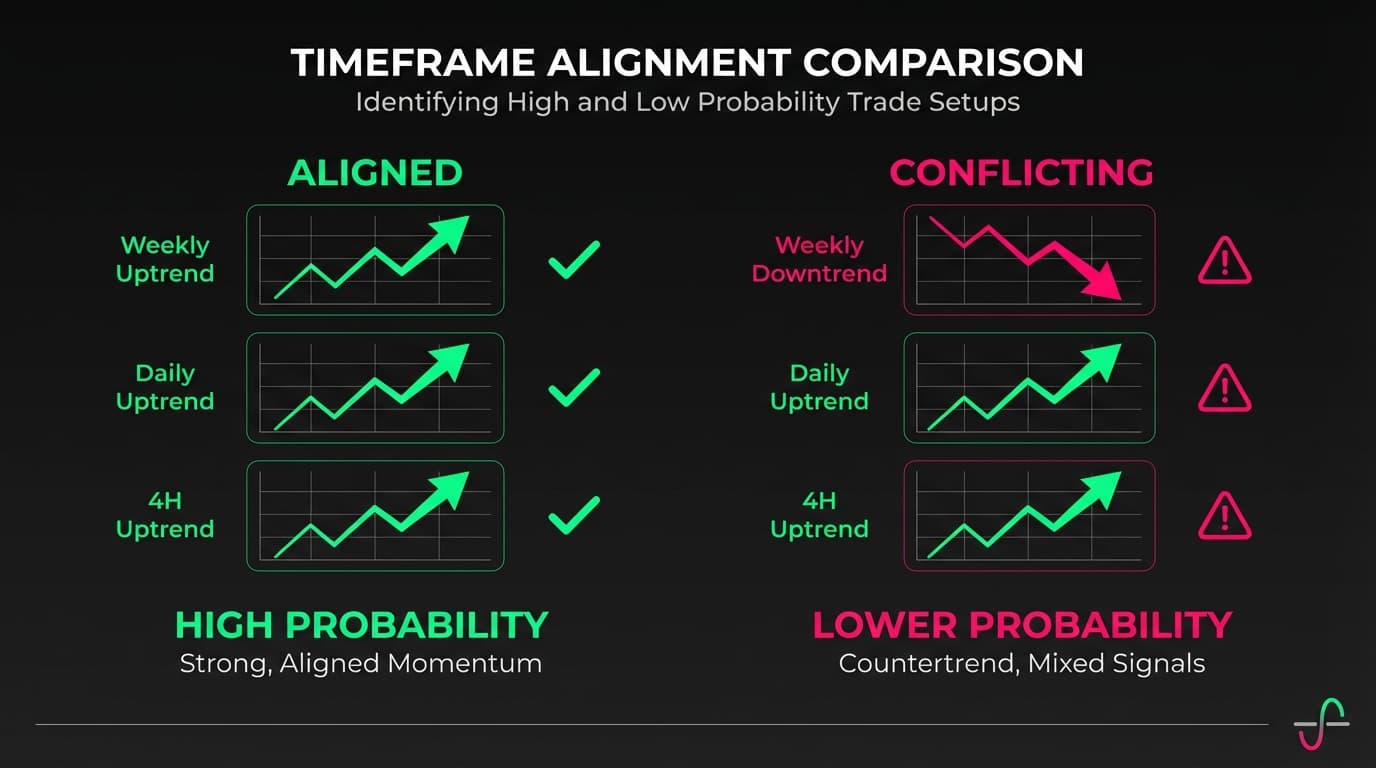
The best setups show alignment across multiple timeframes. Strong alignment with high probability might be weekly showing uptrend with price at support, daily showing bullish setup forming, and 4-hour showing momentum turning up. All 3 timeframes agree, the trade has wind at its back. Mixed alignment with moderate probability might be weekly showing uptrend, daily pulling back to support, and 4-hour still declining. The setup might work, but the 4-hour has not confirmed yet. Wait for the lower timeframe to align. Conflicting alignment with low probability might be weekly showing downtrend, daily showing bullish setup forming, and 4-hour showing bullish momentum. The daily and 4-hour say buy, but the weekly says the trend is down. This is a countertrend trade, lower probability, requires faster profit-taking.
You do not need perfect alignment, but know what you are trading. Aligned timeframes suggest continuation, let winners run. Conflicting timeframes suggest you are fighting something, take profits quickly and use tighter stops.
Use the daily 200 MA as a filter. Only take long trades when daily price is above 200 MA. Only take short trades when daily price is below 200 MA. Then find setups on your trading timeframe. This simple rule keeps you aligned with the major trend. Mark levels on multiple timeframes. A level that appears on weekly, daily, and 4-hour is significant. A level only visible on the 15-minute is minor. Trade reactions at levels with multi-timeframe confluence.
Your trading timeframe shows a bullish setup at support. Instead of entering immediately, drop to the lower timeframe, wait for a bullish candle pattern, wait for momentum indicators to turn up, and enter with stop below the LTF swing low. This improves entry price and confirms the setup is working. Before taking any trade, check the higher timeframe. Is this setup with the HTF trend or against it? If against, is there strong HTF support or resistance to justify the countertrend trade? Adjust expectations accordingly.
Checking too many timeframes leads to confusion. 7 timeframes will always show some conflict. Stick to 3 and make decisions based on those. A perfect setup on the 5-minute chart does not override a weekly downtrend. The lower timeframe should refine higher timeframe decisions, not contradict them. Jumping between timeframe combinations based on what looks good is curve-fitting in real time. Define your timeframes before looking at charts and stick to them. Some traders check the daily, then jump straight to the 1-minute for entry. This skips the middle layer where the actual setup should form. The trading timeframe is where you identify opportunities, do not skip it. Using weekly charts for day trades or 1-minute charts for swing trades does not work. Match your analysis timeframes to how long you actually hold positions.
To implement multiple timeframe analysis, define your holding period. Are you holding trades for hours, days, or weeks? This determines your trading timeframe. Select consistent timeframes. Choose 1 higher and 1 lower timeframe that bracket your trading timeframe logically. Develop a routine. Always start with the higher timeframe. Never take a trade without checking context. Note alignment. Before every trade, explicitly state whether timeframes are aligned, mixed, or conflicting. Adjust position size and targets accordingly. Review and refine. Track whether your aligned trades perform better than mixed or conflicting ones. They should. If they do not, something in your process needs adjustment.
Multiple timeframe analysis is not complicated, but it requires discipline. The temptation to take a lower timeframe setup without checking context is strong. Resist it. The few seconds spent checking higher timeframes will save you from many losing trades.
Finally, I will examine common pitfalls in technical analysis, the mistakes that trap traders and how to avoid them.