
Chart Patterns
Chart patterns are recurring price formations that suggest what might happen next. Traders have catalogued these patterns for over a century because they reflect predictable human behavior. Fear, greed, indecision, and capitulation leave similar footprints regardless of the market or era. Patterns do not predict the future with certainty. They identify situations where probability tilts in 1 direction. That is enough to build an edge. Patterns are probabilities, not prophecies.
Patterns fall into 2 categories. Continuation patterns form during pauses in a trend and suggest the trend will resume. Think of them as the market catching its breath before continuing in the same direction. Reversal patterns form at trend extremes and suggest the trend is ending. They represent the exhaustion of buyers or sellers and the beginning of a shift in control. The same pattern can sometimes act as either, depending on context. Location matters, a pattern at a major support level has different implications than the same pattern in the middle of a trend.
Triangles are the most common continuation patterns. Price compresses into a narrowing range before breaking out. The ascending triangle has a flat resistance line at the top and rising support line with higher lows at the bottom. Price compresses toward the apex and typically breaks upward 75% of the time. The flat top shows sellers defending a level. The rising bottom shows buyers getting more aggressive, willing to pay higher prices on each dip. Eventually, buyers overwhelm the resistance. The descending triangle has a flat support line at the bottom and falling resistance line with lower highs at the top. Price compresses toward the apex and typically breaks downward 75% of the time. The flat bottom shows buyers defending a level. The falling top shows sellers getting more aggressive. Eventually, sellers overwhelm the support. The symmetrical triangle has both support and resistance converging with lower highs and higher lows squeezing price. It can break either direction and usually continues the prior trend. Symmetrical triangles represent pure indecision, neither side gaining ground. The breakout direction determines the winner. Volume typically contracts during formation and expands on breakout.
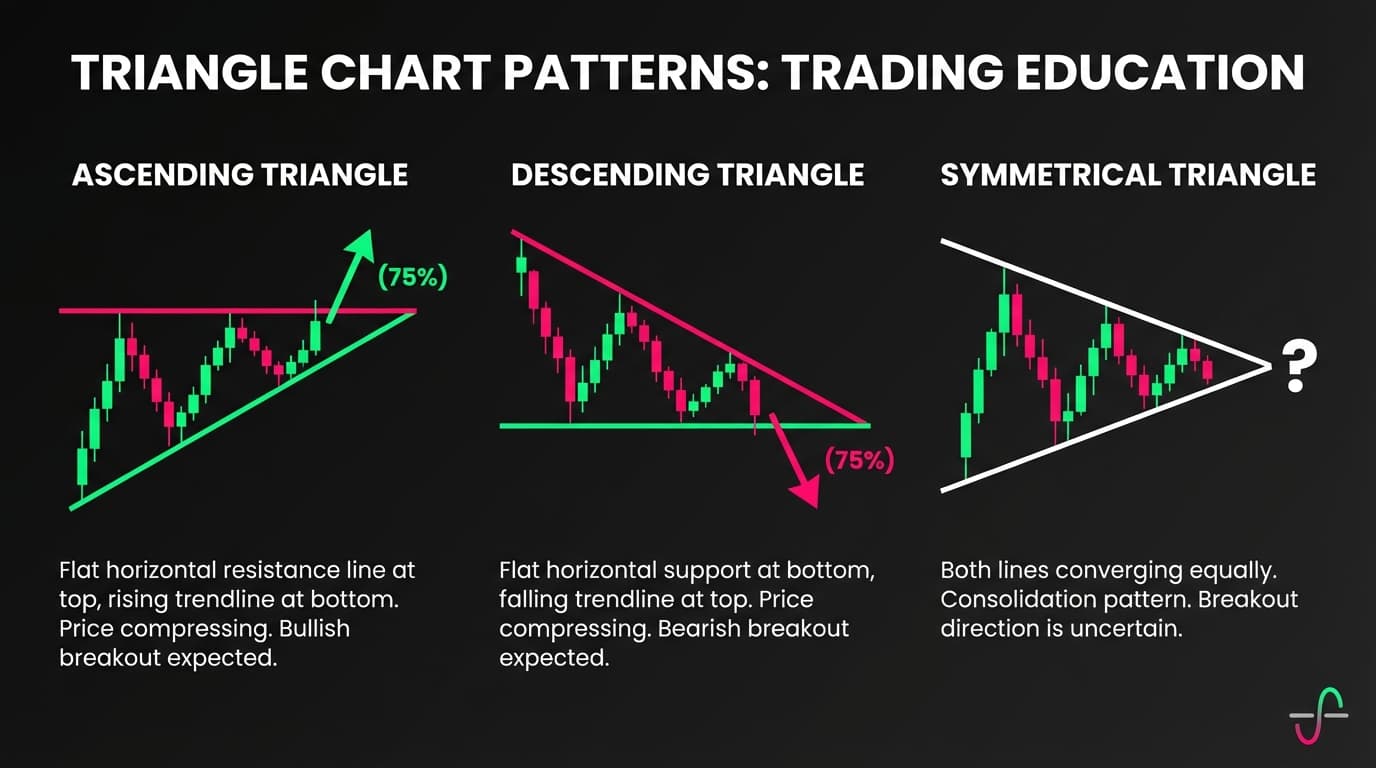
Triangles tell you something is likely to happen, a breakout, but not always which direction. Wait for price to break and close beyond the triangle boundary before committing. The break itself is the signal, not your guess about which way it will go.
Flags and pennants are short-term continuation patterns that form after sharp moves. The bull flag has a sharp rally called the flagpole, then a shallow pullback in a parallel channel called the flag. The pullback retraces 30% to 50% of the flagpole. The breakout continues the upward move. The flag represents profit-taking after the sharp move. New buyers step in, volume picks up, and the trend resumes. The measured move target equals the flagpole length added to the breakout point. The bear flag has a sharp decline called the flagpole, then a shallow bounce in a parallel channel. The bounce retraces 30% to 50% of the drop. The breakdown continues the downward move. Same logic in reverse, the bounce is short-covering and early bottom-fishing that fails when selling resumes. Pennants are similar to flags but form as small symmetrical triangles rather than channels. They appear after sharp moves and resolve in the direction of the prior trend. Same trading approach, wait for the breakout and target the flagpole distance.
Flags that retrace more than 50% of the prior move are weaker. Deep retracements suggest the countertrend move has real conviction, increasing the chance the pattern fails. The best flags are shallow, tight, and brief.
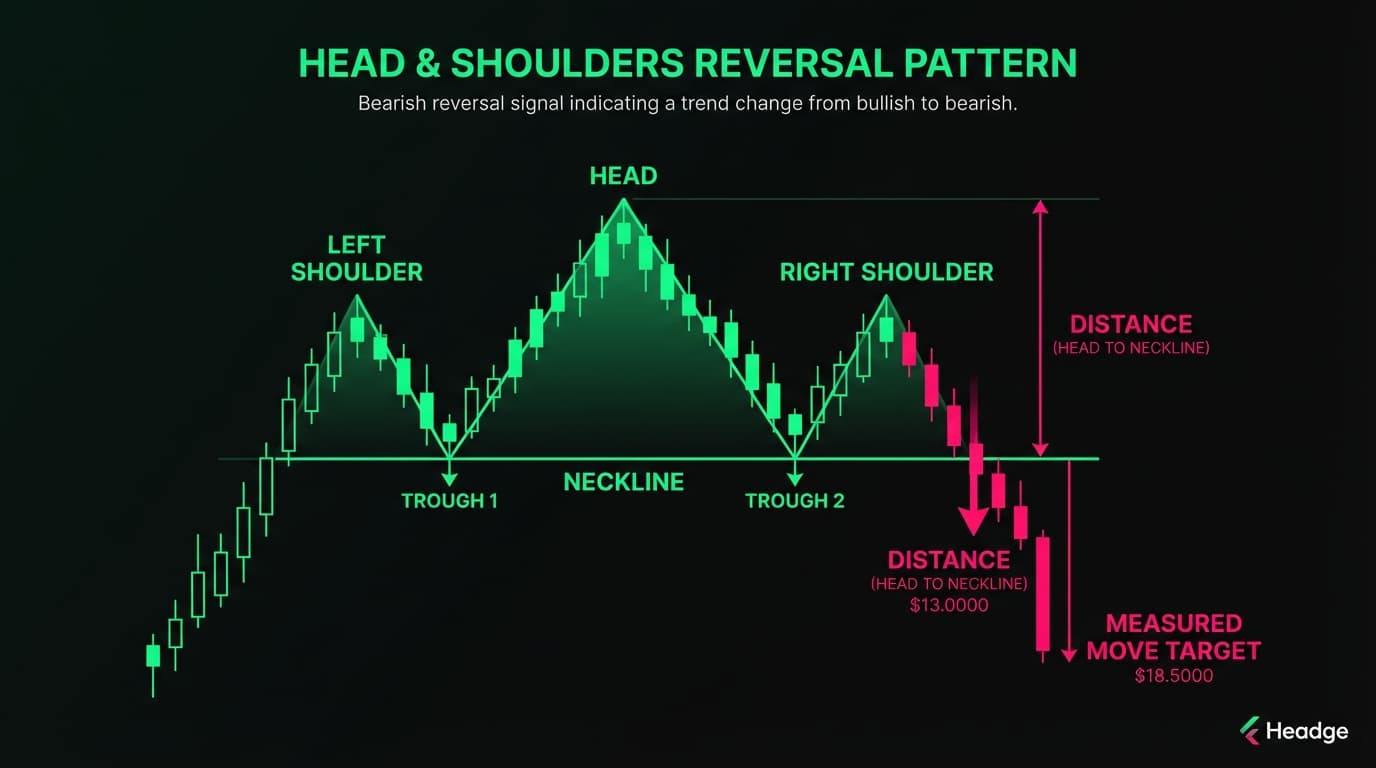
The head and shoulders is the most famous reversal pattern. It marks the transition from uptrend to downtrend. The structure includes the left shoulder which is a rally to a peak then pullback, the head which is a higher rally making a new high followed by a deeper pullback, the right shoulder which is a rally that fails to reach the head followed by a pullback, and the neckline which is the support line connecting the 2 pullback lows. The pattern shows momentum dying. The head makes a new high, but the right shoulder cannot match it, buyers are exhausted. When price breaks the neckline, the reversal confirms. Enter short on neckline break or on right shoulder formation for aggressive entries. Stop above the right shoulder. Target the distance from head to neckline, projected below the neckline. The inverse head and shoulders is the same pattern inverted marking the transition from downtrend to uptrend. Left shoulder low, head making a lower low, right shoulder making a higher low, break above neckline confirms the reversal.
Double tops and bottoms are reversal patterns that are simpler than head and shoulders but equally significant. The double top happens when price rallies to a high and pulls back, then rallies again to approximately the same high. The second rally fails and price breaks support, which is the pullback low. This signals trend reversal from up to down. The double top shows buyers could not push beyond the previous high. Sellers defended that level twice. The support break confirms they have taken control. The double bottom happens when price falls to a low and bounces, then falls again to approximately the same low. The second decline fails and price breaks resistance. This signals trend reversal from down to up. Same logic inverted, sellers could not push beyond the previous low. Buyers defended twice and eventually break through. Triple tops and bottoms have 3 tests of a level before reversal. Stronger patterns than doubles because they show more failed attempts, but also rarer.
Wedges look like triangles but both lines slope in the same direction. The rising wedge is bearish with both support and resistance sloping upward. Support rises faster than resistance, converging. Price makes higher highs and higher lows, but momentum is slowing. It typically breaks downward. Rising wedges often form at the end of uptrends. The shrinking range despite higher prices shows buying exhaustion. The breakdown can be sharp. The falling wedge is bullish with both support and resistance sloping downward. Resistance falls faster than support, converging. Price makes lower highs and lower lows, but momentum is slowing. It typically breaks upward. Falling wedges often form at the end of downtrends or as corrections within uptrends. Either way, the upward break is expected.
Patterns fail regularly. A failed pattern often leads to a sharp move in the opposite direction because traders positioned for the expected outcome must exit. A failed breakout from triangle happens when price breaks out, then reverses back through the pattern and out the other side. Traders who bought the breakout become trapped and fuel the reversal. A failed head and shoulders happens when price breaks the neckline, then reverses back above. The pattern that looked like a reversal becomes a continuation setup. A double bottom that makes a new low means the support was not support. What looked like accumulation was just a pause before further decline.
Failed patterns often produce the best trades, just in the opposite direction. When a heavily-watched pattern fails, the traders positioned for it become trapped. Their stops trigger, accelerating the move against them. Watch for failed patterns and consider trading the failure.
Do not anticipate patterns, wait for confirmation. A head and shoulders is not complete until the neckline breaks. A triangle is not broken until price closes beyond the boundary. Early entries increase risk of trading incomplete or failed patterns. A bullish pattern at major resistance has worse odds than the same pattern at major support. A reversal pattern in a strong trend often fails. Always consider where the pattern appears within the bigger picture. Valid breakouts typically show volume expansion. A triangle breakout on low volume is suspicious. A head and shoulders breakdown on high volume confirms selling pressure. Volume adds conviction to pattern signals.
Most patterns have measured move targets. For triangles, use the height of the triangle projected from breakout. For flags, use the flagpole length projected from breakout. For head and shoulders, use the head-to-neckline distance projected from breakout. For double bottoms, use the pattern height projected from breakout. These targets are not guarantees, but they provide reasonable profit objectives. Every pattern trade needs a stop. Place stops beyond the pattern boundary where the pattern would be invalidated. For triangle breakout, stop on the opposite side of the triangle. For head and shoulders, stop above the right shoulder. For double bottom, stop below the double bottom low. Pattern trading is probability-based. You will have losses. Proper stops ensure no single failure causes significant damage.
Next, I will cover moving averages, 1 of the most widely used tools for smoothing price action and identifying trend direction.