
Momentum Indicators
Price tells you where the market is. Momentum tells you how it got there and whether that energy is sustainable. ES at 4,500 that arrived there with explosive buying pressure is different from ES at 4,500 that limped there on declining volume. Momentum indicators quantify the speed and strength of price movement. They help identify when trends are healthy, when they are exhausting, and when reversals might be forming. Used properly, they add a dimension to analysis that price alone cannot provide.
The RSI is the most widely used momentum indicator. It measures the magnitude of recent gains against recent losses, producing a value between 0 and 100. The calculation concept is that RSI compares average gains to average losses over a period, typically 14. When gains dominate, RSI rises. When losses dominate, RSI falls. Standard interpretation is that RSI above 70 equals overbought, meaning price may have risen too far, too fast, RSI below 30 equals oversold, meaning price may have fallen too far, too fast, and RSI around 50 equals neutral.
A common mistake is seeing RSI at 75 and immediately shorting. In strong uptrends, RSI can stay overbought for extended periods while price continues higher. Overbought means momentum is strong, it does not mean the trend is over. Use overbought or oversold as context, not automatic signals.
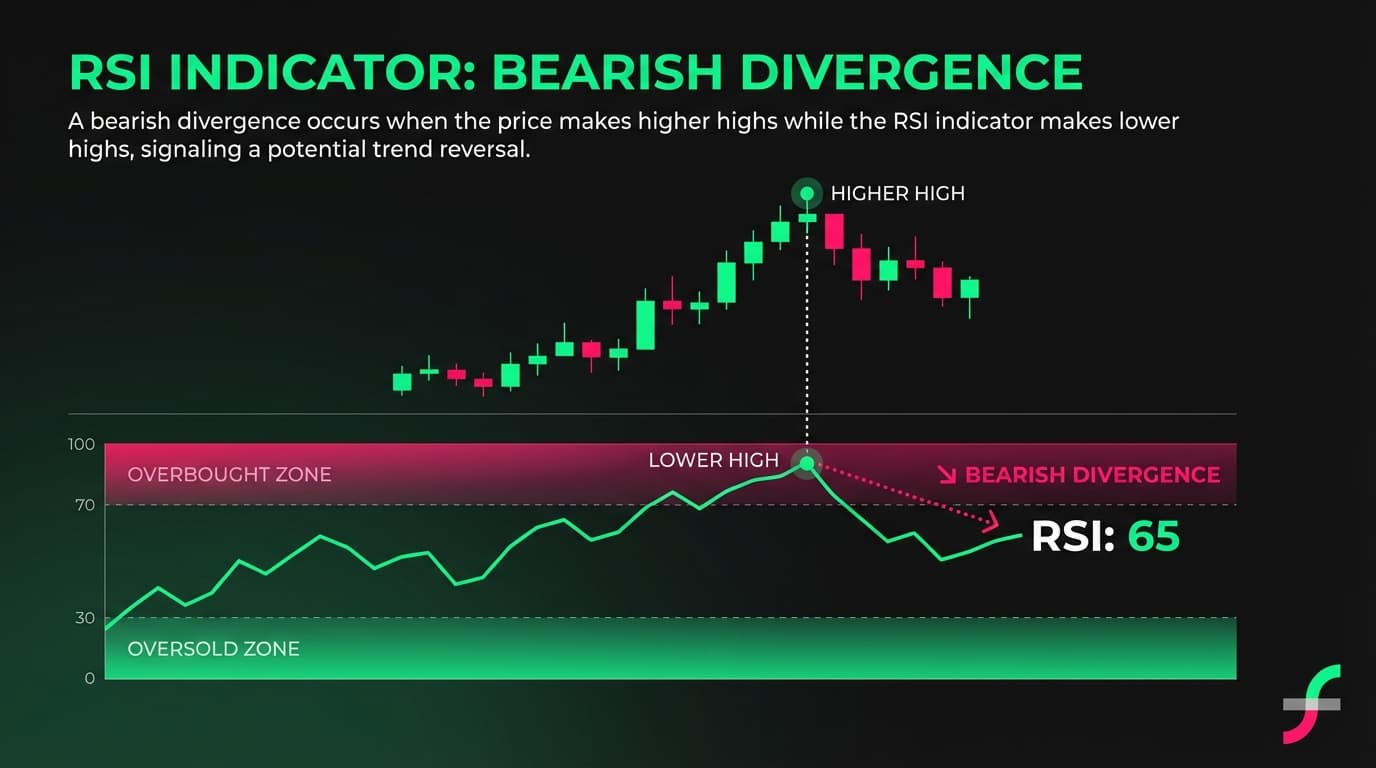
RSI's most powerful signal is divergence from price. Bearish divergence is when price makes a higher high, but RSI makes a lower high. Momentum is fading even as price advances. Warning that the uptrend may be weakening. Bullish divergence is when price makes a lower low, but RSI makes a higher low. Momentum is improving even as price declines. Warning that the downtrend may be weakening. Divergences do not guarantee reversals, they signal reduced conviction. Use them to adjust risk management, not as standalone trade signals.
RSI behaves differently in trends versus ranges. In uptrends, RSI tends to oscillate between 40 and 80. Pullbacks to RSI 40 to 50 often mark buying opportunities. RSI rarely reaches 30. In downtrends, RSI tends to oscillate between 20 and 60. Bounces to RSI 50 to 60 often mark selling opportunities. RSI rarely reaches 70. In ranges, RSI oscillates the full 30 to 70 spectrum. Traditional overbought or oversold levels work better.
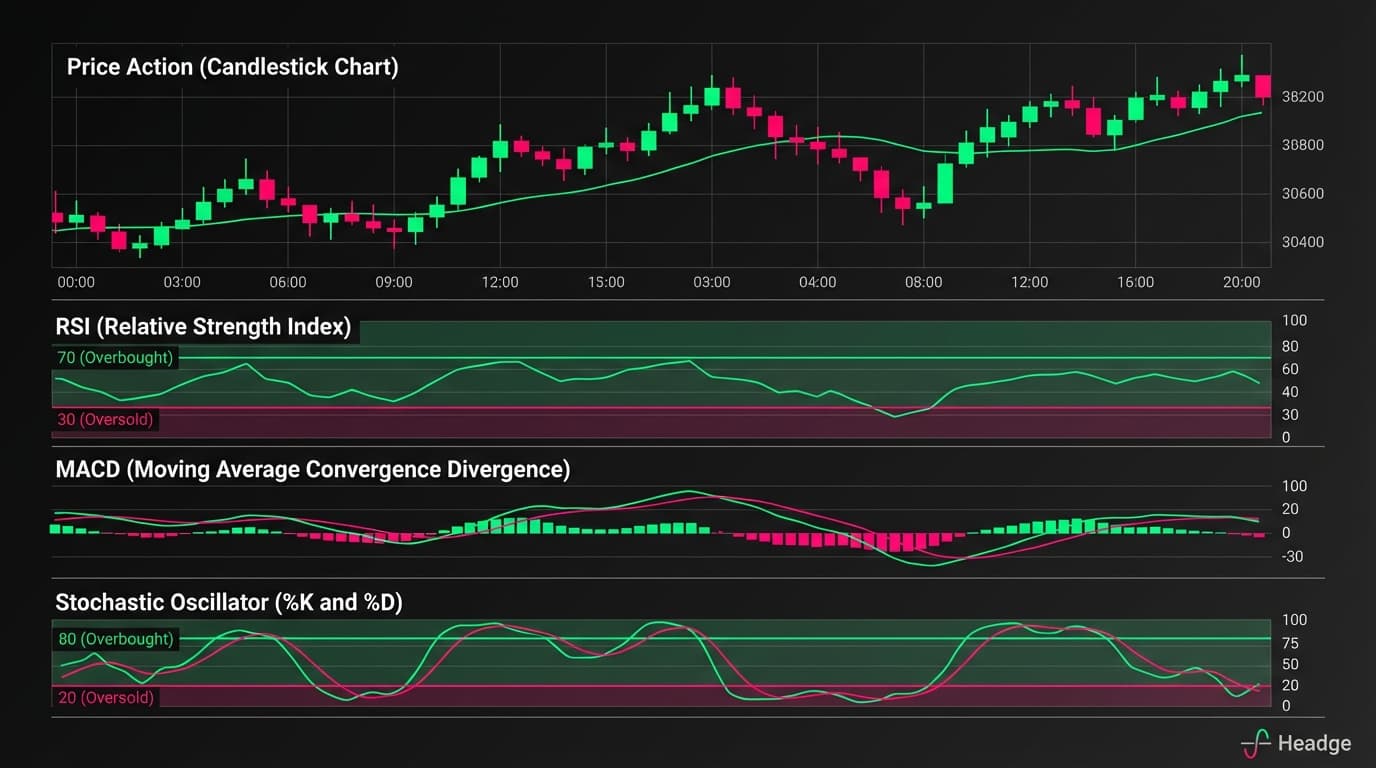
MACD measures the relationship between 2 moving averages, showing both trend direction and momentum. The components are the MACD Line, which is 12-period EMA minus 26-period EMA, the Signal Line, which is 9-period EMA of the MACD line, and the Histogram, which is MACD line minus signal line showing the gap between them. Basic interpretation is that MACD above 0 equals bullish momentum, MACD below 0 equals bearish momentum, MACD crossing above signal line equals bullish signal, and MACD crossing below signal line equals bearish signal.
Zero line crossover happens when MACD crosses above 0, meaning the 12 EMA has crossed above the 26 EMA, a momentum shift to bullish. Crossing below 0 indicates bearish shift. Signal line crossover happens when MACD crosses above its signal line, meaning momentum is accelerating upward. Crossing below indicates slowing or reversing momentum. The histogram shows the distance between MACD and signal line. Growing histogram bars indicate increasing momentum. Shrinking bars indicate decreasing momentum, even if price is still moving.
Like RSI, MACD shows divergences. Bearish divergence is when price makes higher highs and MACD makes lower highs, meaning the trend is losing steam. Bullish divergence is when price makes lower lows and MACD makes higher lows, meaning selling pressure is fading. MACD divergence is especially useful because it combines both price momentum and the relationship between 2 timeframes, 12 and 26 periods.
The stochastic measures where the current close sits relative to the recent high-low range. The logic is that in uptrends, closes tend to be near the high of the range. In downtrends, closes tend to be near the low. The stochastic quantifies this. The components are %K, the main line showing current close position in the range, and %D, a moving average of %K, which is the signal line. Standard interpretation is that above 80 equals overbought, below 20 equals oversold, %K crossing above %D equals bullish, and %K crossing below %D equals bearish. The stochastic is faster than RSI, producing more signals and more false signals. It works best in ranging markets where price oscillates between support and resistance.
In strong trends, the stochastic will stay pinned to overbought or oversold readings for extended periods. Do not fight the trend just because the stochastic looks extreme. Use it for timing in ranges, not for calling reversals in trends.
1 indicator can mislead. Multiple indicators agreeing provide stronger signals. For the confirmation approach, wait for multiple indicators to align. RSI showing oversold, MACD histogram turning up, and stochastic %K crossing above %D all suggest the same thing, potential reversal. Avoid redundancy. Different indicators measuring the same thing, like RSI and stochastic, both momentum oscillators, will often agree. That is not additional confirmation, it is redundancy. Better combinations mix different types, like momentum indicator RSI plus trend indicator MACD plus volume, or oscillator stochastic plus moving average plus price pattern. Less is more. 3 well-understood indicators beat 10 poorly understood ones. Adding more indicators does not improve accuracy, it creates confusion and analysis paralysis. Pick 2 or 3, learn them deeply, and ignore the rest.
Fighting trends with oscillators is a common mistake. RSI is at 80, time to short. This mindset produces consistent losses in trending markets. Oscillators show momentum, not reversals. Use them to time entries with the trend, not against it. Over-optimization means testing every RSI period from 5 to 50 to find the perfect setting is curve-fitting. The backtested results will not repeat. Use standard settings like RSI 14 and MACD 12 26 9 that others use and focus on execution. Ignoring context means a MACD bullish crossover at major resistance means something different than the same crossover at major support. Indicators provide information, context provides interpretation. Signal overload means taking every crossover, every overbought reading, every divergence produces constant trading and constant whipsaws. Filter signals by context, trend, and confluence with other factors.
A sensible approach to momentum indicators starts with identifying the trend first. Is the market trending or ranging? This determines how you will use momentum indicators. Use indicators for timing, not direction. Let price structure tell you direction. Use indicators to time entries within that structure. Look for divergences at key levels. RSI divergence at random prices means little. RSI divergence at major support or resistance matters. Confirm with price action. An oversold reading plus a bullish candle pattern at support is a setup. An oversold reading alone is just information. Respect when indicators fail. If RSI divergence does not lead to reversal, the trend is strong. That is valuable information too, it tells you not to fight the trend.
Momentum indicators are tools for measuring, not predicting. They tell you about the energy behind current price movement. What you do with that information depends on everything else in your analysis.
Next, I will walk you through multiple timeframe analysis, how to combine different chart periods to make better trading decisions.