
Technical Analysis Pitfalls
Technical analysis works, but not the way most people use it. The patterns are real. The indicators measure something meaningful. The concepts are sound. Yet most traders who rely on technical analysis lose money. The problem is not the tools. It is how traders misapply them. Understanding these common pitfalls will save you from expensive lessons that blow up accounts.
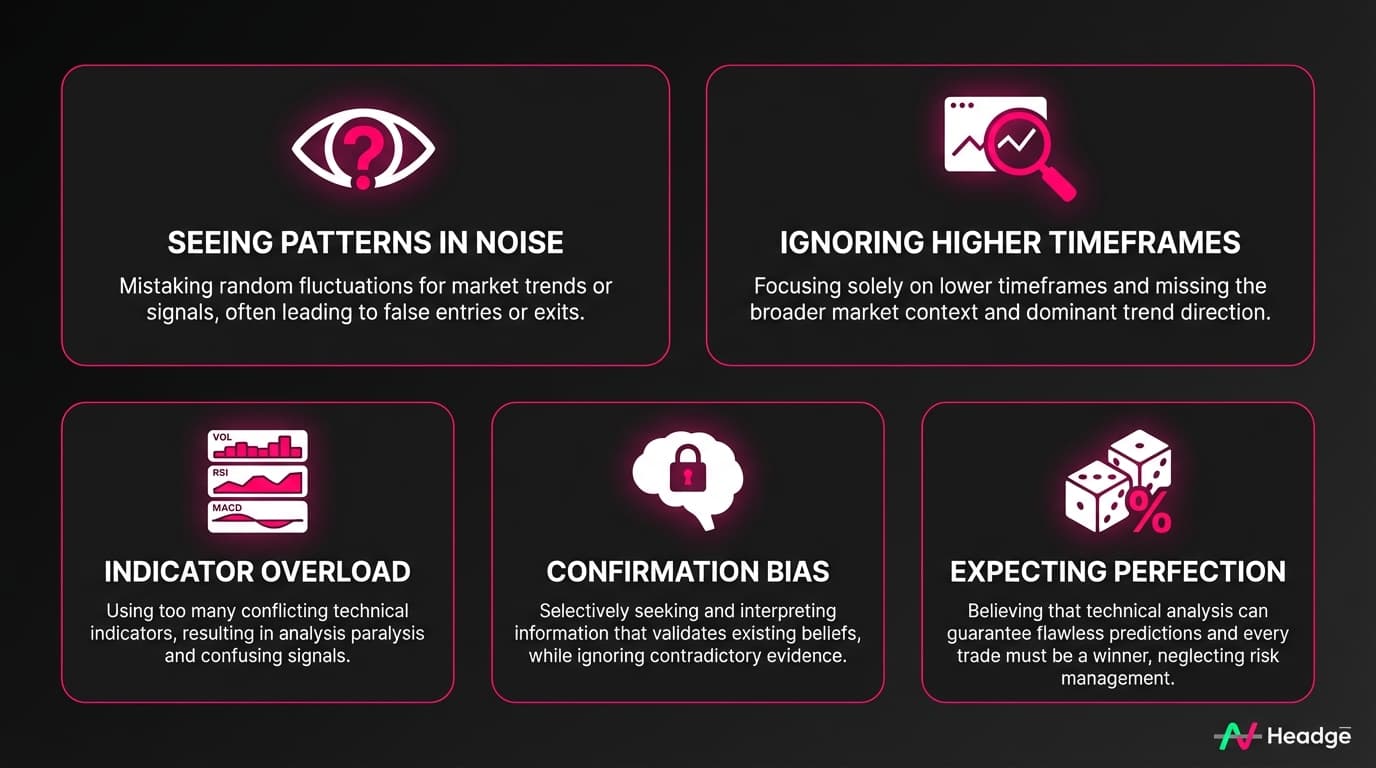
The human brain excels at pattern recognition, so much that it finds patterns in random noise. This is called apophenia, and it is devastating for traders. Stare at any chart long enough and you will see head and shoulders, triangles, double bottoms. Your brain wants to find order. It will draw trendlines through 3 random points and call it significant. It will see a perfect setup that only exists in hindsight. The fix is to only trade patterns that are obvious at a glance. If you have to squint, adjust your lines, or explain why this almost qualifies, it is not a valid pattern. The best setups are the ones any trader would identify immediately.
Significant patterns are obvious. Major support levels jump off the chart. Clear trends do not require creative trendline drawing. When you find yourself adjusting, rationalizing, or kind of seeing a pattern, step back. You are probably manufacturing a trade that does not exist.
Once you form an opinion about a trade, your brain filters information to support that opinion. You will notice every bullish signal while dismissing bearish warnings. You will remember the times your method worked and forget the failures. A trader convinced ES will rally sees support holding as bullish, RSI oversold as bullish, and volume increasing as bullish. The same trader ignores ES being below the 200-period MA as bearish, the sector being in a downtrend as bearish, and the last 3 support levels all breaking as bearish. The fix is to actively seek disconfirming evidence. Before every trade, ask what would have to happen for this trade to fail and what am I not seeing? Make a habit of arguing against your own position.
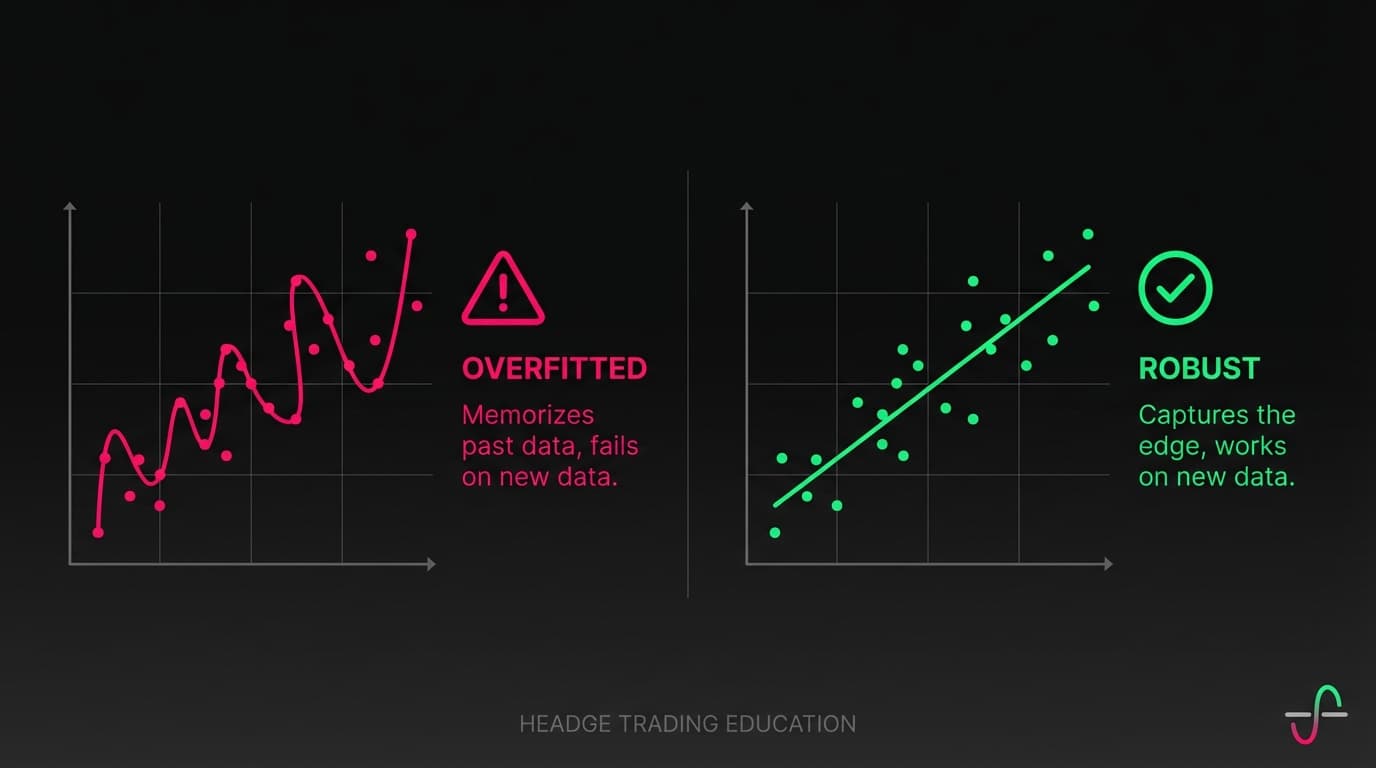
Backtesting lets you optimize strategies, find the perfect RSI period, the ideal moving average combination, the exact parameters that worked historically. This is curve fitting, and it is a trap. A strategy that requires RSI at exactly 23.5 on a 17-period lookback only works because you tuned it to past data. Those specific parameters will not repeat in the future. You have memorized the test, not learned the material. Signs of overfitting include your strategy having many precise parameters, small changes to parameters dramatically affecting results, it working perfectly in backtests but failing live, and you keep improving it to match recent data. The fix is to use standard indicator settings that others use, keep rules simple, test on data you did not optimize on, and accept that no strategy works perfectly. You are looking for an edge, not a holy grail.
Technical analysis on a single timeframe is incomplete. A beautiful bullish setup on the 15-minute chart means nothing if the daily and weekly charts show a vicious downtrend. Traders get tunnel vision on their trading timeframe. They see the setup they want to see and ignore context that would invalidate it. The 15-minute support level is not going to stop a weekly downtrend. The fix is to always check at least 1 higher timeframe before trading. Ask whether you are trading with the larger trend or against it. Fighting trends with technical setups is a losing game.
Some traders believe indicators reveal hidden truths invisible on price charts. They stack RSI, MACD, Stochastic, CCI, and 5 more oscillators, thinking more information means better decisions. Indicators are derivatives of price. They cannot know anything price does not already show. RSI being oversold does not mean price must bounce, it means price fell quickly. That is information you could see by looking at the candles. Problems with indicator overload include conflicting signals paralyzing decision-making, redundant indicators providing false confidence, attention shifting from price action to indicator readings, and complex systems being harder to execute consistently. The fix is to use 1 or 2 indicators at most. Understand that they measure aspects of price movement, not separate information. Price action comes first, indicators provide supplementary context.
No indicator combination will tell you what price will do next. Indicators describe what has happened, momentum, volatility, trend strength. They do not predict. Traders who search for the right indicator combination are chasing something that does not exist.
RSI below 30 means buy. Head and shoulders means sell. These rules work sometimes and fail spectacularly other times. RSI below 30 in a brutal downtrend means price is crashing, not that it is time to buy. Head and shoulders at the beginning of an uptrend often fails. Every pattern, every signal, every indicator reading means something different depending on context. The fix is to learn the principles behind the patterns, not just the rules. Understand why RSI oversold sometimes works, exhausted selling at support in an uptrend, and sometimes fails, momentum collapse in a downtrend. Context determines meaning.
Technical analysis does not promise certainty. A setup with a 60% win rate will still fail 40% of the time. 4 losses in a row does not mean the method is broken, it means you hit a normal losing streak. Traders abandon working strategies after inevitable losses. They search for the perfect system that does not exist. They blame the tools instead of accepting that all trading involves uncertainty. Reality check is that even good setups fail 30% to 40% of the time, losing streaks of 5 plus trades happen to everyone, no method works in all market conditions, and profitable trading is about edges over many trades, not individual wins. The fix is to accept uncertainty. Track your statistics over large samples. Judge methods by long-term expectancy, not recent results. The goal is not to be right every time, it is to be profitable over many trades.
The most sophisticated technical analysis means nothing if you size positions poorly. A trader who correctly predicts direction 70% of the time but risks 20% per trade will still blow up during an inevitable losing streak. Technical analysis tells you where to enter and exit. Risk management tells you how much to risk. Many traders obsess over entry signals while ignoring position sizing, exactly backward in terms of importance. The fix is to define your risk before analyzing the trade. I am willing to risk $200 on this trade comes before is this a valid setup? Position sizing and stop placement matter more than finding the perfect entry.
Every pattern looks obvious in hindsight. Scrolling through historical charts, you see clear entries, obvious support levels, textbook setups. I would have caught that move, you think. You would not have. In real-time, without knowing what came next, those patterns were not obvious. The support that held could have broken. The breakout that worked could have failed. Hindsight analysis is contaminated by knowing the outcome. The fix is to practice identifying setups in real-time, not on historical charts where you know what happened. Cover the right side of the chart and ask what would I do here? Forward-testing and paper trading reveal what you will actually experience.
Making a prediction feels good. Being right feels better. Traders become attached to their forecasts, holding losers because they know they are right, adding to losing positions to prove their analysis correct. The market does not care about your analysis. Price can remain irrational longer than you can remain solvent. Being right about the eventual direction does not help if you get stopped out 3 times before the move happens. The fix is to trade price action, not predictions. Your job is not to be right about where price will go, it is to make money. If the trade is not working, exit. You can always re-enter if conditions change.
Technical analysis is a powerful framework, but it requires humility. Patterns suggest, they do not guarantee. Context determines meaning. Risk management trumps analysis. Uncertainty is permanent. Simple approaches beat complex ones. The traders who succeed with technical analysis are not the ones with the fanciest indicators or the most detailed pattern recognition. They are the ones who apply simple concepts consistently, manage risk ruthlessly, and accept that being wrong is part of the process.
Technical analysis gives you a framework for making decisions in uncertainty. It does not eliminate that uncertainty. The goal is not to predict, it is to respond to what the market shows you, with proper risk management, trade after trade.
You have completed the Technical Foundations module. You now have a solid grounding in reading charts, identifying patterns, and using indicators wisely.