
Options Introduction
Options are contracts that give you the right but not the obligation to buy or sell an asset at a specific price before a specific date. That single distinction from futures, which are obligations, creates an entirely different instrument with unique characteristics. Options let you define your maximum loss upfront while keeping unlimited profit potential. They let you profit from time decay, volatility changes, or specific price targets. They are the most flexible instruments available to retail traders. They are also more complex than anything else I have covered. This lesson introduces the fundamentals. Mastering options takes years.
There are only 2 types of options. Call options give the buyer the right to buy the underlying asset at the strike price. If you buy a call with a 4,500 strike on ES futures, you can buy ES at 4,500 regardless of the market price. If ES is at 4,550, your call lets you buy at 4,500, an immediate 50 point advantage. Put options give the buyer the right to sell the underlying asset at the strike price. If you buy a put with a 4,500 strike on ES futures, you can sell ES at 4,500 regardless of the market price. If ES crashes to 4,400, your put lets you sell at 4,500, protecting you from the decline. The key insight is that call buyers want price to go up and put buyers want price to go down. But unlike simply buying or shorting futures, your loss is limited to what you paid for the option.
Option buyers have rights. Option sellers have obligations. When you buy a call, you can choose whether to exercise it. When you sell a call, you must deliver the underlying if the buyer exercises. This asymmetry is why buying options has limited risk while selling options has potentially unlimited risk.
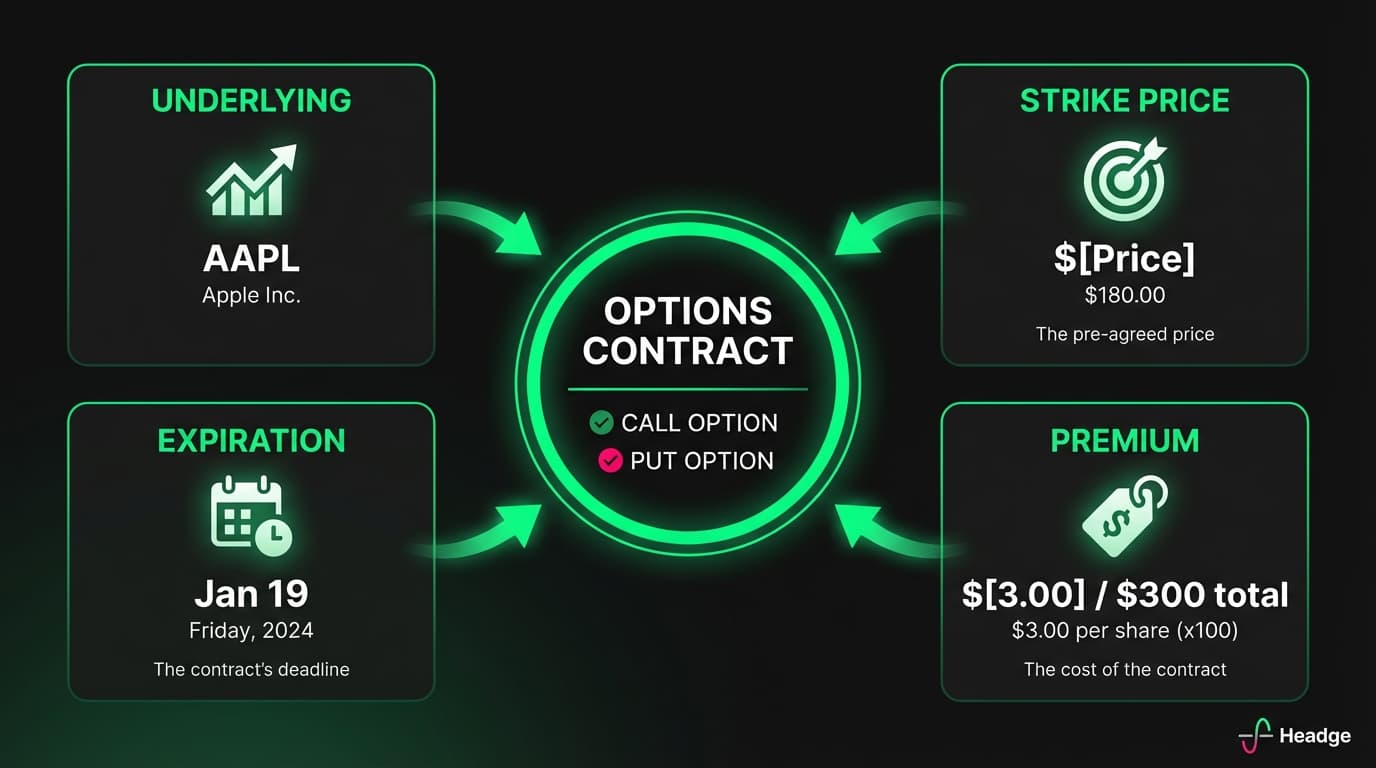
Every option has 4 defining elements. The underlying asset, what the option controls. ES futures, crude oil, Bitcoin, options exist on many instruments. The strike price, the price at which you can buy for a call or sell for put the underlying. A 4,500 strike call lets you buy at 4,500. A 4,400 strike put lets you sell at 4,400. The expiration date, when the option expires. After this date, the option is worthless if not exercised. Options range from daily, 0 DTE, to years out, LEAPS. The premium, what you pay to buy the option or receive when selling. This is the option's price. A call trading at 50 points costs $2,500 to buy, options on futures typically have a multiplier of $50 per point.
An option's price, premium, consists of 2 components. Intrinsic value is the real, tangible value if exercised right now. A 4,500 call when ES is at 4,510 has 10 points of intrinsic value, you can buy at 4,500 and immediately sell at 4,510. Time value is everything else. It represents the possibility that the option could become more valuable before expiration. A 4,500 call when ES is at 4,490 has 0 intrinsic value, you would not exercise to buy at 4,500 when the market is 4,490, but it still has a price because ES might rise above 4,500 before expiration. Options are described by their relationship to the current price. In the money, ITM, has intrinsic value. Calls with strikes below current price and puts with strikes above current price. At the money, ATM, means strike equals current price. Maximum time value, 0 intrinsic value. Out of the money, OTM, has no intrinsic value. Calls with strikes above current price and puts with strikes below current price. Time value decays as expiration approaches, this is called theta decay. An option with 30 days to expiration has more time value than the same option with 7 days to expiration. At expiration, time value reaches 0 and only intrinsic value remains.
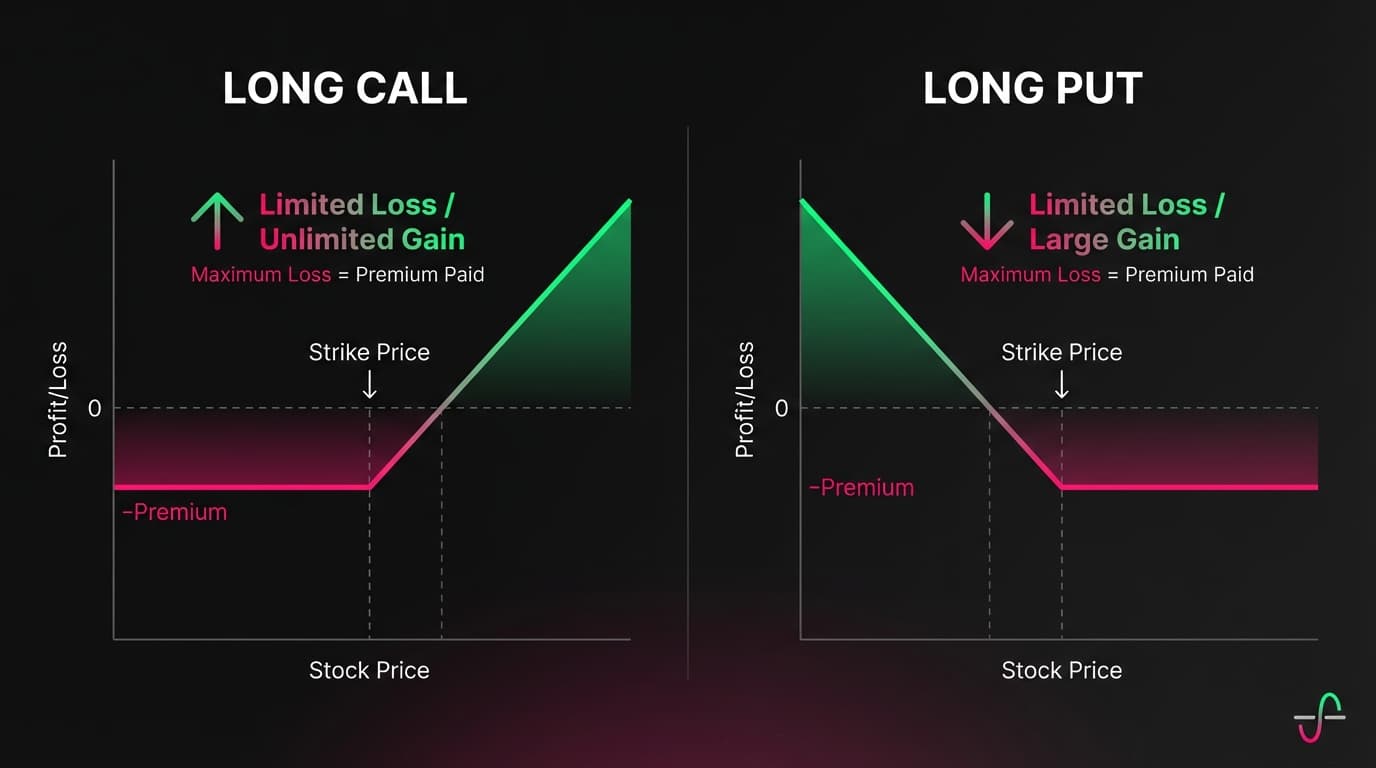
When you buy an option, your maximum loss is the premium paid. Period. You buy a 4,500 call for 50 points, $2,500 total. ES could drop to 4,000, your maximum loss is $2,500. You paid for the right but have no obligation. Meanwhile, if ES rallies to 4,550, your call is worth at least 50 points in intrinsic value, $2,500 total. You risked $2,500 to make $2,500 or more. This asymmetric payoff, limited loss and unlimited gain, is why options are popular for directional bets. You can take a position that profits from a big move while knowing exactly how much you can lose. The catch is that options expire. If ES does not move enough in your direction before expiration, you lose the entire premium even if you were right about direction. Time is constantly working against option buyers.
When buying options, you need to be right about direction AND timing. The underlying might eventually reach your target, but if it does not happen before expiration, your option expires worthless. This is why many professional traders sell options rather than buy them, time decay works in their favor.
Option sellers take the opposite side. They receive premium upfront in exchange for taking on obligations. Selling a 4,500 call means you are obligated to sell ES at 4,500 if the buyer exercises. If ES stays below 4,500, the option expires worthless and you keep the premium as profit. Selling a 4,500 put means you are obligated to buy ES at 4,500 if the buyer exercises. If ES stays above 4,500, the option expires worthless and you profit. The advantage of selling is that time decay works for you. Every day that passes, the option loses time value. You can profit even if ES moves slightly against you, as long as it does not reach the strike. The risk is potentially unlimited on naked calls because ES can rise infinitely, and substantial on puts because ES can fall significantly. This is why option selling requires margin and careful risk management.
Options are unique in that you can trade volatility itself, not just direction. Implied volatility, IV, is the market's expectation of future price movement, derived from option prices. High IV means options are expensive because traders expect big moves. Low IV means options are cheap. When you buy options, you are buying volatility. If IV increases after you buy, your option gains value even if the underlying does not move. When you sell options, you are selling volatility. If IV decreases after you sell, your option loses value, which is good for you as the seller. This creates strategies beyond simple directional bets. Buy options before events like earnings or economic data when you expect volatility to increase. Sell options after events when elevated volatility is likely to decrease. Trade volatility itself through structures that profit from IV changes regardless of direction.
Long call is a bullish bet with limited risk. You pay premium for the right to buy. Profit if the underlying rises above strike plus premium paid. Long put is a bearish bet with limited risk. You pay premium for the right to sell. Profit if the underlying falls below strike minus premium paid. Covered call means you own the underlying and sell call against it. Collect premium in exchange for capping upside. Reduces cost basis but limits gains. Protective put means you own the underlying and buy put for protection. Like insurance, costs premium but protects against crashes. Also called a married put. Cash-secured put means you sell put with cash to buy the underlying if assigned. Collect premium while waiting to buy at lower price. Risk is owning the underlying at strike price if it crashes. These basic strategies form the building blocks. Advanced traders combine multiple options into spreads, condors, butterflies, and other structures with specific risk-reward profiles.
Options are not just for speculation. They serve practical purposes. Hedging protects existing positions from downside risk. A trader might buy puts on ES futures to protect against market crashes. Income generation comes from selling covered calls or cash-secured puts to collect premium regularly. Many traders use options as an income strategy rather than directional betting. Leverage with defined risk means you control large positions with limited capital and known maximum loss. Buying calls costs less than buying futures. Volatility trading lets you express views on volatility without predicting direction. Valuable around events or during unusual market conditions.
Options have the steepest learning curve of any instrument. Key concepts to study beyond this introduction include the Greeks, Delta, Gamma, Theta, Vega, how options respond to various factors. Volatility smile and skew, why different strikes have different implied volatilities. Spread strategies, combining multiple options to create specific payoff structures. Assignment and exercise, the mechanics of what happens at expiration. Options on futures, different settlement and margin mechanics. Start by understanding calls and puts thoroughly before adding complexity. Paper trade basic strategies. Learn how time decay feels by watching options lose value daily. Understand the Greeks conceptually before trading based on them. Options mastery takes years, but even basic understanding provides tools unavailable in any other market.
Next, I will examine leverage and margin in depth, how they work across different instruments and their impact on risk.