
Choosing Your Markets
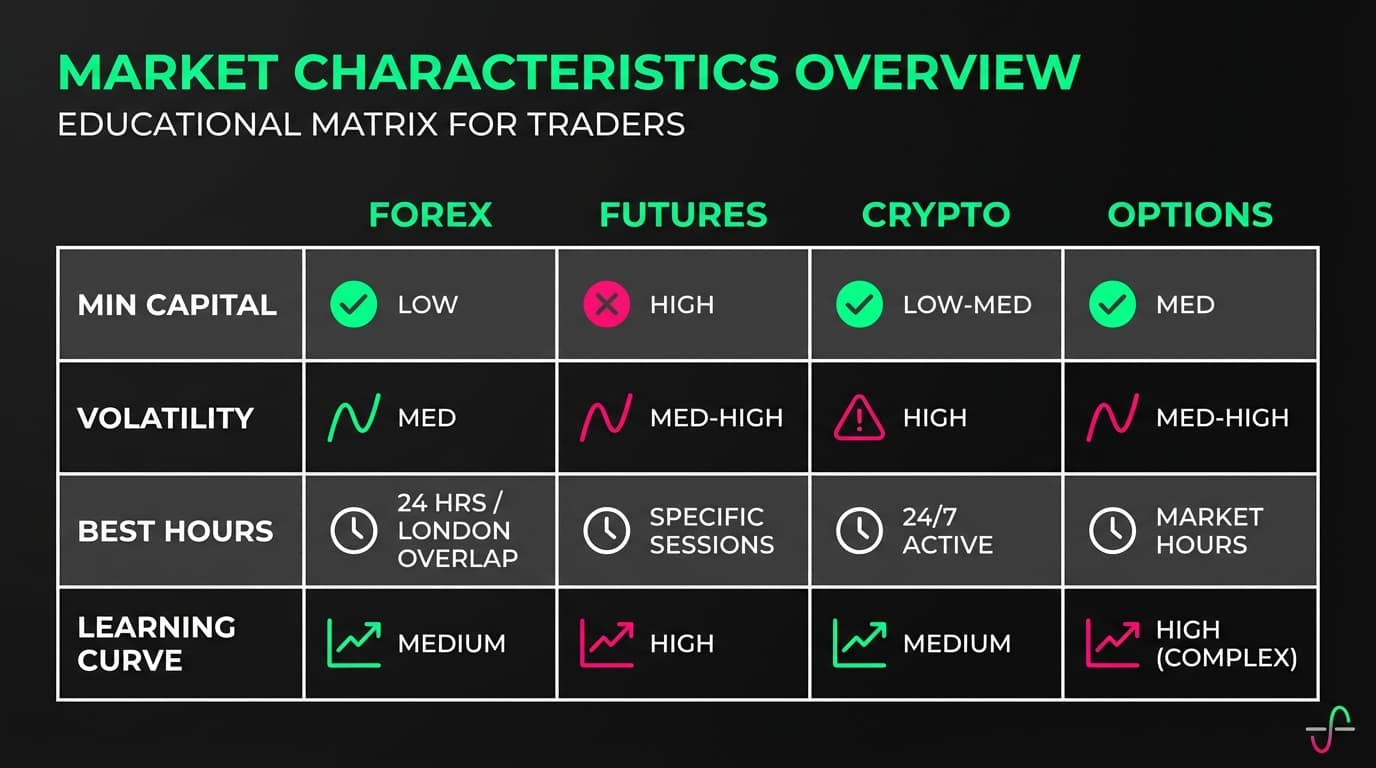
You have now surveyed the landscape. Futures, forex, crypto, options, each with distinct mechanics and characteristics. The question is not which market is best. It is which market fits you. Your capital, schedule, personality, and goals should drive this decision. A night-shift worker should not force themselves into US stock market hours. A risk-averse trader with a small account should not start with leveraged crypto futures. The right market is the 1 that aligns with how you actually live and trade.
Different markets have different barriers to entry.
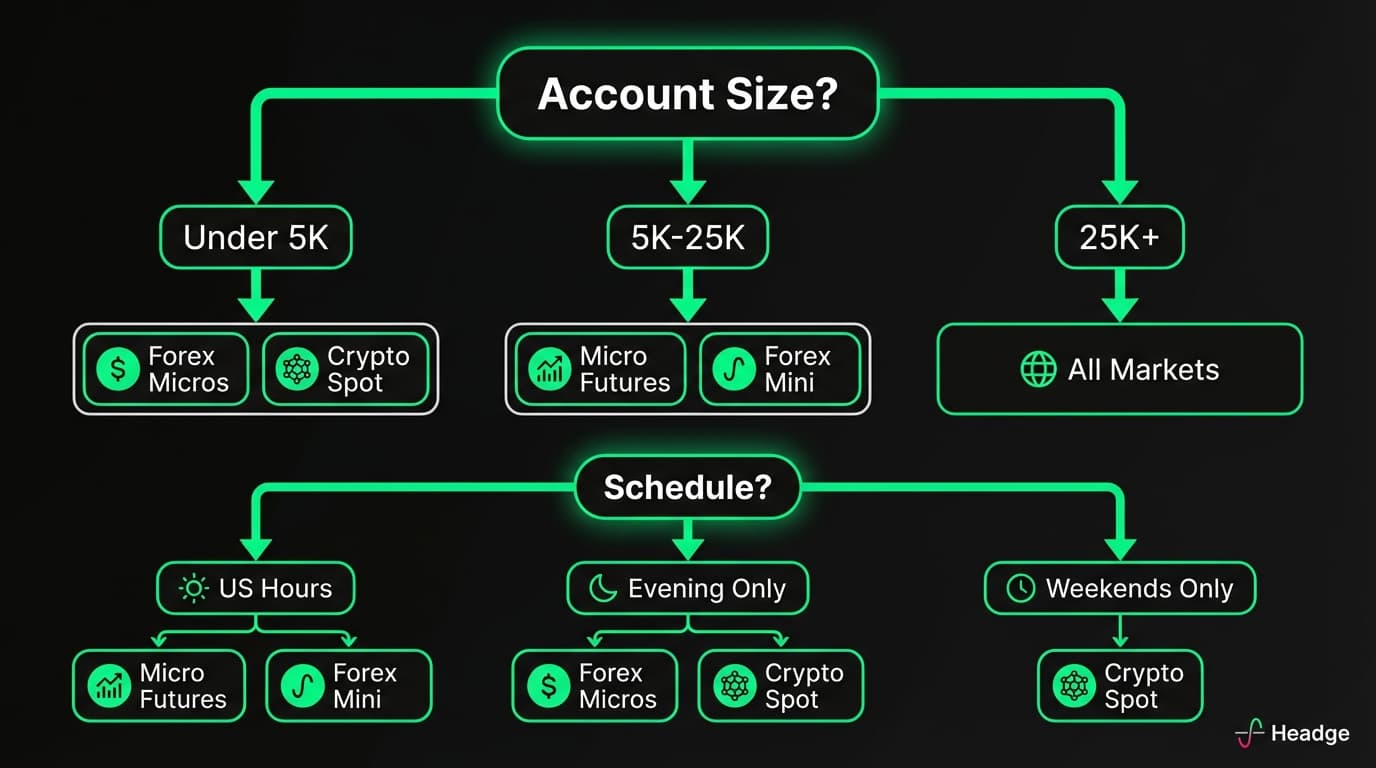
Under $5,000, forex with micro lots works well here. You can trade major pairs with proper position sizing even on small accounts. A 50-pip stop on a micro lot risks just $5. Crypto spot trading is accessible with any amount. Most exchanges have no minimums. Volatility provides opportunity without requiring leverage. Stock CFDs outside the US allow fractional trading with small accounts, though spread costs can eat into returns. Avoid futures, even micros strain accounts this small, options selling because of margin requirements, and pattern day trading stocks which requires $25,000 in the US.
$5,000 to $25,000 means micro futures become viable. MES, MNQ, and MYM allow proper position sizing with meaningful but manageable risk. $10,000 can comfortably trade 1 to 3 micro contracts with appropriate stops. Forex with mini lots scales up from micro. A $10,000 account can trade mini lots with reasonable position sizing. Stock swing trading works if you avoid the pattern day trader rule by holding overnight. Focus on higher-priced stocks where a few shares equals meaningful exposure. Crypto perpetuals with conservative leverage under 5 times become an option, though spot trading remains safer for developing traders.
$25,000 to $100,000 means E-mini futures become accessible. 1 ES contract is manageable for accounts above $50,000 with proper risk management. Options strategies open up. You can sell cash-secured puts, trade spreads, and use options for hedging with adequate capital for margin requirements. Pattern day trading is legal in the US, over $25,000. Full access to intraday stock strategies. Multi-market approach becomes possible. Enough capital to diversify across instruments without spreading too thin.
Above $100,000 means all markets are accessible with full flexibility. Position sizing across multiple contracts, complex options strategies, and professional-grade diversification become practical.
Starting with $3,000 does not make you a worse trader, it limits your instrument choices. Focus on markets where your capital allows proper position sizing. A well-executed forex trade on a $5,000 account beats a poorly-sized futures trade on a $50,000 account.
Your schedule determines what is realistic. Full-time traders or those with flexible schedules can use any market. You can trade the optimal sessions for your chosen instruments. Consider focusing on US hours for the deepest liquidity or specializing in a specific session if it suits your rhythm. Part-time traders with specific windows have different options. Early morning from 5:00 to 8:00 AM ET works for forex during London session, European indices, and pre-market US futures. US market hours from 9:30 AM to 4:00 PM ET means everything is available. Stocks, futures, forex during overlap, and options. Evening from 6:00 to 10:00 PM ET works for Asian session forex like JPY and AUD pairs, crypto, and US futures overnight with thin liquidity. Overnight means crypto is the only market fully active 24/7 with consistent volume.
Weekend-only traders are limited to crypto only. Traditional markets are closed. Some forex brokers offer weekend trading but with wide spreads and thin liquidity. Crypto's 24/7 nature makes it the only serious option for weekend-only traders. Swing traders who do not need to watch markets can use any market since you are not dependent on real-time execution. Set alerts, check positions once or twice daily, and let trades develop. This style fits people with demanding jobs who cannot monitor screens.
Markets have different psychological demands. High volatility tolerance means crypto rewards those who can stomach 10% to 20% swings without panicking. If large drawdowns do not phase you and you can hold through noise, crypto's volatility becomes opportunity. NQ futures and high-beta stocks suit traders who prefer bigger moves. More profit potential, more risk, more emotional demand. Moderate volatility tolerance means ES futures provide significant movement without crypto's extremes. Professional, liquid, and volatile enough to be interesting. Forex majors move meaningfully but within more predictable daily ranges. Good for traders who want action without chaos. Lower volatility tolerance means YM futures or blue-chip stocks offer steadier movement. Less excitement, but also less stress. Options selling strategies like covered calls and cash-secured puts provide steady income with defined risk. Suits patient traders who prefer grinding out returns over hitting home runs.
Patience versus action is another consideration. Scalpers and active traders thrive in high-volume markets like ES futures, major forex pairs, and liquid stocks. These markets offer constant opportunities for those who want to trade frequently. Position traders and investors can trade anything since they are not dependent on intraday movement. Lower frequency means execution quality matters less than the overall trend.
Some strategies work better in certain markets. Trend following works across most markets. Futures and forex trend well over medium timeframes. Crypto trends can be explosive but also reverse violently. Stocks work for swing trading trends. Mean reversion is best in ranging markets or instruments with established trading ranges. Forex pairs often range. Index futures mean-revert intraday. Options strategies like iron condors profit from mean reversion. Breakout trading requires liquid markets with clean technical levels. Futures like ES and NQ break out cleanly. Forex pairs work well. Crypto breaks out but also produces many false breakouts. Income generation comes from options selling on stocks or indices, forex carry trades holding high-yield currencies against low-yield, and crypto funding rate arbitrage for sophisticated traders. News and event trading works in all markets, but some are easier to trade. Forex responds to economic data with tradeable moves. Stock earnings create volatility but also gap risk. Crypto reacts to regulatory news, often unpredictably.
Based on common situations, here are starting recommendations.
- New traders with small accounts of $1,000 to $5,000 should start with forex micro lots. Learn position sizing, risk management, and market mechanics in a forgiving environment. The 24-hour market means you can trade whenever fits your schedule. Graduate to futures or crypto once you are consistently profitable.
- New traders with adequate accounts of $10,000 to $25,000 should start with micro futures like MES and MNQ. You will learn professional-grade instruments with manageable risk. The RTH session provides structure. This prepares you for full-size contracts if you grow your account.
- Experienced traders switching markets should paper trade first. Every market has quirks. Forex spreads behave differently than futures bid/ask. Crypto's 24/7 nature changes risk management. Simulate until the new market's mechanics feel natural.
- Passive income focus means options on stocks or indices. Covered calls, cash-secured puts, and income-focused strategies. Requires adequate capital of $25,000 plus and willingness to learn options mechanics.
- Limited time with occasional trading means swing trading stocks or forex. Set up trades with stops and targets, then let them work. Check positions daily rather than watching charts constantly. Avoid markets that require constant attention.
As you develop, consider expanding across markets. Diversification means different markets trend at different times. When stocks chop, forex might trend. When crypto crashes, futures might offer safer opportunity. Correlation awareness means many markets correlate. ES and NQ move together. USD strength affects multiple forex pairs. Risk-off moves hit crypto, stocks, and high-yield currencies simultaneously. Capital efficiency means futures offer leverage on directional views. Options offer defined risk. Combining instruments lets you express views more precisely. Schedule optimization means trade Asian session forex, then US futures, then crypto overnight. Cover all time zones with appropriate instruments. Most traders start with 1 market, master it, then expand. There is no rush. Better to be excellent in 1 market than mediocre in 5.
Before committing to a market, demo trade it. Every market feels different. Paper trade for at least a month to understand the rhythm, spreads, and behavior. Calculate realistic costs. Spreads, commissions, funding rates, swap costs, these vary enormously between markets and brokers. Understand your true cost of trading. Match your sleep. If the optimal hours for your chosen market conflict with your sleep, you will either trade suboptimal conditions or burn out. Choose markets that fit your natural schedule. Start conservatively. Whatever position size seems reasonable, start smaller. You will make mistakes learning a new market. Make them with minimal capital at risk.
The best market is the 1 where you can trade with proper risk management, during hours that fit your life, with capital appropriate for the instrument's characteristics. Everything else is secondary.
You have completed the Instrument Education module. You now understand the unique characteristics of futures, forex, crypto, and options, and how to choose the right markets for your trading style and capital.