
Cryptocurrency Markets
Bitcoin launched in 2009 as an experiment in decentralized digital money. Today, cryptocurrency is a trillion-dollar asset class traded around the clock on hundreds of exchanges worldwide. The volatility that makes crypto famous, or infamous, creates both opportunity and risk that dwarfs traditional markets. Whether you view crypto as the future of finance or speculative mania, understanding how these markets work is essential for any modern trader.
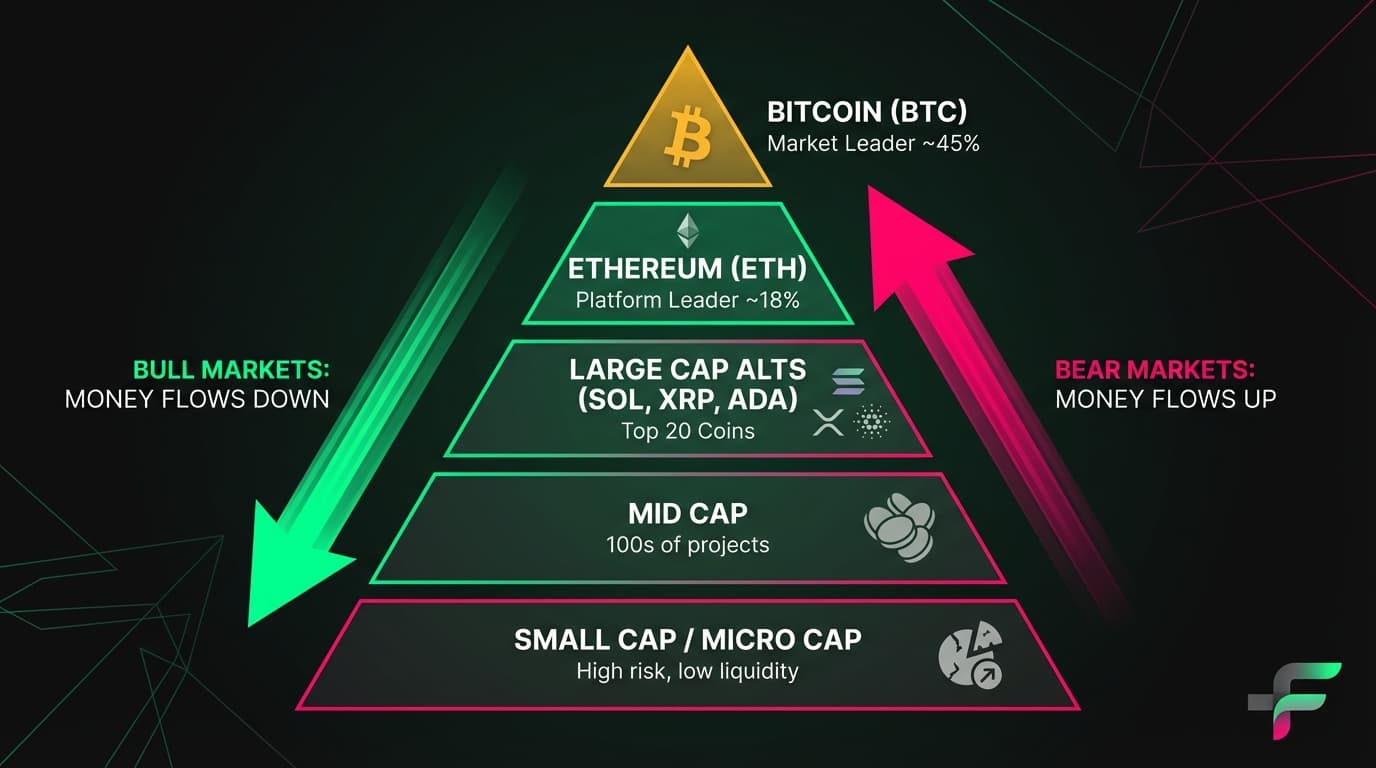
Bitcoin is the original cryptocurrency and remains the largest by market capitalization. It is designed as digital gold, a scarce, decentralized store of value with a hard cap of 21 million coins that will ever exist. Bitcoin moves the entire crypto market. When BTC rallies, most cryptocurrencies rally. When BTC crashes, almost nothing is spared. Ethereum is the second-largest cryptocurrency and serves a different purpose. While Bitcoin focuses on being money, Ethereum is a platform for decentralized applications. Smart contracts on Ethereum power DeFi, decentralized finance, NFTs, and thousands of other projects. ETH tends to be more volatile than BTC, it might gain 15% when Bitcoin gains 10%, or lose 20% when Bitcoin loses 15%. Together, BTC and ETH represent roughly 60% to 70% of total crypto market capitalization. They are the blue chips of crypto, if such a term can apply to assets that routinely move 10% in a day.
Bitcoin's dominance means it sets the tone for the entire market. A major BTC move will drag nearly every other cryptocurrency with it. When analyzing altcoins, always check what Bitcoin is doing first. The best altcoin setup means nothing if Bitcoin is about to dump 20%.
Everything besides Bitcoin is technically an altcoin, alternative coin. Large-cap altcoins include Ethereum, Solana, XRP, Cardano, and Avalanche. These have market caps in the tens of billions, reasonable liquidity, and some institutional adoption. Mid-cap altcoins are projects with market caps of $1 to $10 billion. More volatile than large caps, with varying levels of liquidity and legitimacy. Small-cap and micro-cap are the wild west. These can 10x in a week or go to 0 overnight. Liquidity is thin, manipulation is common, and many are outright scams. The altcoin market follows a pattern. In bull markets, money flows from Bitcoin to large-cap alts to increasingly speculative small caps. In bear markets, the collapse happens in reverse, small caps implode first, then mid caps, then large caps, with Bitcoin holding up longest.
Crypto trades on multiple venue types, each with different characteristics. Centralized exchanges or CEX like Binance, Coinbase, Kraken, and Bybit function like traditional brokerages. You deposit funds, place orders, and the exchange matches buyers with sellers. They offer the best liquidity and most trading features but require trusting the exchange with your funds. Decentralized exchanges or DEX like Uniswap, dYdX, and Jupiter operate on blockchain without intermediaries. You trade directly from your wallet. Pros include no custody risk and access to new tokens immediately. Cons include higher fees, lower liquidity for most pairs, and more technical complexity. Futures exchanges like Binance Futures, Bybit, and CME for institutions offer crypto perpetual futures that are enormously popular, offering leverage up to 100 times or more. The funding rate mechanism keeps perpetual prices aligned with spot. For most retail traders, centralized exchanges offer the best combination of liquidity, features, and usability. Just remember, not your keys, not your coins. Funds on an exchange can be lost to hacks, fraud, or exchange bankruptcy.
Traditional futures have expiration dates. Crypto invented perpetual futures, contracts that never expire. You can hold a leveraged position indefinitely without rolling. Perpetuals stay anchored to spot price through funding rates. When perpetual price trades above spot, meaning more buyers than sellers, longs pay shorts every 8 hours. When perpetual trades below spot, shorts pay longs. This incentive structure keeps perpetual and spot prices aligned. Funding rates also signal market sentiment. High positive funding means many traders are long with leverage, crowded trade with potential for long squeeze. High negative funding means many traders are short with leverage, potential for short squeeze. Near-zero funding means market is balanced with no strong directional bias.
Crypto perpetual futures commonly offer 50 times, 100 times, or even 125 times leverage. This is insane. A 1% move against you at 100 times leverage liquidates your entire position. Professional crypto traders rarely use more than 5 to 10 times effective leverage. The ability to use 100 times does not mean you should.
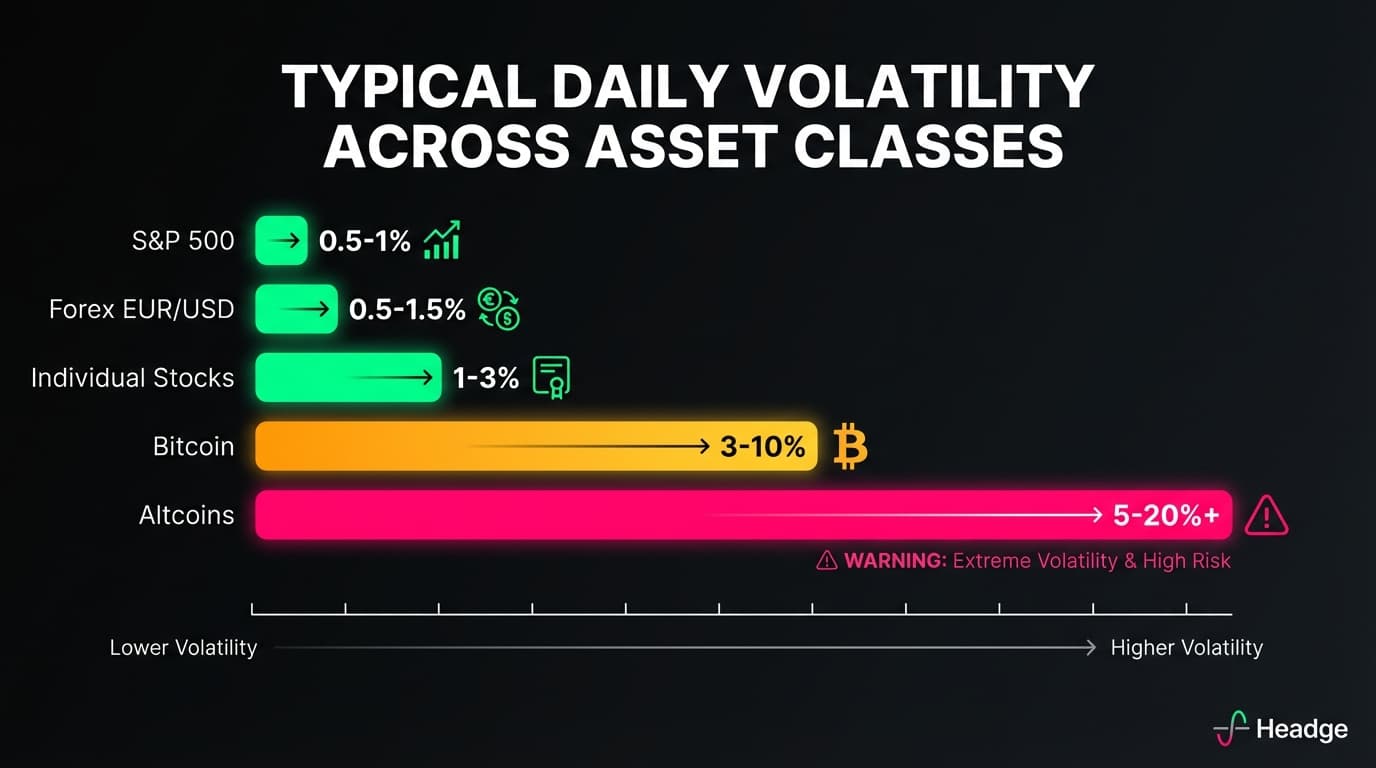
Crypto volatility operates on a different scale than traditional markets. A boring day in Bitcoin might see a 2% to 3% range. A normal day might be 5%. In volatile periods, 10% to 15% daily moves are common. During market events, 20% to 30% moves can happen within hours. For altcoins, multiply everything by 2 to 3 times. A 10% Bitcoin move might correspond to a 25% move in Ethereum and a 50% move in smaller altcoins. This volatility has implications. Position sizing must be smaller. If you size positions in crypto the same way you size positions in S&P futures, you will experience stomach-churning swings. Stop losses get triggered frequently. A stop that would be reasonable in stocks, say 5% below entry, will get hit constantly in crypto. Traders either use wider stops or accept more frequent stop-outs. Weekend gaps do not exist, but 24/7 means constant exposure. There is no closing bell to limit overnight risk. A tweet at 3:00 AM can move Bitcoin 10% while you sleep.
Crypto markets differ from traditional markets in several important ways. 24/7 365 trading means no weekends, no holidays. The market never closes. This is both an opportunity, always able to trade, and a burden, always exposed to risk. Fragmented liquidity means unlike stocks with a consolidated tape, crypto trades across dozens of exchanges with different prices. Arbitrage bots keep prices roughly aligned, but spreads can differ significantly between venues. No circuit breakers means traditional markets halt trading during extreme moves. Crypto does not. Price can fall 50% with no pause. This is why liquidation cascades can be so severe. Minimal regulation means no insider trading enforcement, no prohibition on wash trading, limited recourse if an exchange fails. Manipulation that would be illegal in stocks happens openly in crypto. Whale influence means large holders can move markets significantly. A single entity selling 1% of Bitcoin's supply would move the price far more than selling 1% of Apple stock.
The extreme volatility demands adjusted risk management. Reduce position sizes. If you normally risk 1% of your account per trade, consider 0.5% or less in crypto. The volatility will still give you meaningful gains on winners. Expect larger drawdowns. Even good crypto strategies can see 30% to 50% drawdowns. If that is unacceptable, reduce exposure or do not trade crypto. Use hard stops. In a market that can move 20% overnight, hoping for a bounce is dangerous. Define your exit before entering. Never use maximum leverage. Just because 100 times is available does not make it appropriate. Most professional crypto traders use 3 to 10 times effective leverage. Keep most funds off exchanges. Only keep what you need for active trading on an exchange. Store the rest in self-custody wallets. Accept that gaps can exceed stops. In flash crashes, slippage can be severe. Your stop at negative 5% might fill at negative 15%. Size for worst-case scenarios.
For traders new to cryptocurrency, start with BTC and ETH only. Learn how crypto markets behave with the most liquid assets before touching altcoins. Use spot before futures. Leveraged products in crypto can liquidate your position in minutes. Understand spot dynamics first. Trade small. Really small. The volatility is deceptive, what looks like a conservative position can turn into a large loss quickly. Study market structure. Funding rates, liquidation levels, on-chain metrics, exchange flows, crypto has unique analytical tools worth learning. Do not chase. The fear of missing out is strongest in crypto. The asset that went up 50% this week might drop 30% next week. Patience beats FOMO.
Cryptocurrency offers genuine opportunity for prepared traders. The volatility creates large moves to capture. The 24/7 nature means opportunity is always available. But the same features that create opportunity create risk. Approach crypto with respect, proper sizing, and clear risk parameters.
Next, I will introduce options, a different kind of derivative that offers unique ways to manage risk and express market views.