
Forex Fundamentals
The foreign exchange market trades over $7 trillion dollars daily. That is not a typo. Every day, currency worth more than the annual GDP of Japan changes hands. It is the largest, most liquid market on Earth, and it operates 24 hours a day, 5 days a week. Forex is fundamentally different from stocks or futures. You are not buying a company or a contract, you are exchanging 1 currency for another. Every trade is simultaneously a bet that 1 currency will strengthen while another weakens. This is the core concept that confuses new forex traders. You never just buy dollars or sell euros. You buy 1 currency by selling another.
EUR/USD is the euro versus the US dollar. If EUR/USD is quoted at 1.0850, it means 1 euro costs 1.0850 US dollars. If you buy EUR/USD, you are buying euros and selling dollars, betting the euro will strengthen against the dollar. The first currency in a pair is the base currency. The second is the quote currency. The exchange rate tells you how much quote currency you need to buy 1 unit of base currency. When EUR/USD rises from 1.0850 to 1.0950, the euro has strengthened, or the dollar has weakened. When it falls to 1.0750, the euro has weakened, or the dollar has strengthened.
When you buy EUR/USD, you are bullish on the euro AND bearish on the dollar. Good euro news can push the pair up. Bad dollar news can also push it up. You need to consider both sides of the equation when analyzing currency pairs.
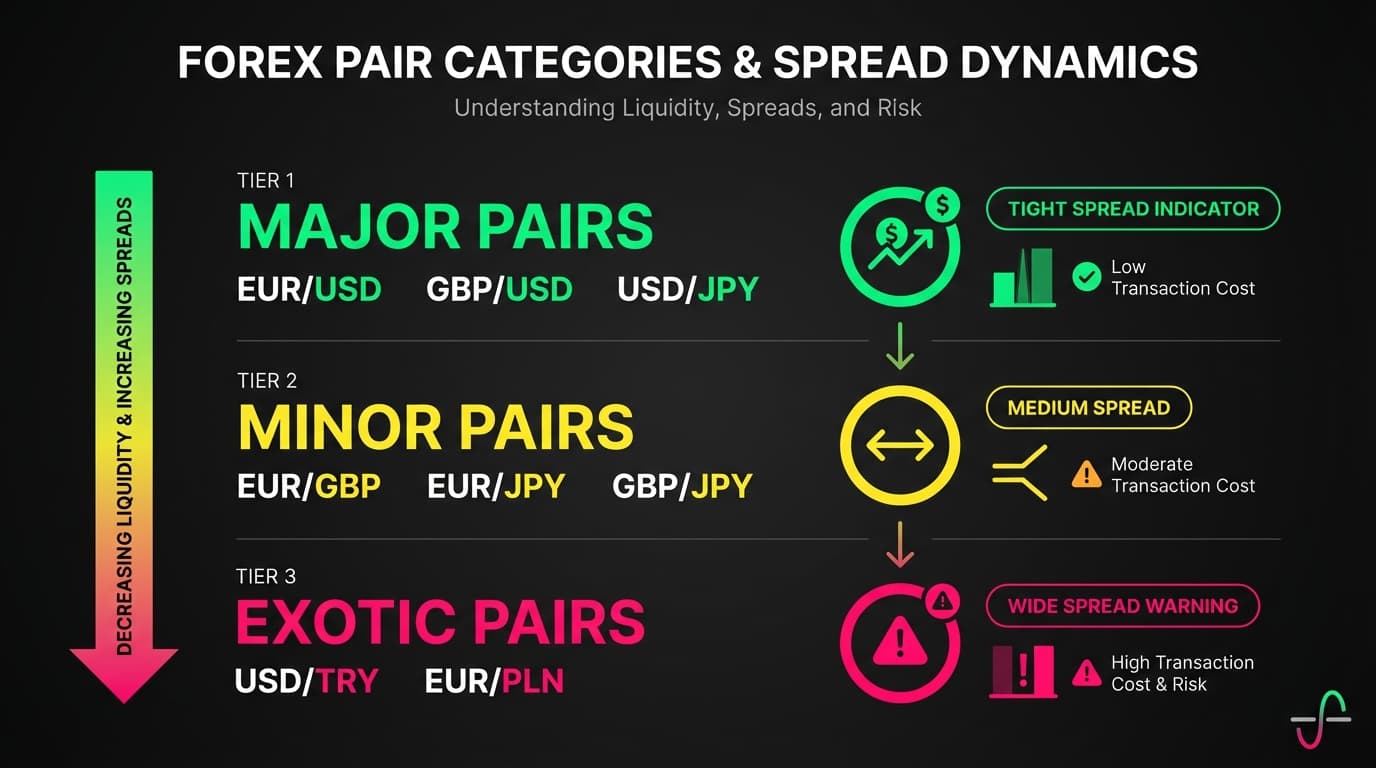
Major pairs all include the US dollar and 1 of the other most-traded currencies. EUR/USD, Euro/Dollar, nicknamed Fiber. GBP/USD, British Pound/Dollar, nicknamed Cable. USD/JPY, Dollar/Japanese Yen. USD/CHF, Dollar/Swiss Franc, nicknamed Swissy. AUD/USD, Australian Dollar/Dollar, nicknamed Aussie. USD/CAD, Dollar/Canadian Dollar, nicknamed Loonie. NZD/USD, New Zealand Dollar/Dollar, nicknamed Kiwi. Majors have the tightest spreads and deepest liquidity. EUR/USD alone accounts for roughly 25% of all forex volume.
Minors or crosses do not include the US dollar but involve other major currencies. EUR/GBP, Euro/Pound. EUR/JPY, Euro/Yen. GBP/JPY, Pound/Yen. AUD/JPY, Aussie/Yen. Minors have wider spreads than majors but still offer good liquidity. Exotic pairs include 1 major currency and 1 from a smaller or emerging economy. USD/TRY, Dollar/Turkish Lira. EUR/PLN, Euro/Polish Zloty. USD/ZAR, Dollar/South African Rand. Exotics have wide spreads, lower liquidity, and can make violent moves. They are generally not suitable for new traders.
A pip, which stands for percentage in point, is the standard unit for measuring currency movement. For most pairs, a pip is 0.0001, the fourth decimal place. If EUR/USD moves from 1.0850 to 1.0851, it moved 1 pip. If it moves from 1.0850 to 1.0950, it moved 100 pips. Exception is for pairs involving the Japanese yen, a pip is 0.01, the second decimal place. If USD/JPY moves from 155.00 to 155.01, that is 1 pip. If it moves from 155.00 to 156.00, that is 100 pips. Many brokers now quote prices to an additional decimal place called a pipette or fractional pip. EUR/USD might show as 1.08505 instead of 1.0850. The pipette allows for tighter spreads but does not change how you calculate pip values for position sizing.
Forex trades in lots. A standard lot is 100,000 units of base currency, with 1 pip equal to $10 for USD quote currency pairs. EUR/USD standard lot means trading 100,000 euros. A mini lot is 10,000 units of base currency, with 1 pip equal to $1 for USD quote currency pairs. A micro lot is 1,000 units of base currency, with 1 pip equal to $0.10 for USD quote currency pairs. The pip value depends on which currency is the quote currency and the current exchange rate. For pairs where USD is the quote currency, EUR/USD and GBP/USD, the calculation is straightforward. For pairs where USD is the base currency, USD/JPY and USD/CAD, the pip value varies with the exchange rate. Most retail brokers allow trading in micro lots, which is essential for proper position sizing with smaller accounts.
For quick mental math on USD quote pairs: micro lot equals $0.10 per pip, mini lot equals $1 per pip, standard lot equals $10 per pip. This lets you calculate position size instantly. If you want to risk $50 and your stop is 25 pips, you can trade 2 mini lots, $1 times 25 pips times 2 equals $50 risk.
Forex is the most leveraged retail market. Brokers commonly offer 50 to 1, 100 to 1, or even higher leverage. Some offshore brokers offer 500 to 1. At 100 to 1 leverage, you can control $100,000 in currency with $1,000 margin. A 1% move in your favor doubles your money. A 1% move against you wipes out your margin. Currency pairs typically move 0.5% to 1.5% daily. That sounds small compared to stocks, which might move 2% to 5%. But with 100 to 1 leverage, a 1% move becomes a 100% gain or loss on your margin. This is why forex has a reputation for blowing up accounts. The leverage is intoxicating and deadly if misused. Sensible leverage usage means trading position sizes where a normal daily move, 50 to 100 pips, risks 1% to 2% of your account, regardless of how much leverage your broker offers. Having 100 to 1 leverage available does not mean you should use it.
Forex brokers make money primarily through the spread, the difference between the bid price, what you can sell at, and the ask price, what you can buy at. If EUR/USD shows bid 1.0850 and ask 1.0852, the spread is 2 pips. When you buy at 1.0852, you are immediately down 2 pips because you could only sell at 1.0850. Spreads vary by pair, with majors having tight spreads of 0.5 to 2 pips and exotics having spreads of 10 plus pips. They vary by time, with spreads widening during low-liquidity periods like Asian session for EUR/USD. They vary by volatility, with news events blowing spreads out to 5 to 10 times normal. They vary by broker, with ECN brokers offering raw spreads plus commission and market makers offering wider spreads with no commission. Some brokers also charge swap or rollover fees for positions held overnight, reflecting the interest rate differential between the 2 currencies.
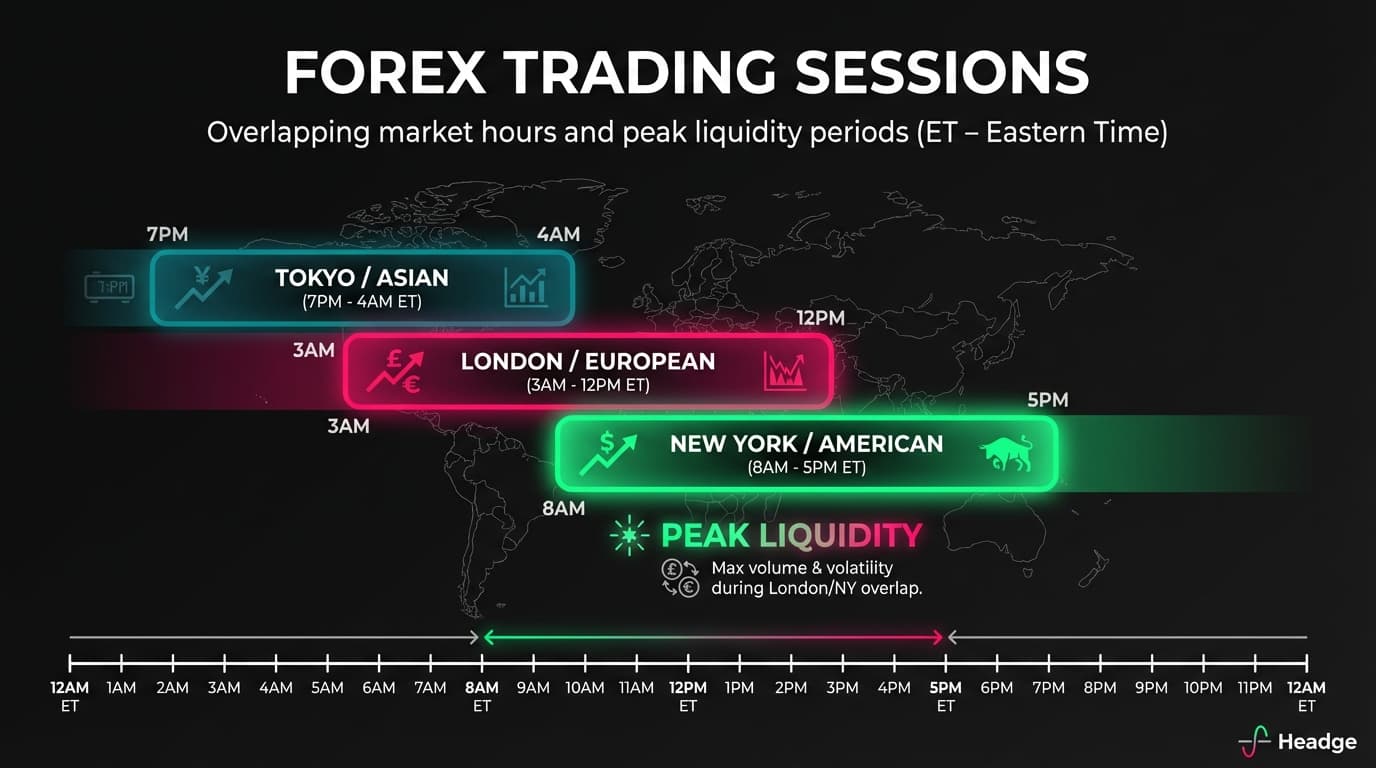
Forex trades around the clock from Sunday evening to Friday evening US time. But activity is not uniform. It follows the sun around the globe through 3 major sessions. The Asian Session, Tokyo, runs from 7:00 PM to 4:00 AM ET. Yen pairs are most active, USD/JPY and EUR/JPY. Generally lower volatility for EUR/USD and GBP/USD. Can see significant moves on Japanese economic data. The session often sets up for the European open. Ranges established during Asia become breakout targets when London wakes up. The European Session, London, runs from 3:00 AM to 12:00 PM ET. London is the world's financial capital for foreign exchange and a major hub for equities and commodities. The European session typically sees highest forex volume of the day, major moves in EUR, GBP, and CHF pairs, European equity indices like DAX, FTSE, and CAC at peak activity, commodity markets waking up, and UK and Eurozone economic data releases often at 3:00 to 4:00 AM ET. The first 2 hours of London, 3:00 to 5:00 AM ET, often establish the day's direction. Breakouts from Asian ranges frequently occur here. The American Session, New York, runs from 8:00 AM to 5:00 PM ET. The US session brings the deepest liquidity for most instruments, US equities at peak volume, S&P and Nasdaq futures most active, US economic data releases typically at 8:30 AM ET, Fed announcements at 2:00 PM ET when scheduled, and commodity markets fully active. The US session tends to be most volatile in the first 2 hours, 9:30 to 11:30 AM ET, and often sees a secondary move around 2:00 to 3:00 PM ET.
The London-New York overlap from 8:00 AM to 12:00 PM ET sees the highest combined volume across forex, futures, and equities. If you can only trade 1 period per day, this is it. Both major financial centers are active, liquidity is deepest, and spreads are tightest.
Currency values respond to multiple factors. Interest rates mean higher rates attract capital, strengthening a currency. Central bank decisions from the Fed, ECB, and BOJ are the most-watched events. Economic data like GDP, employment, inflation, and trade balances all affect currency valuation. Strong economic data typically strengthens a currency. Risk sentiment means in risk-off environments, traders buy safe haven currencies like USD, JPY, and CHF and sell higher-yielding currencies like AUD and NZD. Political events like elections, geopolitical tensions, and policy changes can cause significant currency moves. Central bank intervention means central banks occasionally intervene directly in currency markets, buying or selling their currency to influence its value. Unlike stocks, where you can analyze a single company, forex requires monitoring 2 economies simultaneously. EUR/USD can move because of European Central Bank policy, Federal Reserve policy, or both.
For new forex traders, stick to majors initially. EUR/USD, GBP/USD, and USD/JPY have the best liquidity and most predictable behavior. Learn these before exploring minors or exotics. Use micro lots. They allow proper position sizing even with small accounts. A 50-pip stop on a micro lot risks only $5. Trade during active hours. The London-New York overlap offers the best conditions. Avoid trading during low-liquidity periods until you understand how spreads and slippage work. Ignore the leverage. Trade position sizes appropriate to your account, not based on maximum available leverage. Most successful forex traders use effective leverage of 3 to 1 to 10 to 1, regardless of what their broker offers. Understand both currencies. When trading EUR/USD, know what is happening in both the Eurozone and the US. A trade can go wrong because of news from either side.
Next, I will explore cryptocurrency markets, how Bitcoin, Ethereum, and altcoins trade, and what makes crypto unique among asset classes.