
Leverage and Margin
Leverage lets you control more than you own. It is the defining feature that makes futures, forex, and crypto derivatives accessible to retail traders, and the mechanism that destroys accounts when misused. Understanding how leverage and margin work across different instruments is not just useful knowledge. It is survival knowledge.
Leverage is a ratio. 10 to 1 leverage means you control $10 for every $1 of your own capital. If you have $10,000 and use 10 to 1 leverage, you control $100,000 worth of assets. Margin is the collateral you put up. It is your stake in the position. The margin requirement determines how much leverage is available. An ES futures contract at 5,000 has notional value of $250,000. If the margin requirement is $12,500, you need $12,500 to control $250,000, that is 20 to 1 leverage. The math is simple. Leverage equals Notional Value divided by Margin Required. What makes leverage powerful and dangerous is that gains and losses are based on the notional value, not your margin.
A 1% move on $250,000 notional is $2,500. If your margin is $12,500, that 1% move represents a 20% change in your capital. Leverage does not create risk, it magnifies the risk already present in price movement. The same mechanism that doubles your money can halve it just as fast.
Different markets offer vastly different leverage. Stocks in the US have cash accounts at 1 to 1, meaning no leverage, margin accounts at 2 to 1 for positions held overnight, and day trading at 4 to 1 intraday with pattern day trader status. Futures typically offer 10 to 1 to 20 to 1 depending on the contract. ES futures offer roughly 20 to 1, crude oil roughly 15 to 1, and micro contracts have similar leverage ratios. Forex in the US regulated market offers up to 50 to 1 for majors and 20 to 1 for minors. International brokers offer 100 to 1 to 500 to 1 commonly, and some offshore brokers offer up to 1,000 to 1. Crypto spot trading offers 1 to 1 to 5 to 1 depending on exchange, while perpetual futures commonly offer 20 to 1 to 125 to 1, with some exchanges offering up to 200 to 1. Options buying have inherent leverage that varies by delta and premium, while options selling have margin requirements that vary by strategy and broker.
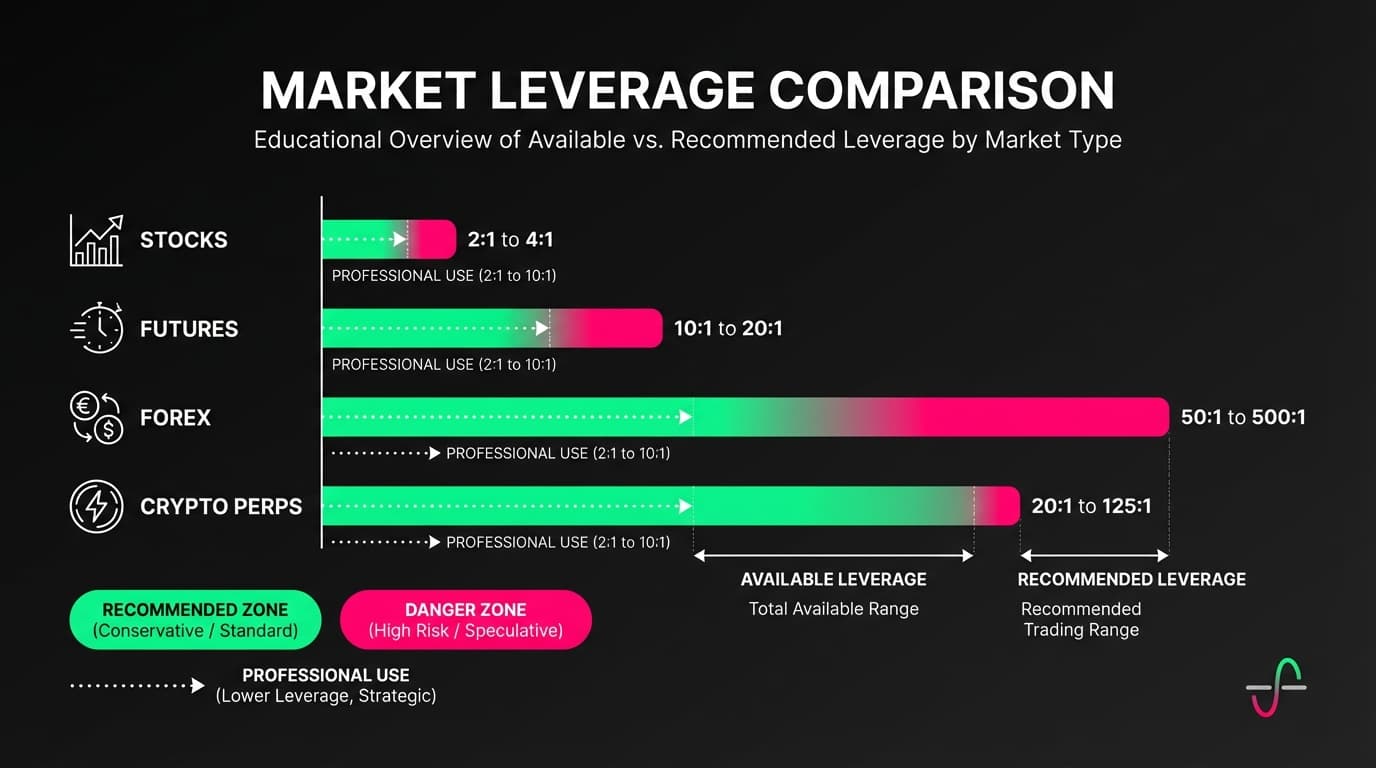
A critical distinction is that leverage available is not leverage you should use. Your forex broker offers 50 to 1. This means you can control $500,000 with $10,000. It does not mean you should. Professional traders typically use effective leverage of 2 to 1 to 10 to 1, regardless of what is available. They use the excess margin capacity as a buffer, not as an invitation to maximize position size. Calculating effective leverage works like this. Position Size times Price equals Notional Value. Notional Value divided by Account Equity equals Effective Leverage. If you have $50,000 and take a position with $150,000 notional exposure, your effective leverage is 3 to 1, conservative by most standards, regardless of whether your broker offers 50 to 1 or 500 to 1.
The leverage your broker offers is a ceiling, not a target. Trading at maximum available leverage guarantees eventual account destruction. Even a 2% adverse move at 50 to 1 leverage wipes out 100% of your capital. Professional traders treat maximum leverage as an emergency reserve, not standard operating procedure.
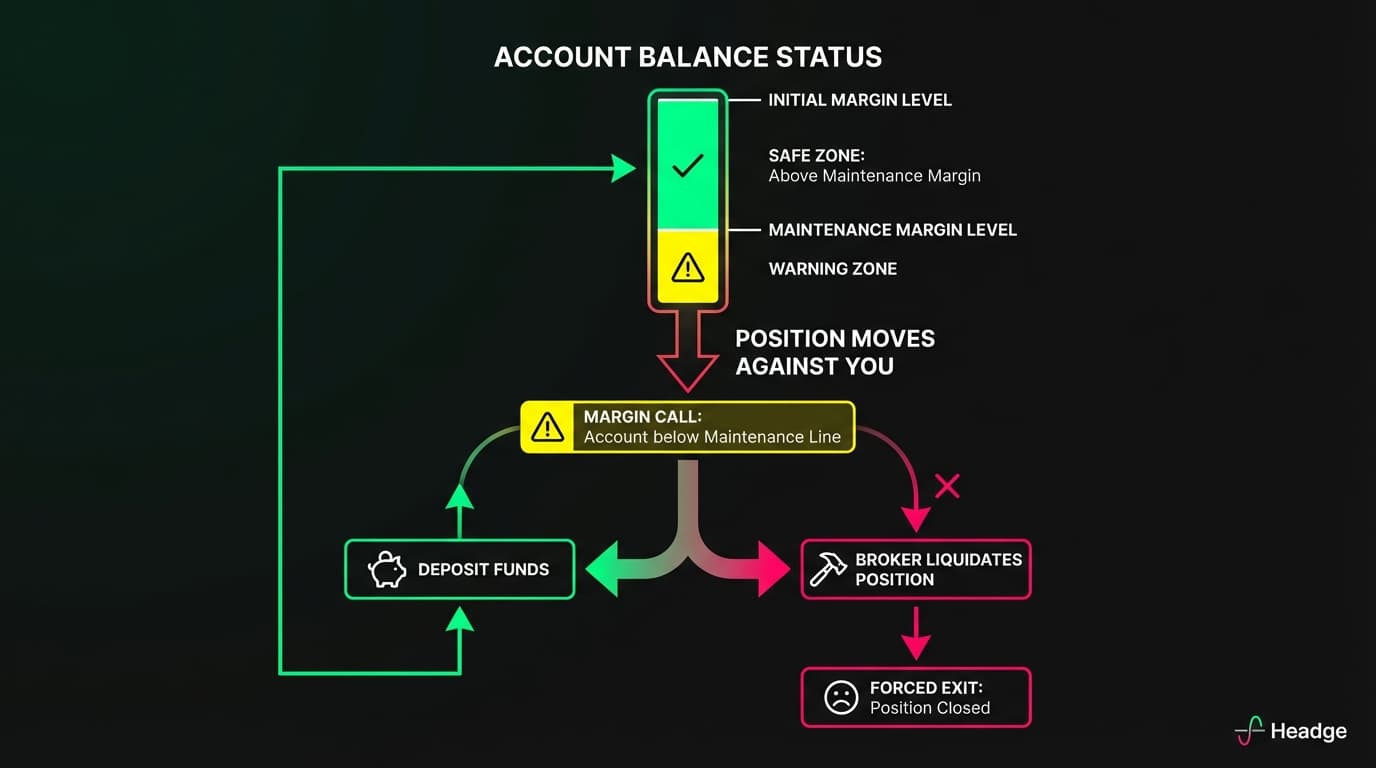
Futures and leveraged products have 2 margin levels. Initial margin is what you need to open a position. Think of it as the entry ticket. Maintenance margin is what you need to keep a position open, typically 70% to 90% of initial margin. If your account falls below this, you get a margin call. With ES futures, initial margin might be $12,500 and maintenance margin $11,000. If you have $15,000 and open 1 contract, and the position goes against you by 80 points, $4,000, your account equity is $11,000, exactly at maintenance. 1 more tick against you triggers a margin call. When you receive a margin call, you typically have limited time to either deposit more funds or close positions. If you do not act, your broker will liquidate positions to bring your account back into compliance, often at the worst possible prices.
Here is why leverage demands respect. Consider a $50,000 account. At 2 to 1 effective leverage, $100,000 notional, a 10% adverse move equals $10,000 loss, which is 20% drawdown. The account survives and can recover. At 10 to 1 effective leverage, $500,000 notional, a 10% adverse move equals $50,000 loss, which is 100% wipeout. The account is destroyed. At 20 to 1 effective leverage, $1,000,000 notional, a 5% adverse move equals $50,000 loss, which is 100% wipeout, and a 10% adverse move equals $100,000 loss, which means you owe the broker money. The higher your leverage, the smaller the move required to destroy your account. And in volatile markets, 5% to 10% moves happen regularly. This is not theoretical. Traders blow up accounts every day by using available leverage rather than appropriate leverage.
Advanced traders can access more favorable margin treatment. Cross-margining allows offsetting positions in related instruments to reduce total margin. Long ES futures and short NQ futures might require less margin together than separately because they are correlated, losses in 1 are partially offset by gains in the other. Portfolio margin, available to qualified traders, calculates margin based on overall portfolio risk rather than position-by-position. A hedged portfolio might get 6 to 1 leverage on stocks instead of 2 to 1, because the hedges reduce real risk. These arrangements reduce margin requirements for sophisticated strategies but still do not eliminate the underlying leverage risk. Lower margin requirements mean more leverage, which means larger gains and losses.
For futures, use position sizing based on dollar risk, not contracts. I am risking $500 is safer thinking than I am trading 2 contracts. The leverage is built in, you do not need to maximize it. For forex, never use more than 10 to 1 effective leverage. The availability of 50 to 1 or 100 to 1 is irrelevant. Currency moves are smaller than other assets, but extreme leverage can still destroy accounts on normal daily ranges. For crypto, keep effective leverage under 5 to 1 given the extreme volatility. A 20% move is routine in crypto, at 5 to 1 leverage, that is a 100% gain or loss. Higher leverage is gambling, not trading. For options, leverage is implicit in the option's delta and premium. A 50 point option controlling 4,500 futures has significant leverage embedded. Treat options as already leveraged and size accordingly.
There is a framework for determining appropriate leverage. Define maximum acceptable drawdown. What percentage loss can your account and psychology survive? Most traders should cap this at 20% to 30%. Estimate worst-case move. What is the largest adverse move that could happen overnight or during a news event? Be conservative, assume worse than historical. Calculate position size backward. If worst-case move times position size exceeds maximum acceptable drawdown, reduce position size. The resulting leverage is your answer. It might be 2 to 1, 5 to 1, or 10 to 1. It is probably not 50 to 1. This approach treats leverage as an output of risk management, not an input. You do not pick a leverage level and then manage around it, you define acceptable risk and let that determine your actual leverage.
The traders who survive leveraged markets share common traits. They use a fraction of available leverage. They calculate position size in dollar risk, not leverage ratios. They never add to losing positions, which increases effective leverage. They maintain cash reserves well above minimum margin requirements. They reduce leverage during high-volatility periods. They accept that leverage is a tool, not a strategy. Leverage lets small accounts participate in markets that would otherwise be inaccessible. Used wisely, it is a genuine advantage. Used recklessly, it compresses years of potential losses into days or hours. The market does not care how much leverage you use. It just moves. Whether that movement grows your account or destroys it depends entirely on how you have sized your positions.
Next, I will cover market hours and sessions, understanding when different markets are most active and why timing matters for execution.