
Equity Index Futures
The E-mini S&P 500 futures contract trades more notional value daily than all the stocks in the S&P 500 combined. It is the most liquid equity instrument on Earth. For retail traders seeking exposure to the broad US stock market, equity index futures offer efficiency that individual stocks cannot match. 3 contracts dominate retail trading: ES for S&P 500, NQ for Nasdaq 100, and YM for Dow Jones. Each tracks a different index with different characteristics, but they share the core advantages of futures, leverage, liquidity, and nearly 24-hour access.
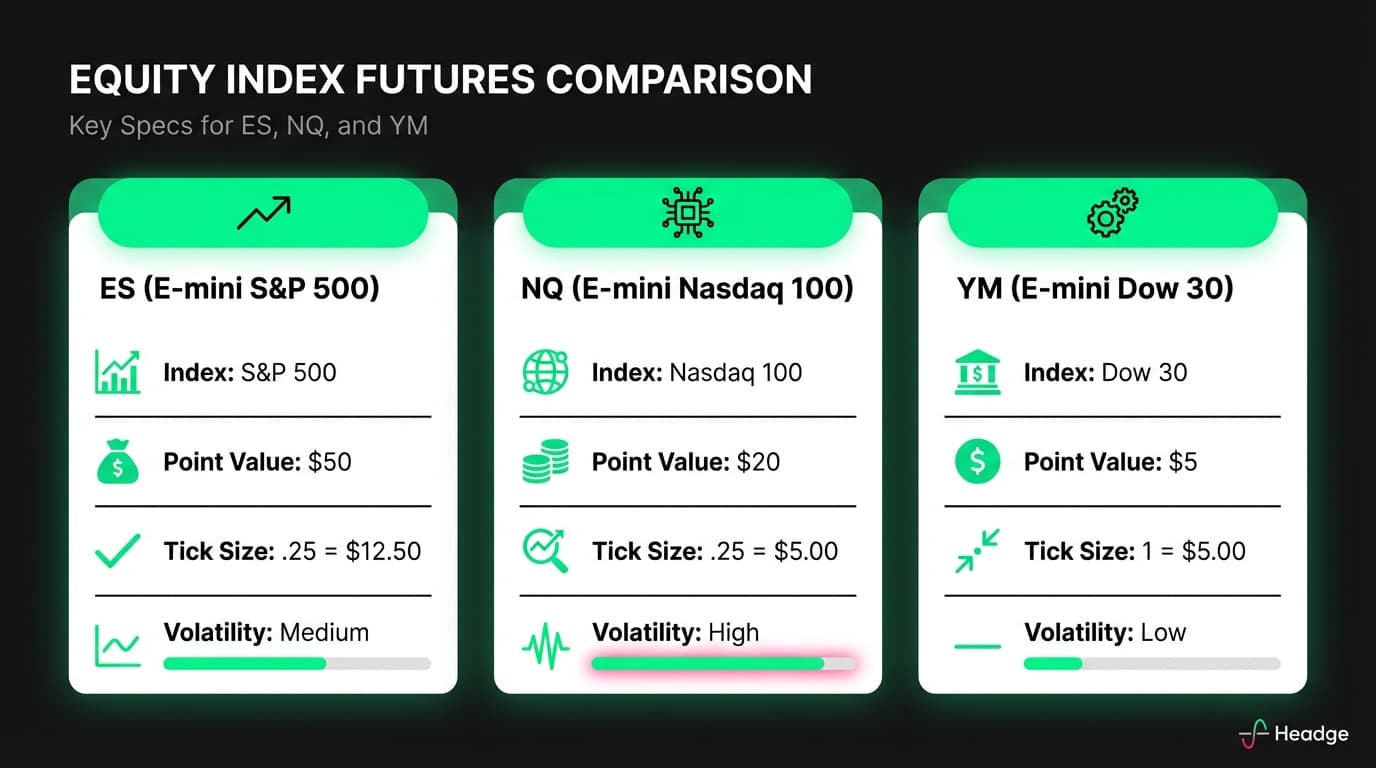
ES tracks the S&P 500 index, 500 large-cap US stocks weighted by market capitalization. It is the benchmark for the market. When news anchors say the market was up 1% today, they are usually talking about the S&P 500. The contract specifications are $50 per index point, 0.25 points tick size which is $12.50 per tick, and at S&P 5,000 the notional value is $250,000. ES is heavily diversified across sectors. Technology, healthcare, financials, consumer discretionary, and industrials all have significant weight. This diversification makes ES less volatile than sector-specific instruments.
NQ tracks the Nasdaq 100, the 100 largest non-financial companies on the Nasdaq exchange. In practice, this means heavy technology concentration. Apple, Microsoft, Amazon, Nvidia, and Meta alone can represent 40% plus of the index. The contract specifications are $20 per index point, 0.25 points tick size which is $5 per tick, and at Nasdaq 18,000 the notional value is $360,000. NQ moves more than ES. On a typical day, NQ might move 1.5% while ES moves 1%. During tech selloffs or rallies, NQ can move 2 to 3 times as much as ES. This higher volatility means more profit potential and more risk.
YM tracks the Dow Jones Industrial Average, 30 large-cap stocks selected to represent the American economy. Unlike the S&P and Nasdaq, the Dow is price-weighted, not market-cap weighted. A $500 stock affects the index more than a $50 stock, regardless of company size. The contract specifications are $5 per index point, 1 point tick size which is $5 per tick, and at Dow 40,000 the notional value is $200,000. YM is the slowest of the 3. Its 30-stock composition and price-weighting methodology make it less volatile than ES or NQ. Some traders prefer this steadier movement, others find it less interesting.
The standard E-mini contracts are too large for many retail accounts. A 20-point move in ES is $1,000. For a $10,000 account, that is 10% on a single contract. The CME introduced Micro E-mini contracts at 1/10th the size.
- MES, Micro E-mini S&P, is $5 per point and $1.25 per tick.
- MNQ, Micro E-mini Nasdaq, is $2 per point and $0.50 per tick.
- MYM, Micro E-mini Dow, is $0.50 per point and $0.50 per tick.
A 20-point ES move is $100 on MES instead of $1,000. This allows proper position sizing for smaller accounts. You can trade 3 MES contracts instead of being forced into the binary choice of 0 or 1 ES contracts. The tradeoff is that micro contracts have slightly wider bid-ask spreads and less depth than the standard contracts. For most retail traders, this difference is negligible. The ability to size positions properly far outweighs the minor execution disadvantage.
If you are new to index futures or have an account under $50,000, start with micro contracts. They let you learn the mechanics and develop your trading without risking account-threatening losses on single trades. Graduate to E-minis when your account and skill level justify the larger position sizes.
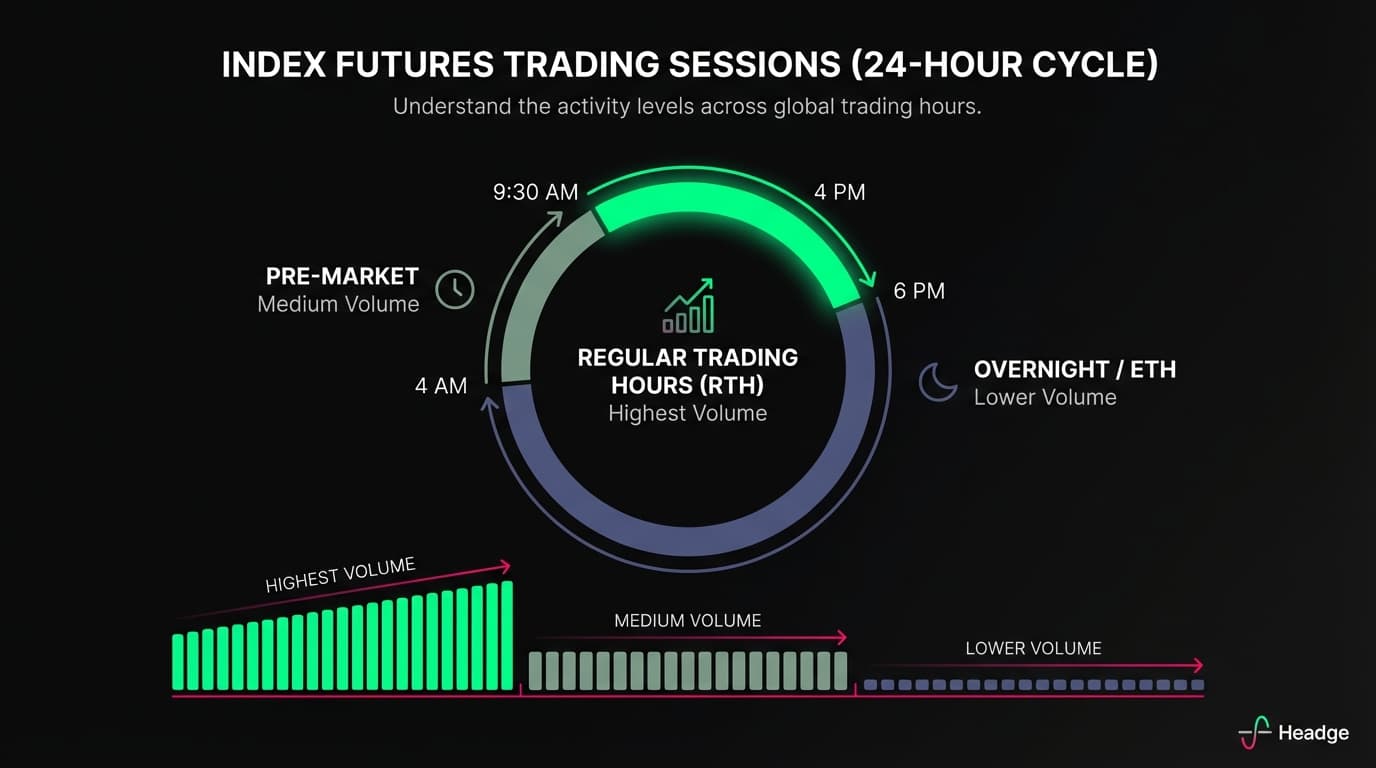
Equity index futures trade nearly 24 hours, Sunday evening through Friday afternoon US time. But not all hours are equal. Regular Trading Hours, RTH, from 9:30 AM to 4:00 PM ET is when the underlying stock market is open. Highest volume, tightest spreads, most predictable behavior. Economic data releases, corporate earnings, and most news events move markets during RTH. Electronic Trading Hours, ETH, from 6:00 PM to 5:00 PM ET next day means futures trade overnight when stocks are closed. Volume is lower, spreads are wider, and movement can be choppy. Asian and European market hours overlap with ETH, so international events can drive overnight moves. Pre-market from 4:00 AM to 9:30 AM ET sees volume pick up as US traders wake up. Economic data often releases at 8:30 AM ET, causing significant moves before the stock market opens. Most retail traders focus on RTH, where conditions are most favorable. Overnight trading requires understanding international catalysts and accepting thinner liquidity.
The 3 indices are highly correlated, they generally move together. When ES is up 1%, NQ might be up 1.3% and YM up 0.8%. They are all tracking large US companies. But divergences happen.
- Tech-driven moves occur when technology stocks lead, earnings from Apple, Nvidia, and others cause NQ to outperform. When tech lags, NQ underperforms.
- Defensive rotation happens when investors get cautious and rotate from growth, which is tech-heavy NQ, to value, which is more represented in YM. ES sits in between.
- Sector-specific news like an energy crisis might barely affect NQ because it has no energy stocks while moving ES and YM more significantly.
Some traders watch the relationships between indices for clues. If NQ is making new highs while ES and YM lag, it might signal narrow leadership that could reverse. If all 3 are moving together with strong volume, the trend has broad participation.
ES is the default choice. Highest liquidity, most balanced exposure, extensive educational resources. When in doubt, trade ES. NQ suits traders who want more volatility and are comfortable with technology concentration. The bigger moves mean more profit potential and larger drawdowns. YM suits traders who prefer slower, steadier movement. The $5 tick value versus $12.50 for ES allows finer position management for those who prefer smaller risk increments.
With ES at 5,000, 1 contract has $250,000 notional exposure. A 2% index move, 100 points, means $5,000 profit or loss. On a $50,000 account, that is 10%. This is why professionals often use micro contracts even with large accounts, they allow precise risk management. There is no shame in trading MES with a $100,000 account if your strategy calls for specific position sizes that E-minis cannot achieve.
Index futures make it easy to take oversized positions. Margin requirements of $12,000 to $15,000 per ES contract mean a $50,000 account could theoretically hold 3 to 4 contracts. That is $750,000 to $1,000,000 in exposure. This is how accounts blow up. A 3% down day in ES, 150 points, would wipe out $22,500 on 3 contracts, 45% of the account in a single day. Position size for survival, not for maximum theoretical profit.
The leverage available in index futures is both their greatest advantage and greatest danger. The ability to control $250,000 with $12,000 margin does not mean you should. Size positions based on dollar risk per trade, not margin available.
If you are new to index futures, paper trade first. Get comfortable with the mechanics, order entry, margin, position sizing, without real money at risk. Start with micros. MES, MNQ, or MYM let you learn with real skin in the game while keeping risk manageable. Focus on RTH initially. Trade when volume and liquidity are highest. Overnight trading adds complexity you do not need while learning. Track your dollar risk. Think in dollars lost per trade, not contracts. I am risking $200 on this trade is clearer than I am long 2 MES. Respect the leverage. The market will eventually move against you sharply. Position size so that when it happens, your account survives.
Index futures are powerful instruments. Used properly, they offer efficient exposure to the world's most liquid equity markets. Used carelessly, they accelerate losses as efficiently as gains.
Next, I will explore the forex market, how currencies trade in pairs, what pips and lots mean, and why forex operates differently from equity markets.