
Risk Management in Practice
You now understand position sizing, risk-reward, drawdowns, loss psychology, Kelly, and preservation strategies. The concepts are clear. But knowing and doing are different things. This lesson is about implementation. How do you take these principles and build them into a system you actually follow? What does risk management look like in real-time, when prices are moving and decisions need to be made?
A complete risk framework has 3 layers: pre-trade rules, real-time monitoring, and post-trade review. Before any trade, these questions should have clear answers. What is my current account balance? What percentage am I risking on this trade? Where is my stop loss? What position size does that give me? What is the risk-reward ratio? Does it meet my minimum threshold? How does this trade fit my current drawdown status? What positions am I already holding? Does this trade correlate with existing exposure? What is my total portfolio risk if this trade is added?
Write these answers down. Not in your head. On paper or in a trade journal. The act of writing forces clarity and creates accountability.
Never enter a trade without completing your pre-trade checklist. The few minutes this takes prevents the impulsive trades that cause the most damage. If you cannot answer all the questions clearly, you are not ready to trade.
Once in a trade, monitoring shifts to execution and adjustment. Track your stops. Know exactly where they are. If using mental stops, which is not recommended, be honest about whether you will actually execute them. Watch correlation. If multiple positions start moving together, your actual risk is higher than the sum of individual risks. Monitor your state. Are you calm and executing your plan, or anxious and considering adjustments you had not planned? Know your exit triggers. What would make you close early? What would make you hold through volatility? Decide this before it happens.
After every trade, win or lose, ask these questions. Did I follow my pre-trade rules? Was the position sized correctly? Did I honor my stop? If I deviated from the plan, why? What would I do differently? This review is not about beating yourself up over losses. Good losses that followed the rules need no correction. Bad wins that broke the rules need attention. They got lucky, and luck runs out.
You have 3 separate trades. Long ES, Long NQ, and Long YM. You have calculated each position size correctly. You are risking 1% on each. Total risk is 3%, right? Wrong. These positions are highly correlated. When equity indexes sell off, they all sell off together. Your 3 separate 1% risks become 1 3% bet on equity indexes.
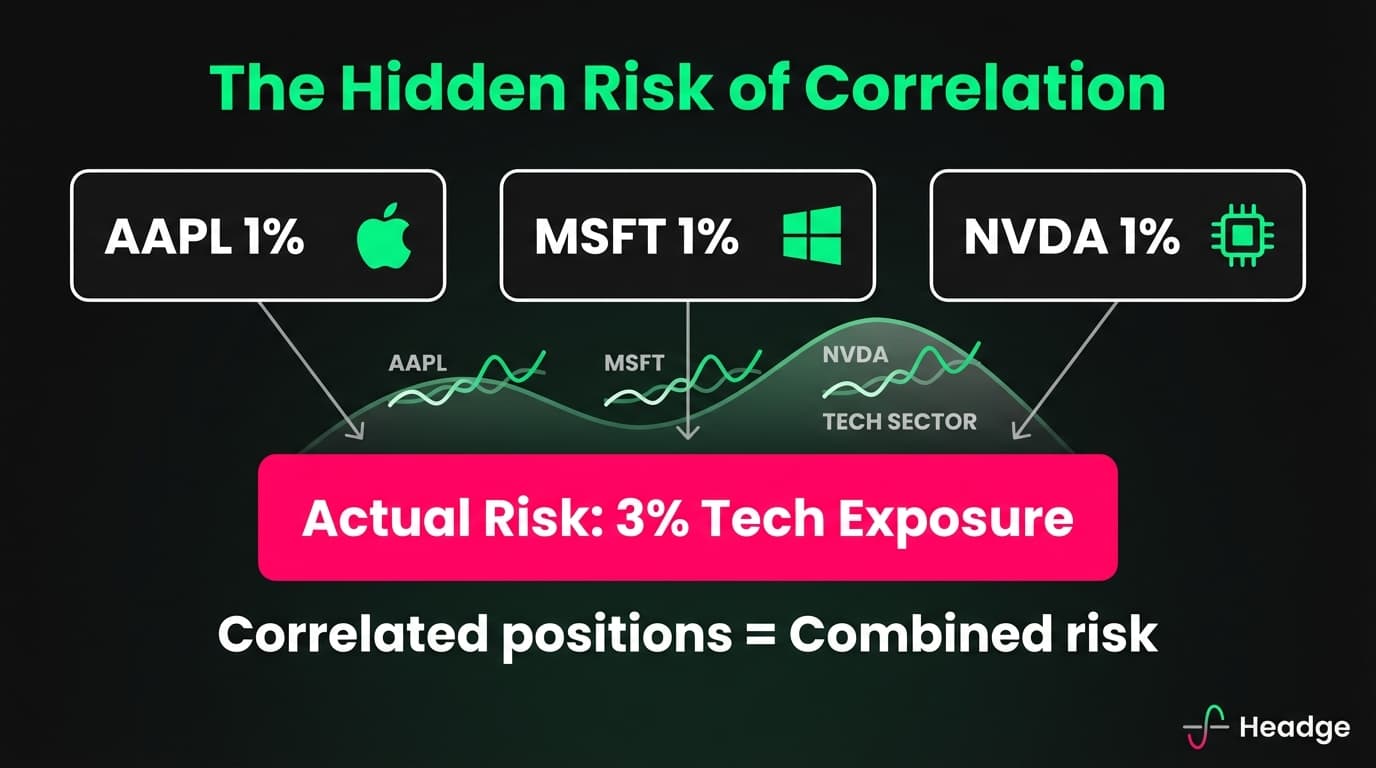
Portfolio correlation is the hidden risk that catches traders off guard. Individual position limits mean nothing if everything moves together. To manage correlation, limit exposure to any single sector or theme. Consider correlation when sizing. If adding a correlated position, reduce size on both. Track your effective exposure. Saying I am 50% long equity indexes is more honest than saying I have 5 positions. In correlated portfolios, your worst day will be worse than position-level risk suggests.
Markets close, but risk does not. News happens overnight. Gaps happen on Monday morning. The position you thought was safe can open 50 points against you before you can react. Economic announcements often release after hours or pre-market. Geopolitical events do not wait for market hours. Your stop loss will not execute until the market opens, possibly at a much worse price. To manage overnight risk, reduce position size for overnight holds. Use options to hedge overnight exposure if you understand options. Simply do not hold overnight if your strategy does not require it. 2 days of potential news with no ability to exit becomes 3 days if it is a holiday weekend. Major events, from Fed announcements to geopolitical crises, can completely change the landscape before Monday open. Friday closing does not mean safe until Monday. Weekend gaps can exceed any reasonable stop loss. Consider whether your position can survive a 50 to 100 point overnight move.
The worst losses often happen not during market hours but across gaps. A perfectly sized position with a proper stop can still gap through that stop for a loss several times larger than planned. Overnight and weekend exposure requires extra conservatism.
Professional traders do not improvise their risk management. They follow routines. Pre-market, 15 to 30 minutes before open, review overnight news and futures, check current positions and P&L, note key levels and potential setups, confirm daily loss limit, and set maximum number of trades for the day to prevent overtrading. During market hours, execute pre-planned trades only with no improvisation, update position tracker after each trade, monitor portfolio correlation, check P&L against daily limit regularly, and take scheduled breaks because tired traders make mistakes. Post-market, 15 to 30 minutes after close, log all trades with entry, exit, size, and rationale, calculate daily P&L and drawdown status, review any rule violations, prepare watchlist for tomorrow, and step away from screens.
Create a single page that summarizes your risk rules. Keep it visible while trading. It should include position sizing rules like risk per trade percentage and maximum position value. Trade quality minimums like minimum R to R ratio and maximum trades per day. Circuit breakers like daily loss limit percentage, weekly loss limit percentage, and monthly loss limit percentage. Scaling rules like at 5% drawdown reduce to what percentage, at 10% drawdown reduce to what percentage, and at 15% drawdown reduce to what percentage. Correlation limits like maximum exposure to single sector percentage and maximum correlated positions. Non-negotiables like always use stops, never move stops further from entry, no trading after hitting limits, and no revenge trading.
Even good systems fail sometimes. Markets change. Strategies stop working. Black swan events exceed any reasonable planning. When your system fails, stop trading. If your framework is not working, more trading will not help. Diagnose honestly. Is it bad luck, market regime change, or has your edge disappeared? Reduce size dramatically if you must trade while diagnosing. Consider a complete break. Sometimes the best risk management is stepping away entirely while you figure things out. Do not rebuild in real-time. Paper trade or sim trade any system changes before risking real capital.
The goal of a risk framework is not to prevent all losses. It is to prevent catastrophic losses, to ensure that when systems fail, and they will, you still have capital and psychological reserves to try again.
Next up: I will consolidate everything in a module review and test your understanding of risk management principles.