
The Kelly Criterion
In 1956, a Bell Labs physicist named John Kelly published a paper on information theory that would eventually transform how professional gamblers and traders think about bet sizing. His formula answered a question that sounds simple but has profound implications. If you have an edge, exactly how much should you bet? The answer is precise, mathematically optimal, and almost certainly too aggressive for real-world trading.
The Kelly Criterion calculates the optimal fraction of your bankroll to bet on a single wager. The formula is Kelly percent equals W minus 1 minus W divided by R, where W is win probability as a decimal and R is win-loss ratio, which is average win divided by average loss. Let us work through an example. You have a trading strategy with a 55% win rate, so W equals 0.55, and average winner is 1.5 times your average loser, so R equals 1.5. Kelly percent equals 0.55 minus 1 minus 0.55 divided by 1.5, which equals 0.55 minus 0.45 divided by 1.5, which equals 0.55 minus 0.30, which equals 0.25 or 25%. According to Kelly, you should risk 25% of your account on each trade. If that sounds insane, you are paying attention.
The Kelly Criterion is mathematically optimal for maximizing long-term growth rate. But optimal comes with asterisks the size of billboards.
The Kelly formula assumes you know your exact win rate and payoff ratio. In trading, you never do. You have estimates based on historical data, and those estimates have uncertainty. Betting full Kelly on uncertain estimates is a recipe for disaster.
Full Kelly produces stomach-churning volatility. Even with accurate inputs, Kelly-sized bets produce drawdowns that would break most traders psychologically. Simulations show that full Kelly betting routinely produces 50% to 70% drawdowns on the path to long-term wealth maximization. Most traders quit long before the long term arrives. The formula also assumes you can make unlimited sequential bets. In reality, trading has costs, liquidity constraints, and correlation between trades. These frictions mean full Kelly oversizes positions.
Professional gamblers and traders who use Kelly almost never use full Kelly. Instead, they use a fraction. Half Kelly, or 0.5 times, is the most common choice. It captures about 75% of the growth rate with significantly reduced variance. Quarter Kelly, or 0.25 times, is very conservative. It captures about 50% of the growth rate but with much smoother equity curve.
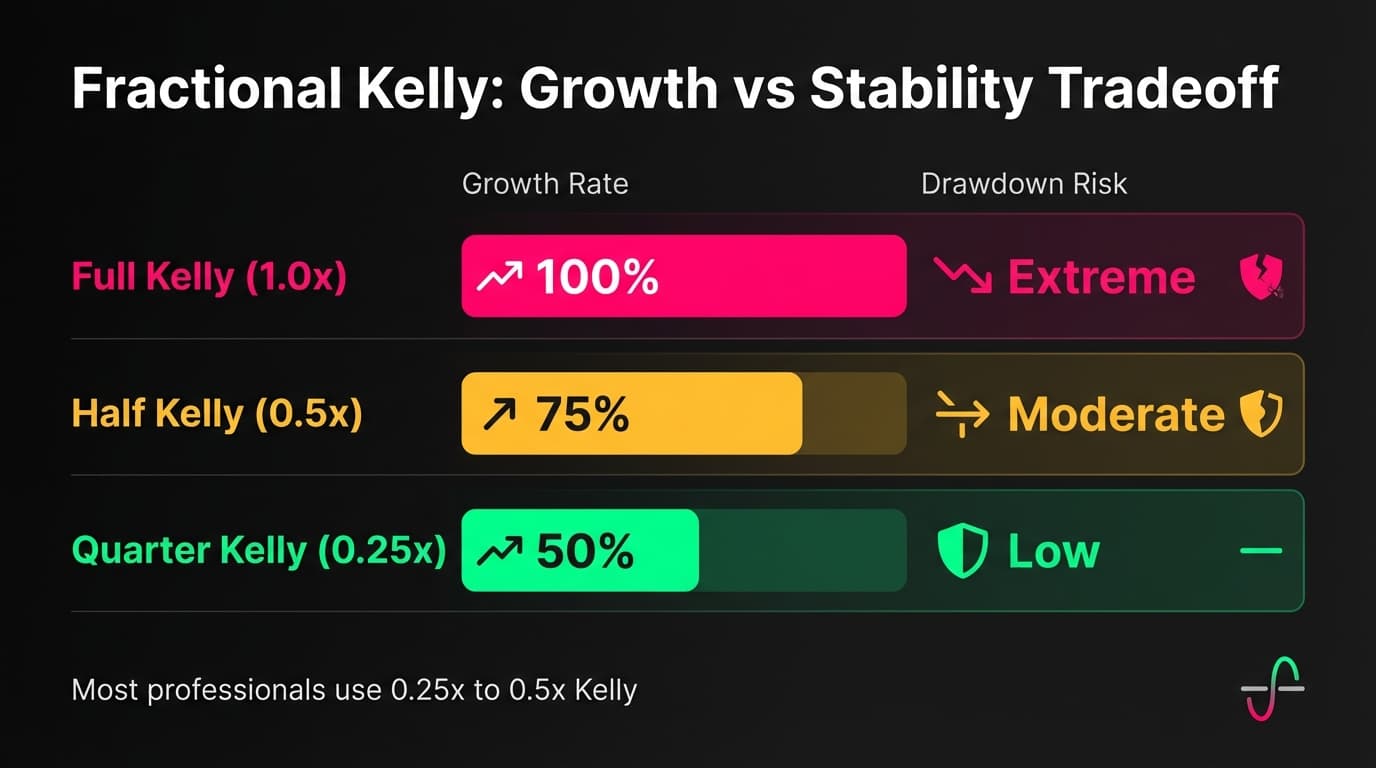
Using our earlier example with a 25% full Kelly, half Kelly would be 12.5% per trade and quarter Kelly would be 6.25% per trade. Half Kelly still looks aggressive by most trading standards. This reveals something important. If your position sizing seems conservative, either your edge is small, which is probably true, or you are nowhere near Kelly territory, which is probably wise.
The formula requires 2 numbers, win rate and win-loss ratio. Neither is easy to estimate accurately. Your historical win rate is not your future win rate. Market conditions change. Strategies decay. What worked last year might not work next year. Even with stable conditions, you need significant sample size for confidence. With 50 trades, your measured 60% win rate could easily be 50% or 70% in reality. The uncertainty is enormous.
Average winner divided by average loser sounds simple, but distribution matters. If most of your wins are small and occasional wins are huge, the average misrepresents typical outcomes. Kelly assumes a consistent payoff structure that trading rarely provides.
When using Kelly, be conservative with your inputs. If you estimate a 55% win rate, use 50% in the formula. If your win-loss ratio is 2 to 1, use 1.5 to 1. This margin of safety protects against estimation error.
The most useful way to think about Kelly is not as a target but as an absolute ceiling. Whatever Kelly says, you should be betting less than that, often much less. If full Kelly says 20% and you are risking 2% per trade, you are not being suboptimal. You are being sensible. The 2% gives you psychological stability, room for estimation error, and the ability to survive the inevitable period when your edge temporarily disappears. If your normal position sizing exceeds what Kelly suggests, you have a serious problem. Either you are overestimating your edge, or you are taking on risk that even perfect edge could not justify.
Despite its limitations, Kelly thinking offers valuable insights. It forces edge quantification. You cannot use Kelly without estimating win rate and payoff ratio. This exercise alone is valuable, forcing you to think precisely about your edge rather than trading on vague feelings. It scales with edge. Kelly naturally sizes positions based on edge strength. A small edge means small bets. A large edge means larger bets. This is directionally correct even if the absolute numbers need adjustment. It prevents overbetting. Kelly provides a mathematical ceiling. If you are betting more than Kelly says, you are gambling, not trading an edge. It handles changing conditions. As your estimated edge changes, Kelly adjusts position size proportionally. This automatic scaling is sensible risk management.
1 underappreciated aspect of Kelly is that it is anti-martingale. Martingale systems increase bet size after losses to chase recovery. Kelly does the opposite. When you lose, your bankroll shrinks. If you are betting a percentage of your bankroll as Kelly prescribes, your bet size shrinks too. You automatically press when winning and pull back when losing, exactly the opposite of what emotional traders do. This automatic adjustment is perhaps Kelly's most practical benefit. You do not need to calculate the formula precisely. Just maintaining proportional betting captures this essential feature.
Here is how to actually use Kelly thinking without the dangerous precision. Estimate conservatively. Take your best guess at win rate and payoff ratio, then haircut both by 10% to 20%. Calculate full Kelly. Run the formula to get a ceiling. Apply a fraction. Use quarter to half Kelly at most. Compare to your actual sizing. If you are below fractional Kelly, good. If you are above full Kelly, you have a problem. Recalculate periodically. As your track record grows, your estimates improve. Update your Kelly calculation quarterly or after significant market regime changes.
For most traders, this exercise reveals that proper position sizing based on realistic edge assessment is smaller than what feels comfortable. A 1% to 2% risk per trade often turns out to be appropriate quarter Kelly for edges that actually exist in liquid markets.
Run the Kelly formula with realistic trading parameters. A 52% win rate with 1.2 to 1 payoff, respectable for most strategies, yields Kelly percent equals 0.52 minus 0.48 divided by 1.2, which equals 0.52 minus 0.40, which equals 12%. Half Kelly would be 6%. Quarter Kelly would be 3%. Even quarter Kelly suggests 3% per trade, which many risk managers would consider aggressive. This tells you something important. Either your edge is small, true for most, or Kelly itself is too aggressive, also true, or both. The traders who blow up usually are not unlucky. They are betting as if their edge is larger than it actually is. Kelly, used honestly, prevents this delusion.
Next up: account preservation strategies, circuit breakers, and knowing when to stop trading.