
Account Preservation Strategies
The goal is not to maximize profits. The goal is to not blow up. This sounds defeatist until you understand the math. A trader who compounds 15% annually for 20 years turns $50,000 into $818,000. A trader who swings for 50% returns but blows up twice along the way ends up with far less, or nothing. Survival is the strategy. Everything else is tactics.
Most traders have their priorities backwards. They focus first on making money, then on making a lot of money, and only then on not losing too much. The right order is different. First priority is survival. Second is maintaining ability to trade tomorrow. Third is making money. Fourth is compounding over time. The first priority is not profit. It is ensuring you can still play the game. Every risk decision should filter through this lens. Does this threaten my ability to continue trading?
Your trading capital represents time, sacrifice, and opportunity. Once lost, it must be re-earned through work outside of trading or rebuilt through the painfully slow process of compounding small amounts. Treat capital as irreplaceable, because functionally, it is.
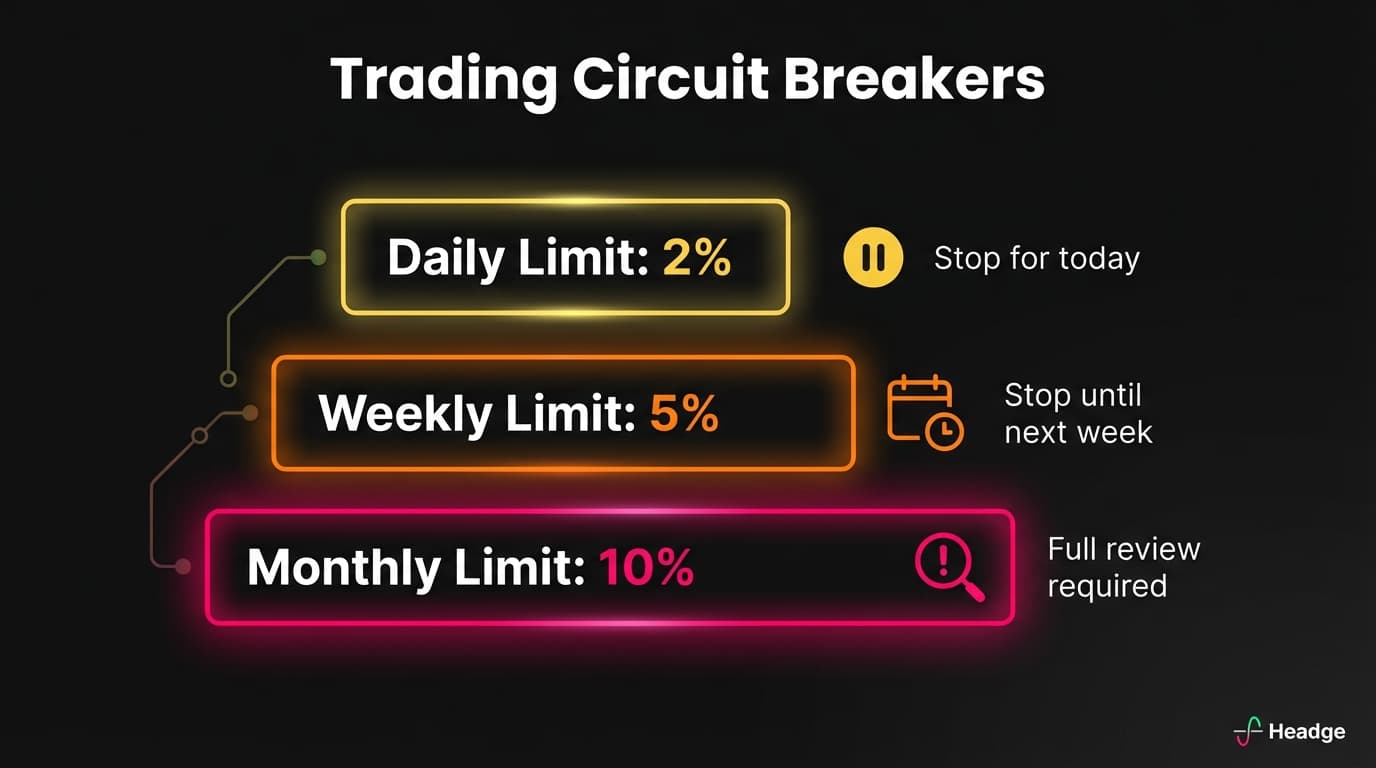
Circuit breakers are predetermined stop points that force you to stop trading before damage becomes catastrophic. They work because they remove decision-making from moments when you are least capable of making good decisions. Set a maximum loss for any single day. When you hit it, you are done for the day. No exceptions. Common thresholds range from conservative at 1% of account to moderate at 2% to aggressive at 3%. If you have a $50,000 account with a 2% daily limit, you stop trading after losing $1,000 in a day. Period.
The daily limit serves multiple purposes. It caps single-day damage. It prevents revenge trading, those desperate attempts to make back what you lost that usually make things worse. It forces a reset, giving you time to regain emotional equilibrium before your next session. The daily limit catches bad days. The weekly limit catches bad weeks, those stretches where nothing works and you keep showing up hoping tomorrow will be different. Common weekly thresholds range from conservative at 3% of account to moderate at 5% to aggressive at 7% or more. Hit your weekly limit and you are done until the following week. Use the time to review what is happening. Is this normal variance? Has something changed in the market? Is your strategy broken, or just cold?
Monthly limits are the serious circuit breaker. Hitting 1 should trigger a complete review of your approach. Common monthly thresholds range from conservative at 5% of account to moderate at 8% to 10% to aggressive at 15% or more. If you have lost 10% in a month, something is wrong. Maybe it is the market. Maybe it is you. Either way, continuing to trade without understanding what is happening is how 10% becomes 30%.
When things go wrong, reduce exposure. This seems obvious but runs counter to how most traders behave. The instinct is to increase size to make it back faster. This instinct is wrong and dangerous. A simple scaling framework works like this. At equity highs, trade at 100% normal size. When down 5%, reduce to 75% normal size. When down 10%, reduce to 50% normal size. When down 15%, reduce to 25% normal size. When down 20% or more, stop and review.
The math supports this approach. When you are down, you need larger percentage gains to recover. Reducing size slows the bleeding, preserves capital for when conditions improve, and reduces psychological pressure that leads to poor decisions. The traders who scale up during drawdowns occasionally get lucky and recover quickly. More often, they accelerate their destruction.
Sometimes the right trade is no trade. Knowing when to step away is a skill most traders never develop. Stop when you have hit a circuit breaker. Stop when you are trading to recover losses rather than executing your strategy. Stop when you are distracted by personal issues. Stop when you are sick, exhausted, or impaired. Stop when market conditions have become unreadable. Stop when you have had 3 losing trades in a row and feel the urge to get it back. Resume when mandatory cool-off period has passed. Resume when you can honestly say you are trading your plan, not your P&L. Resume when market conditions have returned to something you understand. Resume when you have identified what went wrong, if anything, and adjusted.
Build break triggers into your trading plan before you need them. Deciding to take a break while you are losing is nearly impossible. Having predetermined rules that force breaks removes the decision from the emotional moment.
I covered this in the drawdown lesson, but it bears repeating in the context of preservation. Losses and gains are not symmetric. Lose 20% and you need 25% to recover. Lose 50% and you need 100% to recover. This asymmetry means that avoiding large losses is mathematically more important than capturing large gains. A trader who avoids a 30% drawdown is better off than a trader who captures a 30% gain then suffers a 30% drawdown. Preservation strategies exploit this asymmetry. By capping losses through circuit breakers and position scaling, you ensure that your gains do not get erased by the occasional catastrophic loss.
Before every trading session, check your drawdown status. Where are you relative to your limits? Do you need to scale position size? Check your mental state. Are you trading to execute your strategy, or trading to fix your P&L? Check market conditions. Does the environment match what your strategy requires? Confirm your limits. What is your maximum loss for this session? At what point will you stop? After every losing session, ask if you followed your rules. If yes, the loss is acceptable variance. If no, that is the problem to fix. Ask if you are approaching any limits. Daily? Weekly? Monthly? Ask if you need to scale down. Check your drawdown level against your scaling framework. Ask if you should take tomorrow off. Sometimes the best trade is none.
The traders who last decades in this business share a common trait. They are paranoid about survival. They assume the worst-case scenario will eventually happen and plan accordingly. They would rather leave money on the table than risk money they cannot afford to lose. This paranoia is not pessimism. It is realism. Markets have crashed, strategies have failed, and traders have blown up for as long as markets have existed. Assuming you are immune to this history is arrogance. Planning for it is wisdom.
Your edge, whatever it is, only works if you are still trading when it pays off. The compounding that creates wealth only happens if you survive long enough to compound. Every preservation strategy, every circuit breaker, every scaling rule exists to ensure you are still in the game when your edge finally delivers. Survive first. Everything else follows.
Next up: I will bring everything together into a practical risk management framework you can implement immediately.