
The Psychology of Taking Losses
You know you should cut your losses. Everyone knows this. Cut your losers, let your winners run is trading advice so common it has become cliche. So why is it so hard to actually do? The trade is going against you. The stop is right there. You know, intellectually, that you should take the loss. But your finger hovers over the button, and instead of clicking, you move the stop. Just a little further. Just to give it more room. Just this once. This is not a knowledge problem. It is a psychology problem. And until you understand why your brain fights you on every loss, you will keep making the same mistake.
Psychologists have a name for this. Loss aversion. Daniel Kahneman and Amos Tversky demonstrated that losses feel roughly twice as painful as equivalent gains feel good. Lose $100, and the emotional impact is about the same as gaining $200.
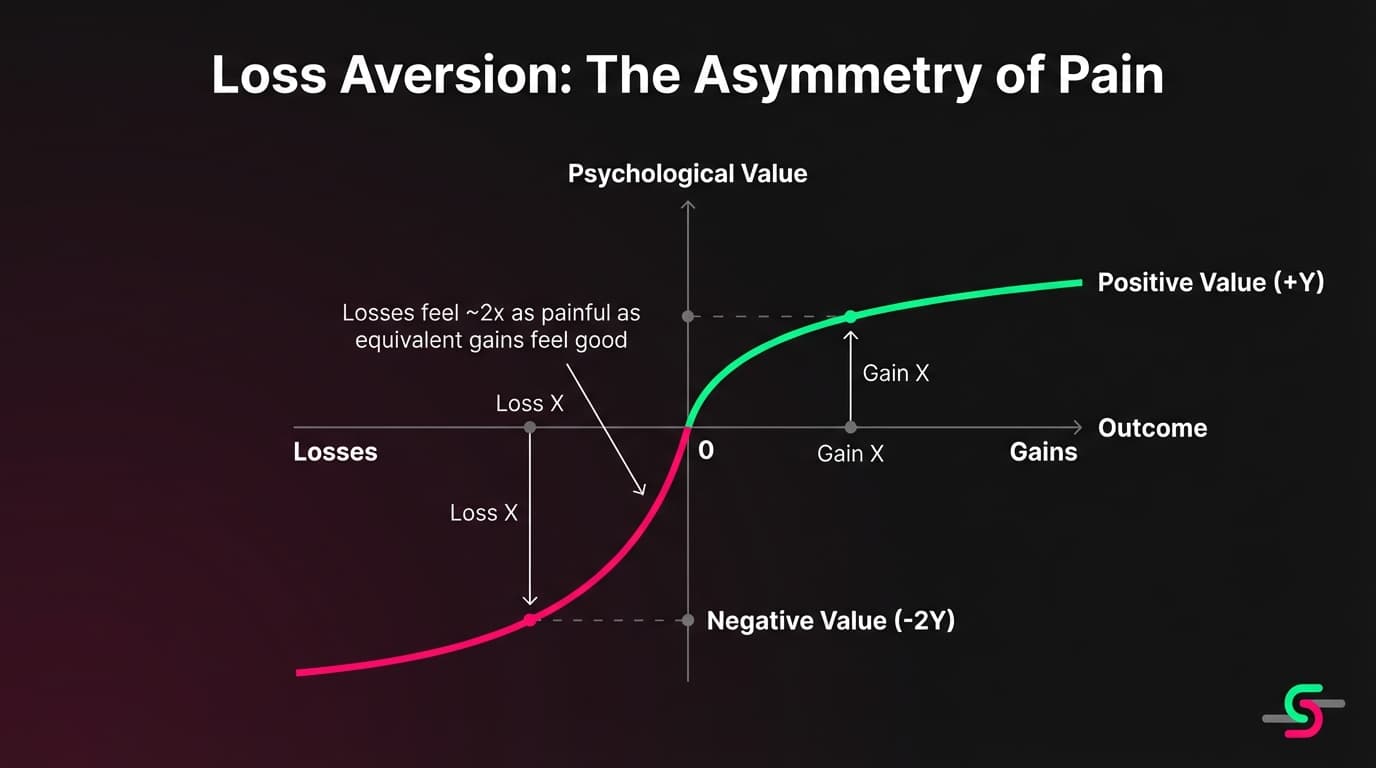
This is not weakness or poor discipline. This is how human brains are wired. Humans evolved to avoid losses because, for most of human history, a loss could mean death. Losing your food meant starving. Losing your shelter meant exposure. The brain learned to weight losses heavily because survival depended on it. Trading triggers these ancient circuits. When that position goes red, your brain does not see numbers on a screen. It sees threat. And the natural response to threat is to fight, flee, or freeze. None of which involve calmly clicking close position.
The pain of losses is not a character flaw you can willpower away. It is a neurological reality you must design around. The best traders do not eliminate loss aversion; they build systems that work despite it.
You are down $500 on a trade. If you close now, that $500 is gone. But if you hold, maybe it comes back. So you hold. This is the sunk cost fallacy, and traders fall into it constantly. The money you have lost is gone regardless of what you do next. It is sunk. The only question that matters is, given the current situation, is this trade still worth holding? The entry price is irrelevant. Your loss is irrelevant. Only the present setup matters. But the brain does not work that way. It fixates on the entry, on what should have happened, on the loss that has not been realized yet. As long as you do not close the trade, you have not really lost the money. It is Schrodinger's loss, both real and not real until you click the button. This is why traders who would never enter a trade at the current price will hold that same trade, refusing to exit. The logic is identical, but the psychology is completely different.
Watch a trader with a losing position and you will see hope become the dominant emotion. Hope that it bounces. Hope that support holds. Hope that the news is good. Hope that somehow this time will be different. Hope feels productive. It feels like you are doing something. But hope is passive. The market does not care about your hopes. While you are hoping, the loss is growing, the opportunity cost is mounting, and the psychological damage is deepening. The alternative to hope is not despair. It is action. Define your stop before the trade. Honor it when it is hit. No hoping required.
Here is a technique that changes everything. Accept the loss before you enter the trade. When you calculate your position size and set your stop, you are defining your maximum loss. Let us say it is $300. Before you click buy, mentally hand over that $300. Consider it gone. It is the cost of this trade.
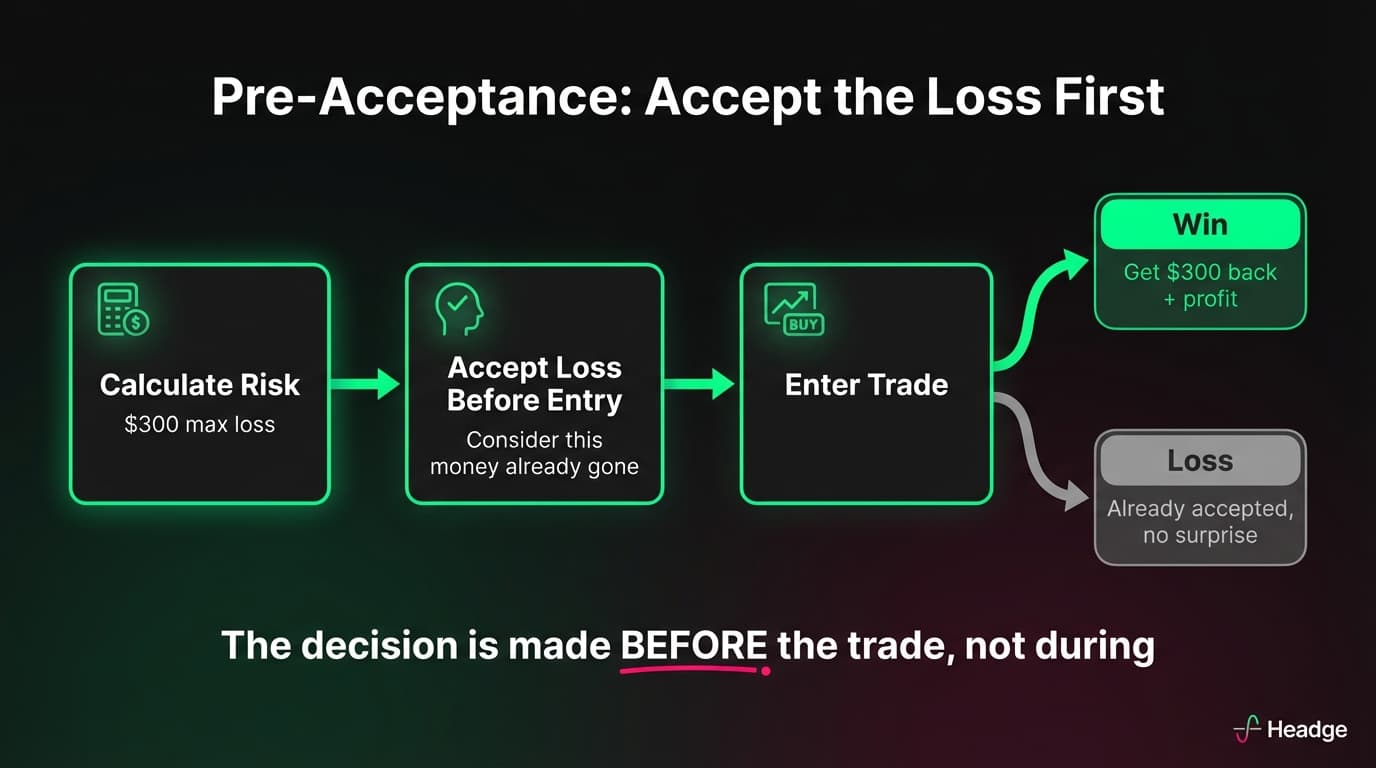
If the trade works, great. You get your $300 back plus profit. But if it does not work, you are not surprised, you are not hoping, you are not in denial. The money was already gone when you entered. This mental shift is profound. It removes the decision-making at the worst possible moment, when the trade is going against you and emotions are high. The decision was already made. The loss was already accepted. Now you are just executing.
Before every trade, say the loss amount out loud: "I am risking $300 on this trade. If my stop is hit, I will lose $300, and that is acceptable." This simple practice makes the loss concrete before it happens.
Not all losses are created equal. Understanding the difference is essential for maintaining confidence through losing periods. Good losses happen when the setup was valid based on your criteria, you sized the position correctly, your stop was placed at a logical level, you followed your plan, and the market simply did not cooperate. A good loss is tuition. It is the cost of playing a probabilistic game. Even perfect execution produces losses because no strategy wins 100% of the time. These losses should bother you no more than a casino bothers a professional poker player. Variance happens, and you move on.
Bad losses happen when you broke your rules to enter, you sized too large because you were confident, you moved your stop or did not use 1, you held through your exit signal hoping for recovery, or you averaged down without a plan. Bad losses are preventable. They do not come from market randomness. They come from your own failure to follow your system. These losses should bother you, not because of the money, but because they represent a breakdown in discipline that will repeat until fixed. The goal is not to eliminate losses. The goal is to eliminate bad losses. Good losses are the price of doing business. Bad losses are the price of doing business poorly.
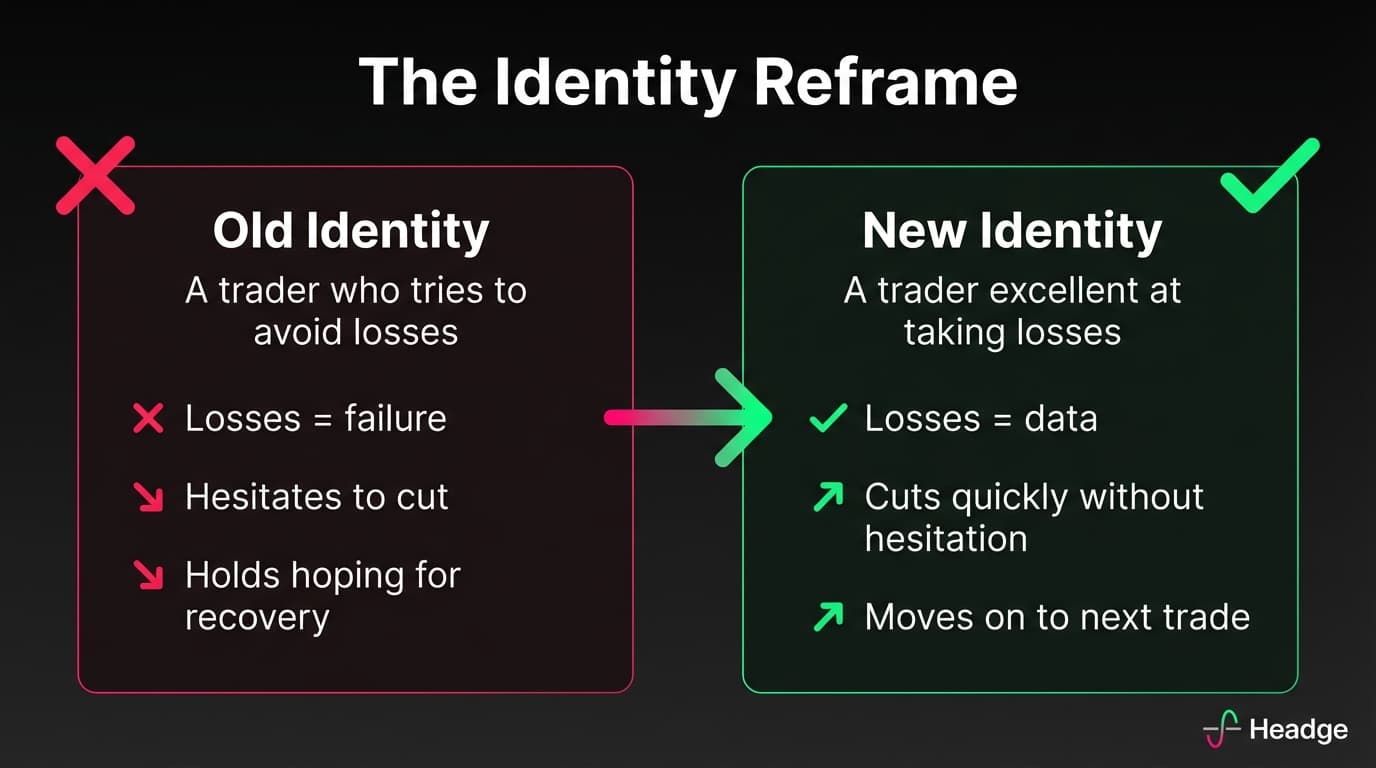
Most traders have an adversarial relationship with losses. Losses mean they were wrong. Losses mean they are bad at this. Losses threaten their identity as a trader. This framing is backwards. Consider reframing your identity. From I am a trader who tries to avoid losses to I am a trader who is excellent at taking losses. What would it mean to be excellent at taking losses? You accept them quickly without hesitation. You do not compound them by holding or averaging. You do not let them affect your next trade. You treat them as data, not failure. You actually look forward to closing losers because it proves your discipline. The best traders are not the ones with the fewest losses. They are the ones who handle losses best. They cut quickly, learn what they can, and move on without emotional residue.
Every trade makes a deposit or withdrawal from your emotional bank account. Wins deposit confidence, calm, and clarity. Losses withdraw the same. The problem with big losses and prolonged losing streaks is not just the money. It is the emotional depletion. When your emotional bank account is empty, decision-making deteriorates. You become reactive, impulsive, desperate. This is why proper position sizing and loss limits are not just about capital preservation. They are about psychological preservation. Small losses make small withdrawals. You can take many of them without depleting your reserves. Big losses, or worse, losses that should have been small but became big because you refused to cut them, empty the account fast.
For your next 20 trades, track not just P&L but your emotional response to losses. What did you feel when the trade went against you? Did you consider moving your stop? How long after the loss did the emotion linger? Did the loss affect your next trade? Patterns will emerge. Maybe you handle morning losses well but evening losses poorly. Maybe losses after winning streaks hit harder. This self-knowledge is invaluable.
Before entering any trade, imagine it losing. Visualize watching the price hit your stop. Feel the loss. Now ask, can I accept this? If the answer is no, the position is too big. After any loss that bothers you more than it should, wait 24 hours before taking another trade. This circuit breaker prevents the revenge trade, the desperate attempt to make back what you lost that usually makes things worse.
Over a trading career spanning thousands of trades, individual losses become meaningless. What matters is the aggregate: your expectancy, your discipline, your ability to keep showing up. The traders who make it are not the ones who avoid losses. They are the ones who lose well. They lose quickly, they lose small, and they lose without losing themselves in the process. Your job is not to be right. Your job is to survive the wrong trades long enough for the right trades to compound.
Next up: the Kelly Criterion, the mathematical formula that tells you exactly how much to bet, and why you should never follow it precisely.