
Watchlist Curation: Fewer Symbols, Sharper Focus for Better Trades
Curate a small, high-quality watchlist to reduce noise, speed decisions, and improve consistency, with clear criteria, routines, and a midweek pruning habit.

Headge Team
Product Development
Why fewer symbols improve performance
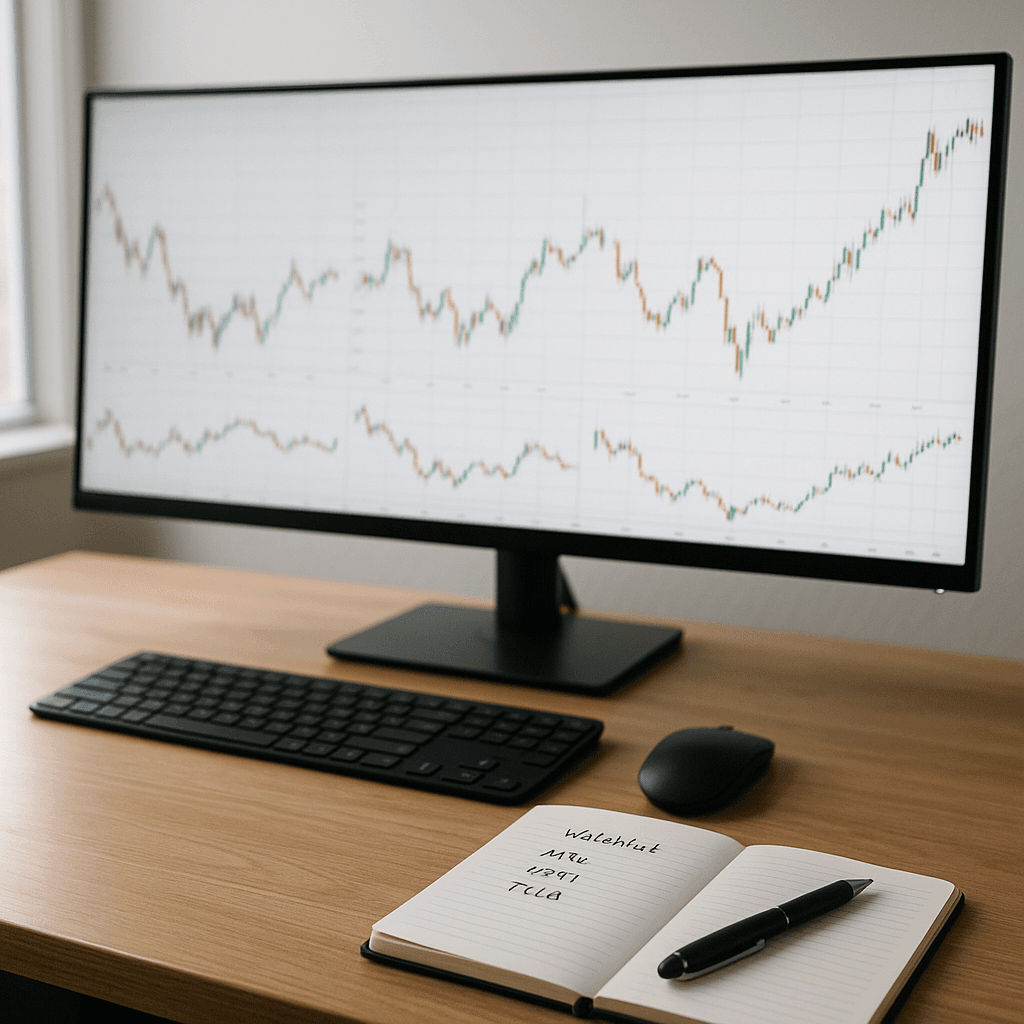
A focused watchlist is a psychological tool as much as a market filter. Traders operate with limited attentional bandwidth and working memory. When the list of symbols is long, attention fragments and decision latency rises. Every chart switch introduces a context shift that taxes cognition. Research on selective attention and task switching consistently shows that too many simultaneous targets degrade detection and increase errors. In trading, this appears as missed entries, late exits, and impulsive second guesses.
Reducing the universe to a small set of high-quality symbols raises the signal to noise ratio. Price information becomes more familiar and patterns feel less ambiguous. Execution improves because the mind can rehearse scenarios in advance rather than reacting on the fly. Consistency follows from this stability. A smaller field also enhances learning. With fewer variables changing, feedback loops are cleaner and the journal captures true cause and effect rather than noise.
What counts as a high-quality symbol
Quality is contextual. The symbol must express the edge of the strategy in a way that is observable and repeatable. Liquidity and clean structure matter because they reduce slippage and make levels meaningful. Volatility should match the holding period and risk budget. A day trader might want steady intraday range with orderly pullbacks. A swing trader might prefer a persistent trend with catalysts that attract participation over several days.
Clarity across timeframes is a useful test. If the higher timeframe trend aligns with the execution timeframe structure, decisions are simpler. Symbols that respond to levels consistently also rank higher. Avoid charts that frequently gap erratically, chop around key areas, or trade thinly at your preferred entry times. Consider correlation too. Several names in the same sector can move as one position. Quality improves when the list captures different drivers so a single headline does not dominate P and L.
A practical approach is to assign a brief clarity score before the session. Rate each candidate on trend clarity, liquidity, and alignment with your setup. Keep the scoring simple and stable so it can become habit.
Build a routine for watchlist curation
The weekly cycle sets the foundation. Start with a broader scan to create a longlist. Then compress it into a shortlist that you actually plan to trade. Many intraday traders function well with five to eight symbols that reliably meet their criteria. Swing traders often do better with even fewer. The exact number matters less than the idea that each symbol earns its place against the same standards.
Time boxing helps. Limit the longlist review to a set window and use a repeatable checklist. This reduces decision fatigue and prevents the list from expanding without merit. When a symbol is added, record the reason in the journal. The reason should reference observable features rather than hope. When a symbol is removed, write that reason too. Over time, these notes expose patterns in selection biases, such as chasing recent headlines or favoring familiar names regardless of quality.
Daily, run a brief premarket refinement. Confirm that the shortlist still fits the plan. If one symbol no longer aligns, replace it only if a clear upgrade is available. Avoid mid-session additions unless they meet a pre-defined exception rule, such as a scheduled catalyst on a name you have studied. Protecting the shortlist from impulsive expansions is a form of precommitment, which in behavioral research is shown to support discipline.
Wednesday midweek prune
By Wednesday, enough new information has arrived to reassess quality without scrapping the entire plan. A short midweek audit keeps focus sharp. Spend 15 minutes to retire one or two laggards that have become noisy or misaligned. Promote any name from the parking lot that objectively meets the criteria. Keep the net size stable. If one comes in, one goes out.
This rhythm balances flexibility with consistency. It also reduces FOMO because changes occur on a schedule rather than as reactions to social feeds or sudden moves.
Execution benefits of a small list
A small, stable list permits deeper scenario rehearsal. Before the open, plan the two or three most probable paths for each symbol. This builds if then responses that are easy to execute. Research on implementation intentions shows that pre-specified cues and responses reduce hesitation and emotional interference. Faster recognition and cleaner action are natural consequences when the mind has already walked the road.
Traders also report a calmer state when scanning fewer charts. Calm is not a luxury. It is the condition that allows the strategy to run as designed. With fewer distractions, it becomes easier to respect stops and wait for true setups instead of inventing them.
Journal for watchlist quality, not just trades
Most journals track entries and exits. Add a watchlist page that scores the curation itself. For each symbol, log the selection reason, the planned triggers, and the invalidation conditions that would prompt removal. After the session, mark whether the symbol presented an A setup, a B setup, or none at all. Over time, this produces base rates of setup appearance by symbol and condition. Those base rates reduce overfitting and guide future selection.
It is also helpful to record the opportunities you deliberately ignored outside the watchlist. When a different ticker makes a large move, note the feeling, the narrative that tempted you, and the outcome had you chased it. This reframes FOMO as data. Many traders discover that the missed opportunities were less replicable than they appeared in the moment.
A simple watchlist scorecard
Keep the evaluation light so it gets done. Three metrics are enough:
- Coverage hit rate: the percentage of sessions where the shortlist produced at least one valid setup.
- Setup conversion: the percentage of valid setups that met profit targets or delivered a positive expectancy result.
- Cognitive ease rating: a 1 to 5 self-report of how effortless it felt to monitor the list and make decisions.
These numbers should be reviewed weekly. Adjust the criteria only when the scorecard shows a consistent pattern, not after a single session.
Managing FOMO and missed moves
A compact list means some moves will be missed. That is the cost of focus, not a signal to abandon the plan. Use if then statements to handle FOMO. If a non-watchlist name makes a dramatic move, then log it and evaluate during the next scheduled review. If a name outside the list meets a pre-defined catalyst and pattern that has been tested, then it can be queued for the parking lot rather than traded immediately.
This policy protects against random inclusion that harms expectancy. It also trains patience. Over time, the journal will show whether the moves you missed were consistent or mostly outliers. That knowledge quiets the mind more effectively than willpower alone.
Risk and correlation when focus increases
Concentrating attention should not concentrate risk beyond plan. When several watchlist names share a driver, treat them as a single thematic position. Adjust size accordingly. A quick correlation check can be qualitative. If two charts look nearly identical on the higher timeframe and respond to the same news cycle, they likely share risk. Aim to diversify the list by behavior rather than only by ticker count.
Position sizing rules become even more important with a small list. With fewer bites of the apple, each bite should be sized to survive normal variance. Many traders find that sizing by volatility or by a fixed fraction of account risk per trade stabilizes outcomes. The key is to apply the rule consistently and to respect the invalidation level, which should be defined before the order is placed.
Two brief examples
An intraday momentum trader selects seven names for the week based on liquidity, clean intraday trends, and upcoming catalysts. Each morning the trader plans two scenarios for each name. By midweek, two symbols show compression with erratic wicks and no clean follow through. They are replaced with two others from the parking lot that now meet the criteria. The scorecard shows high coverage hit rate and improved cognitive ease.
A swing trader focusing on trend continuation maintains a three-name list. Each symbol has a higher timeframe trend, a clear pullback to a key level, and positive volume behavior. The trader resists adding a fourth name that is strongly correlated to one already held. When the week ends, the journal notes that one planned setup never triggered. This is recorded as a neutral outcome, not a failure, because the plan was to wait for a specific condition.
Putting it all together
A smaller, higher-quality watchlist is a deliberate constraint that supports better decisions. It reduces cognitive load, accelerates recognition, and strengthens routine. The practice becomes even more powerful when connected to a weekly rhythm and a simple scorecard. Curate with clear criteria, commit to the list for defined intervals, and review the outcomes in the journal. Quality in, quality out. The rest is noise.
James Strickland
Founder of Headge | 15+ years trading experience
James created Headge to help traders develop the mental edge that strategy alone can't provide. Learn more about Headge.
Ready to build your mental edge?
Meditation and mindfulness techniques designed specifically for traders. Build the discipline and emotional resilience you need to perform at your best.
