
One Chart, One Plan, One Action: Minimal Screens for Better Trades
Simplify your trading workspace to one chart, one plan, and one action to cut noise, lower cognitive load, and improve execution with clear routines and reviews.

Headge Team
Product Development
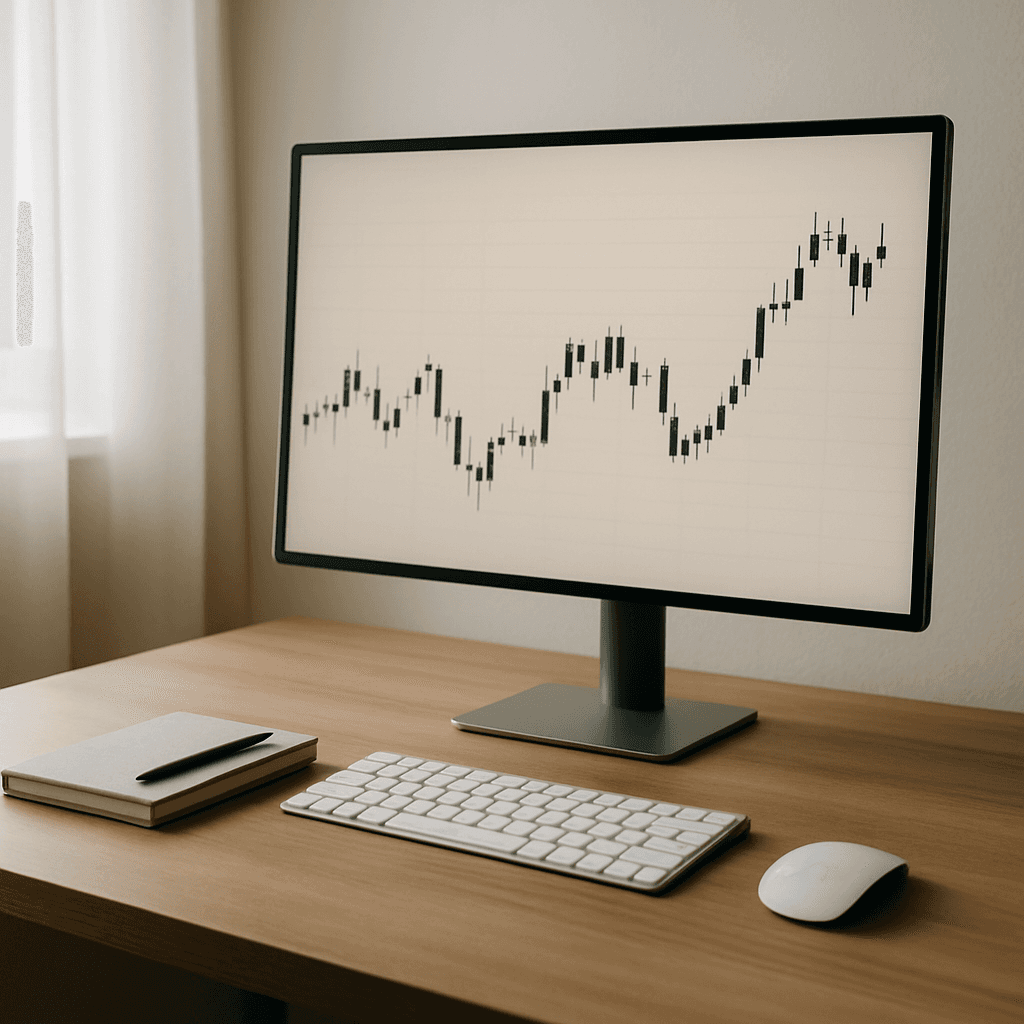
Why fewer screens can mean better trades
Traders often assume more screens equal more insight. The evidence from cognitive psychology suggests otherwise. Working memory is limited and attention is easily fragmented by competing visual inputs. Research on perceptual load shows that clutter increases distraction and error rates. Decision science points to Hick's law, where more choices slow reactions and encourage second-guessing. In market terms, too many panes and indicators nudge the mind toward impulsive actions that feel informed but are frequently noise-chasing.
Minimalism is not deprivation. It is a deliberate reduction of irrelevant stimuli so that relevant cues stand out. "One chart, one plan, one action" is a practical constraint that reduces cognitive load, stabilizes emotions, and improves execution quality. It narrows attention to a single decision loop: perceive the setup, commit to the plan, carry out the next action.
The one-chart principle
A single execution chart anchors attention. It prevents rapid context switching between symbols and timeframes that taxes working memory. Choosing the execution timeframe depends on the strategy, but the rule remains: one primary view for the trade. Higher-timeframe context does not require additional windows. Summarize it as a concise pre-trade note instead of a second chart. For example, a futures trader might keep a 1-minute execution chart while noting "bias long above 4800 based on 1-hour structure" in the plan field rather than opening a second pane.
Visual hygiene matters. Remove indicators that do not directly affect decisions. A small set that encodes the plan is enough. Common choices include a moving average for trend context or an anchored VWAP for location, but they should exist only if they drive entry, risk, or exit. Avoid overlapping colors and dense studies that obscure price. Prefer a neutral background, clear candle bodies, and a minimal color palette that reduces arousal and makes anomalies obvious.
Minimalism supports emotion regulation in subtle ways. Fewer flashing elements reduce physiological arousal, making it easier to regulate breath and keep attention steady. The calmer the visual field, the easier it is to apply routines that lower impulsivity, like brief pauses before clicking.
The one-plan constraint
Most trading mistakes stem from ambiguous intent. A concise plan renders ambiguity visible before money is at risk. Formulating a plan in a single sentence imposes clarity: If X occurs at level Y with risk Z, then enter and manage using rule A. This format turns the idea into an implementation intention, a technique shown to improve follow-through by linking cues to concrete actions.
Keep the plan directly on the screen, not in a separate document. A small plan pane or sticky note next to the chart is sufficient. The plan should be no longer than a tweet and should include entry trigger, invalidation, and position size. An equity swing trader might write: If price retests 50-day MA and holds on 15-minute close, buy; stop below last swing low; target prior high; size 0.5 R. The goal is not literary elegance but operational clarity.
Clarity reduces regret. When the market moves and emotions surge, the written plan provides a reference point that is immune to the moment's volatility. This buffer against impulsivity matters because affective states bias risk perception. Plans that pre-commit risk and action reduce the chance that a spike in arousal will lead to an oversized or late entry.
The one-action rule
After entry, discretion often expands unintentionally: chasing partial exits, moving stops, adding out of plan. Restricting post-entry behavior to a single allowed action reduces churn and preserves expectancy. The one-action rule defines what happens next with precision. Examples include either hold until stop or target triggers, or move stop to break-even only after a defined milestone. The operative word is one. The rule removes the temptation to tinker.
Technology can lock the rule into place. Bracket orders create an OCO structure so that either the stop or target fills without additional input. A single hotkey to flatten positions serves as the emergency override. This is not automation for convenience but for discipline. The fewer in-flight decisions, the lower the error rate, and the less likely frustration will surface as reactive trading.
Display hygiene and focus cues
Environment drives behavior. On the screen, hide real-time PnL in currency terms and show it in R if a platform allows, which normalizes risk across trades and reduces loss aversion triggers. Remove chat boxes, social feeds, and news tickers during execution windows. Full-screen the chart. Keep the watchlist narrow or collapse it to a single symbol during active trades to prevent flicking between names.
Color and typography influence cognitive processing. High contrast supports quick recognition, while overly saturated palettes increase arousal. Choose two or three muted colors that encode function and avoid gradients and animations. Increase font size for price and reduce or hide labels that do not change decisions. The objective is legibility and calm, not entertainment.
Finally, create a "focus mode" routine: silence notifications, set the chart to a saved minimalist layout, and place the cursor where the trade will be managed. This anchors attention at the locus of decisions and reduces micro-delays when the trigger appears.
A simple pre-market routine
Minimalism gains its power from repetition. A short pre-market sequence aligns tools and mind. Load the one-chart layout, review the overnight or higher-timeframe context briefly, then translate it into a one-sentence bias note. Note the key level and the condition that would negate the idea. Prepare the one-sentence trade plan for the top setup. Breathe for 60 to 120 seconds, exhaling slowly to lower arousal and synchronize attention with the slower tempo of deliberate action.
Use a timer to enforce session boundaries. Many errors happen at the edges of attention when fatigue accumulates. Timeboxing scanning and execution preserves energy and keeps decisions within a consistent state. If multiple markets are involved, split the day into discrete blocks so only one symbol is on-screen during its block.
In-session micro-journaling
Reflection increases learning and reduces repeated errors. Micro-journaling adapts this to real time without breaking focus. Before entry, write the one-sentence plan in the journal field. After exit, add a single line about adherence: kept stop, followed target, broke rule. Attach a quick screenshot of the chart with the entry and exit marks. This produces a minimal yet rich dataset: the plan, the behavior, and the picture. Over time, patterns become unambiguous, and the journal resists the hindsight bias that tends to rewrite memory after strong wins or losses.
The tone should be clinical. Record what happened, not what should have happened. The market outcome is not the metric. The quality of decisions relative to the plan is. Techniques from performance psychology emphasize that process evaluations protect motivation and direct practice. This is especially important after losses when emotion runs high and narratives become seductive. The micro-journal keeps evaluation anchored to observable behaviors.
A three-metric post-trade scorecard
A compact scorecard makes improvement measurable without creating busywork. Score each trade from 0 to 2 on three items:
- One-Chart Adherence: stayed on the execution chart during setup and management.
- Plan Clarity: plan stated before entry and included trigger, invalidation, and size.
- Action Discipline: executed exactly one post-entry action as pre-defined.
Aggregate the scores weekly. A rising adherence rate typically precedes improvements in PnL because it tightens variance from behavioral errors. When scores slip, inspect the journal screenshots to locate the moment the rules were abandoned. The fix often lies not in analysis but in layout or routine adjustments that simplify the decision path.
Handling exceptions without breaking the frame
Not every context fits a strict single-instrument day. Swing traders may scan several tickers pre-market and then shift into the one-chart execution mode for the chosen symbol. Index scalpers might need order book or volume profile data. These exceptions can be handled without breaking minimalism by treating secondary information as pre-trade context. Perform the analysis in a dedicated block, summarize it in the plan, and then close those windows before execution begins.
Training can include brief "two-chart" drills to compare outcomes, but the default returns to one. The objective is not ideological purity but lower cognitive load during the action phase. If a second pane does not alter a decision rule, it likely belongs in preparation, not execution.
Measuring the impact of minimalist screens
Look for changes in behavioral and execution metrics rather than immediate PnL. Track the average time from signal to click, the number of clicks per trade, the frequency of rule deviations, and slippage relative to stop distance. Many traders observe fewer premature exits and fewer mid-trade adjustments when the screen quiets. The relationship is consistent with findings that simpler environments reduce decision latency variability and emotional reactivity.
Consider subjective measures as well. Rate perceived calm and focus on a 1 to 5 scale after sessions. Pair those ratings with the adherence scores to see whether calmer days coincide with better rule following. Over several weeks, the data will show whether the minimalist approach is improving decision quality.
Friday reset: a weekly rhythm for clean screens
Friday is a natural pivot in markets and in routines. Use the close to reset the workspace for next week. Archive the week's screenshots in a dated folder, review the top three and worst three trades by adherence, and remove any widgets or watchlist clutter that crept in. Set the platform to open on Monday with the minimalist layout, one default symbol, and an empty news panel. Write a short paragraph in the journal about how the one-chart, one-plan, one-action frame affected behavior this week, and name one small tweak to test next week. This weekly cadence prevents slow drift toward complexity.
Practical examples
A futures scalper selects the 1-minute chart for execution, defines a plan that triggers only on a retest of a pre-marked level with a single stop and target, and uses a bracket order with a hotkey. During entry, the watchlist is collapsed. After the trade, a one-line note records whether the plan was followed. The trader notices fewer impulse cancels and less slippage as the layout stays quiet.
An equity swing trader prepares before the open by scanning, then chooses one ticker for active attention. The execution chart is set to 15 minutes with one moving average for context. The plan states the trigger, invalidation under a prior swing, and fixed size. Social feeds remain closed during execution blocks. The post-trade scorecard reports a high plan clarity score but a lower action discipline score, highlighting a tendency to take partial profits early. The fix is a tightened one-action rule for next week.
A crypto trader who previously kept six charts open reduces to one, sets alerts for secondary markets, and routes all notifications to a summary panel so only the chosen symbol remains visible. The change reduces the urge to chase moves elsewhere and increases time in trade according to plan.
Bringing it together
One chart, one plan, one action is a behavioral scaffold. It limits the number of visual and cognitive objects competing for attention, which reduces impulsivity and stabilizes execution. The technique blends environment design with pre-commitment and reflection. Its strength lies in how each component supports the others: the chart focuses perception, the plan focuses intention, and the action rule focuses behavior. Across time, the feedback from micro-journaling and scorecards strengthens the loop.
The market will always offer more information than attention can process. Minimalist screen design accepts this constraint and turns it into an advantage. By choosing what to ignore, the trader chooses how to behave. The result is not only cleaner charts but cleaner decisions.
James Strickland
Founder of Headge | 15+ years trading experience
James created Headge to help traders develop the mental edge that strategy alone can't provide. Learn more about Headge.
Ready to build your mental edge?
Meditation and mindfulness techniques designed specifically for traders. Build the discipline and emotional resilience you need to perform at your best.
