
Caffeine and Trading Decisions: Arousal, Risk, and Consistency
How caffeine and other stimulants shape arousal, attention, and risk in trading, with evidence-based routines for dose, timing, and journal-driven control.

Headge Team
Product Development
Why stimulants matter on the desk
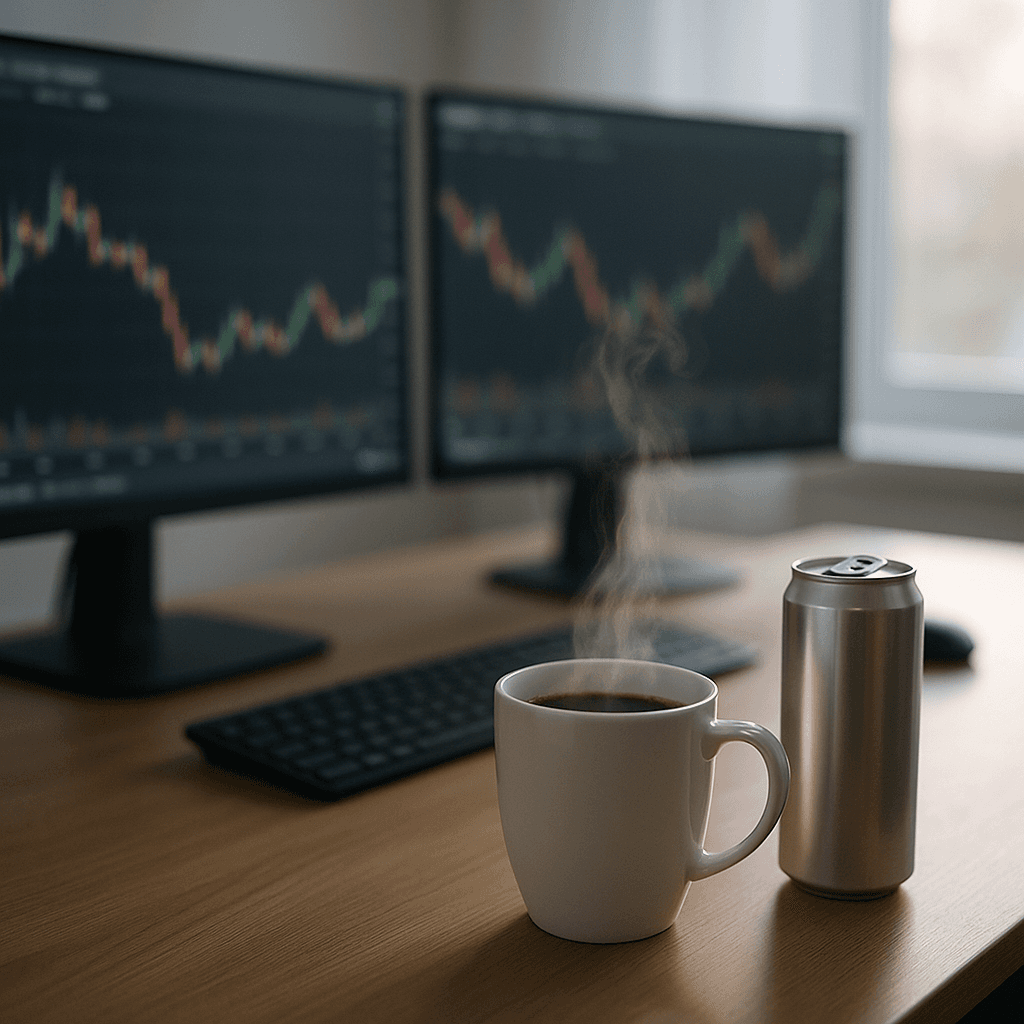
Caffeine and related stimulants are embedded in trading culture because they reliably increase alertness and reaction speed. The same properties can also distort risk perception and narrow attention when arousal runs too high. The practical question is not whether to use caffeine, but how to use it so that execution quality, risk control, and consistency improve rather than degrade.
What caffeine changes in the brain
Caffeine blocks adenosine receptors, reducing sleep pressure and increasing the availability of dopamine and norepinephrine in circuits that govern vigilance and task engagement. Acute effects include faster reaction time, improved sustained attention, and reduced perceived effort during monotonous monitoring. Meta-analyses in psychopharmacology find that these benefits are clearest when baseline arousal is low, such as early morning, after poor sleep, or during prolonged vigilance tasks.
The same literature reports costs at higher doses or when baseline arousal is already elevated. These costs include jitter, reduced fine motor control, stronger speed over accuracy tendencies, and greater confidence in early judgments. Half-life averages 4 to 6 hours but varies widely with genetics, liver enzyme activity, and hormonal status. Tolerance develops with daily use, and withdrawal can produce headaches, lethargy, and performance variability that traders sometimes try to mask by taking more, which can entrench a volatile arousal pattern.
The arousal curve and the open
Performance often follows an inverted U-shaped relation with arousal. For discretionary trading, the left side of the curve shows slow reactions and mind wandering. The right side shows impulsive entries, premature exits, and overtrading. Market open, news events, and drawdowns naturally push arousal upward. Added caffeine in those windows can push the system past the peak into error-prone territory. The tendency to act quickly becomes stronger than the capacity to inhibit and verify.
A simple way to test position on the curve is to track resting sensations before placing risk: breathing pace, hand steadiness, and the subjective urge to act. Research on speed accuracy tradeoffs suggests that a pre-trade pause that restores a deliberate tempo often rescues accuracy without significant latency cost.
Risk preferences under stimulants
Behavioral work on stress and decision making shows a shift toward heuristics under time pressure. Stimulants can amplify approach behavior and reduce loss sensitivity in the short term, especially when arousal is already high. In practice this shows up as adding size to losing positions, chasing breakouts after a near miss, or moving stops to avoid the discomfort of being wrong. The mechanism is not simply impulsivity. Heightened arousal narrows the evaluation window so that near-field cues like the most recent candle dominate over base rates or plan-level context.
These shifts are subtle and state dependent. The same dose that improves premarket scanning might degrade judgment during a fast reversal. A stable routine needs to respect context, not just total milligrams.
Attention control and noise
Caffeine improves vigilance during quiet periods but can narrow attentional breadth, which is useful for a single instrument and hazardous when juggling multiple correlated products. Traders sometimes report tunnel vision, where the most salient chart consumes all resources and cross-confirmation is neglected. Microtremor also increases with higher doses, which raises the rate of small order-entry errors. The remedy is to regulate both dose and cognitive load. Fewer watchlist items after large doses, and more deliberate cross-checks before transmitting orders, keep attention aligned with the plan.
Sleep, timing, and the next session
Sleep research consistently shows that caffeine taken 6 hours before bed can still reduce sleep duration and quality. Poor sleep then reduces prefrontal control, increases emotional reactivity, and raises next-day caffeine demand. The cycle erodes risk discipline over time. A time-of-day rule helps: load modestly early, taper by early afternoon, and protect sleep so that the next session begins near the optimal arousal midpoint rather than on the recovery edge.
Thursday tip: consider a small taper today to protect tonight’s sleep so that Friday decisions are made with a full cognitive tank. Shifting the largest dose earlier and trimming late-day use often pays off in Friday execution quality.
Build a caffeine budget
Set an intentional dose range based on body mass, sensitivity, and session demands. General performance research suggests that low to moderate dosing is sufficient for vigilance without incurring strong side effects for most healthy adults. Many traders find that an initial small dose before premarket work, followed by a smaller top-up near the first lull, stabilizes attention without overshooting during volatile periods. Avoid stacking different stimulants in quick succession. Food, hydration, and light physical movement increase alertness with fewer tradeoffs and reduce the need for additional milligrams.
Just as risk is sized relative to volatility, caffeine can be sized relative to market conditions and personal state. Quiet, monotonous markets may justify a slightly higher vigilance target. On high-volatility days, make the minimum effective dose the default.
The stimulant log inside your journal
Decision quality improves when stimulant use is visible in the journal. Add a column to capture dose, timing, form, baseline state, and outcomes. Recording a few concrete behaviors gives the clearest signal: stop moves, early exits, entry haste, and order-entry errors. Over several weeks, patterns often emerge, such as increased chasing within 45 minutes of a high dose or more precise execution after a smaller, earlier dose.
A simple within-person analysis is enough. Compare win rate, average adverse excursion, and rule deviations on low-dose versus high-dose days. The goal is not abstinence. The goal is calibration, so that stimulant use supports the playbook rather than writing it.
Pre-trade protocol to moderate arousal
A brief protocol aligns stimulant effects with decision quality. Sit for two minutes with eyes on a single chart and breathe at a slower, steady pace. Run one pass of the plan checklist. If the urge to act feels urgent, wait one more minute before placing risk. This puts a brake on the speed bias that caffeine can amplify and re-centers attention on the process rather than the recent tick sequence.
Heart rate or perceived arousal can be used as guardrails. Some traders use a simple 1 to 5 state rating before orders. If the rating is high, reduce size or skip the first impulsive idea. Physiological tools like heart rate variability can help advanced users, but a simple subjective scale often suffices when applied consistently.
Three guardrails for consistency
- No new discretionary positions for 20 minutes after a large dose. Use the window for analysis and order staging.
- Caffeine cutoff at least 8 hours before planned sleep to protect the next session.
- If state rating is elevated, reduce size by half or trade only preplanned setups with limit orders.
Post-trade review questions
During the end-of-day review, add two questions. Did stimulant timing align with the trading plan stages of scan, execute, and manage? Where did speed gain override accuracy? Tie answers to specific examples, such as a chased entry after an energy drink or a clean execution after a smaller, earlier coffee. Over time, the journal will reveal a personal dose-response curve that is far more actionable than general rules.
Putting it together
Caffeine can be an asset for vigilance and sustained analysis when it is dosed modestly, timed early, and paired with pre-trade pacing. It becomes a liability when stacked during already high-arousal windows, especially around the open or after losses, and when it damages sleep. Treat stimulant use like position sizing. Define boundaries, measure outcomes, and adjust based on observed effects. The payoff is not only steadier attention but also greater consistency in how plans become trades.
James Strickland
Founder of Headge | 15+ years trading experience
James created Headge to help traders develop the mental edge that strategy alone can't provide. Learn more about Headge.
Ready to build your mental edge?
Meditation and mindfulness techniques designed specifically for traders. Build the discipline and emotional resilience you need to perform at your best.
